





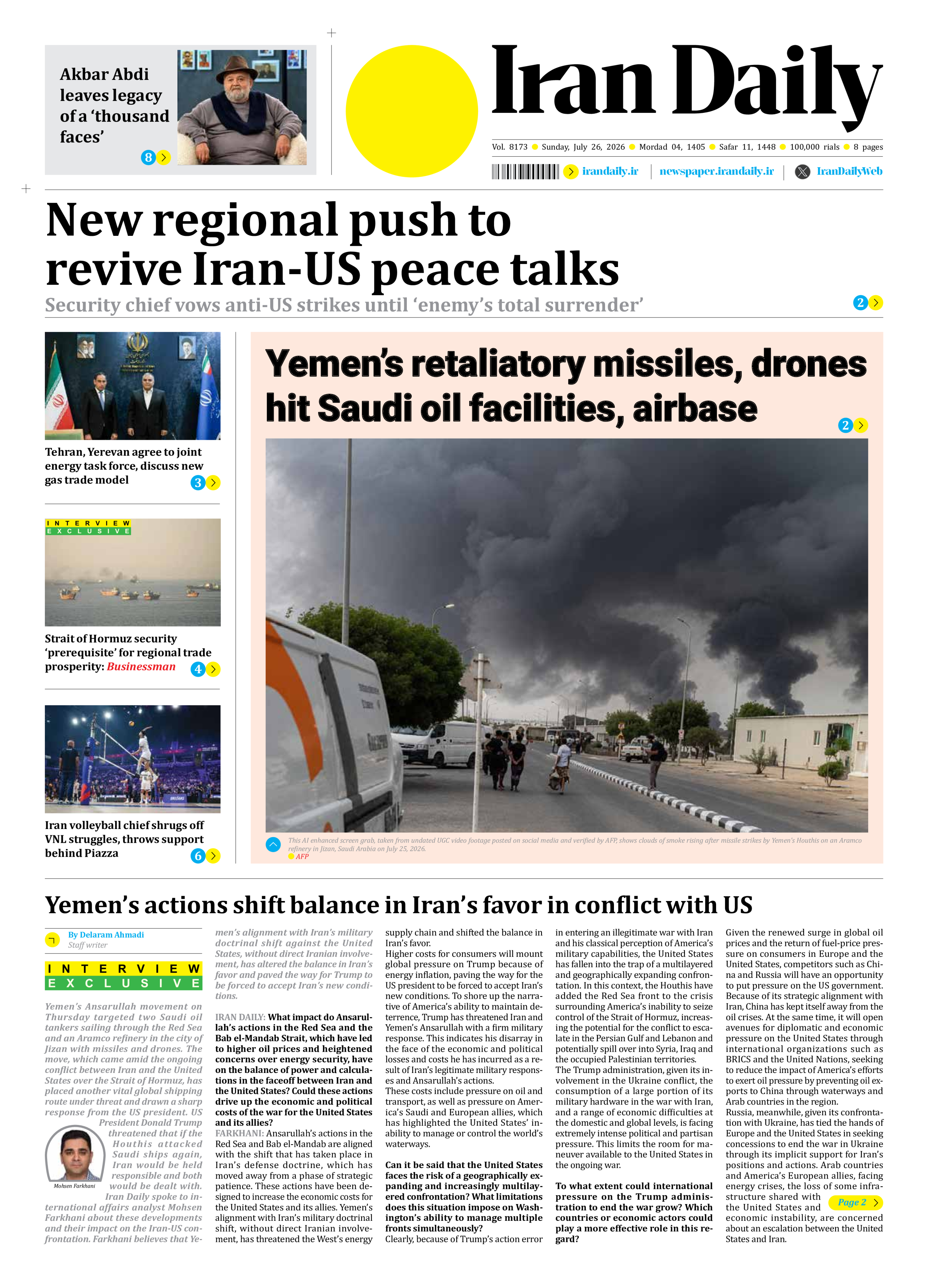


Yemen’s actions shift balance in Iran’s favor in conflict with US
By Delaram Ahmadi
Staff writer
Yemen’s Ansarullah movement on Thursday targeted two Saudi oil tankers sailing through the Red Sea and an Aramco refinery in the city of Jizan with missiles and drones. The move, which came amid the ongoing conflict between Iran and the United States over the Strait of Hormuz, has placed another vital global shipping route under threat and drawn a sharp response from the US president. US President Donald Trump threatened that if the Houthis attacked Saudi ships again, Iran would be held responsible and both would be dealt with. Iran Daily spoke to international affairs analyst Mohsen Farkhani about these developments and their impact on the Iran-US confrontation. Farkhani believes that Yemen’s alignment with Iran’s military doctrinal shift against the United States, without direct Iranian involvement, has altered the balance in Iran’s favor and paved the way for Trump to be forced to accept Iran’s new conditions.
IRAN DAILY: What impact do Ansarullah’s actions in the Red Sea and the Bab el-Mandab Strait, which have led to higher oil prices and heightened concerns over energy security, have on the balance of power and calculations in the faceoff between Iran and the United States? Could these actions drive up the economic and political costs of the war for the United States and its allies?
Farkhani: Ansarullah’s actions in the Red Sea and Bab el-Mandab are aligned with the shift that has taken place in Iran’s defense doctrine, which has moved away from a phase of strategic patience. These actions have been designed to increase the economic costs for the United States and its allies. Yemen’s alignment with Iran’s military doctrinal shift, without direct Iranian involvement, has threatened the West’s energy supply chain and shifted the balance in Iran’s favor.
Higher costs for consumers will mount global pressure on Trump because of energy inflation, paving the way for the US president to be forced to accept Iran’s new conditions. To shore up the narrative of America’s ability to maintain deterrence, Trump has threatened Iran and Yemen’s Ansarullah with a firm military response. This indicates his disarray in the face of the economic and political losses and costs he has incurred as a result of Iran’s legitimate military responses and Ansarullah’s actions.
These costs include pressure on oil and transport, as well as pressure on America’s Saudi and European allies, which has highlighted the United States’ inability to manage or control the world’s waterways.
Can it be said that the United States faces the risk of a geographically expanding and increasingly multilayered confrontation? What limitations does this situation impose on Washington’s ability to manage multiple fronts simultaneously?
Clearly, because of Trump’s action error in entering an illegitimate war with Iran and his classical perception of America’s military capabilities, the United States has fallen into the trap of a multilayered and geographically expanding confrontation. In this context, the Houthis have added the Red Sea front to the crisis surrounding America’s inability to seize control of the Strait of Hormuz, increasing the potential for the conflict to escalate in the Persian Gulf and Lebanon and potentially spill over into Syria, Iraq and the occupied Palestinian territories.
The Trump administration, given its involvement in the Ukraine conflict, the consumption of a large portion of its military hardware in the war with Iran, and a range of economic difficulties at the domestic and global levels, is facing extremely intense political and partisan pressure. This limits the room for maneuver available to the United States in the ongoing war.
To what extent could international pressure on the Trump administration to end the war grow? Which countries or economic actors could play a more effective role in this regard?
Given the renewed surge in global oil prices and the return of fuel-price pressure on consumers in Europe and the United States, competitors such as China and Russia will have an opportunity to put pressure on the US government. Because of its strategic alignment with Iran, China has kept itself away from the oil crises. At the same time, it will open avenues for diplomatic and economic pressure on the United States through international organizations such as BRICS and the United Nations, seeking to reduce the impact of America’s efforts to exert oil pressure by preventing oil exports to China through waterways and Arab countries in the region.
Russia, meanwhile, given its confrontation with Ukraine, has tied the hands of Europe and the United States in seeking concessions to end the war in Ukraine through its implicit support for Iran’s positions and actions. Arab countries and America’s European allies, facing energy crises, the loss of some infrastructure shared with the United States and economic instability, are concerned about an escalation between the United States and Iran.
Page 2