







Celebrities, concerts, and football
What transformation did American culture make in FIFA World Cup?
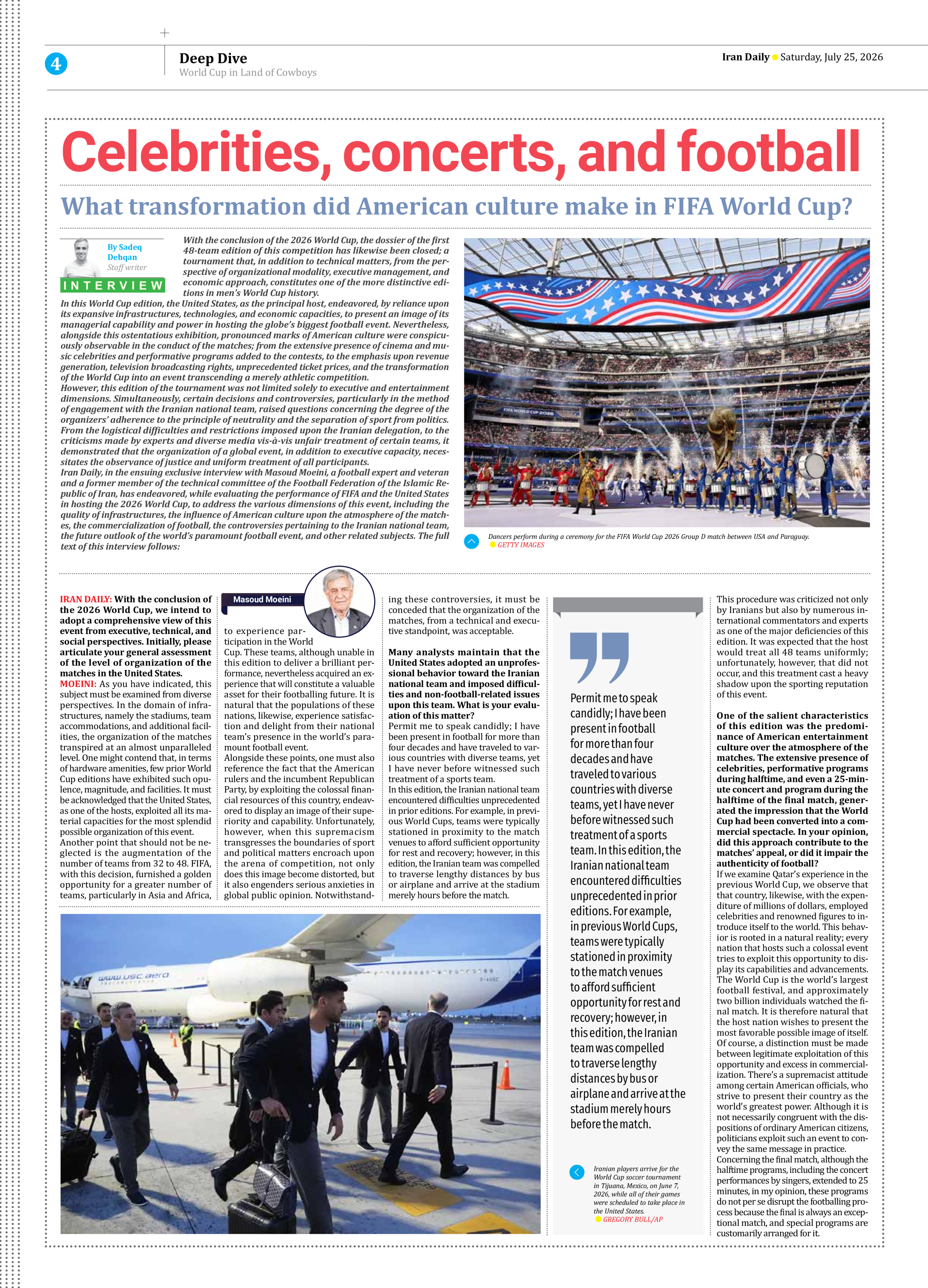
With the conclusion of the 2026 World Cup, the dossier of the first 48-team edition of this competition has likewise been closed; a tournament that, in addition to technical matters, from the perspective of organizational modality, executive management, and economic approach, constitutes one of the more distinctive editions in men’s World Cup history. In this World Cup edition, the United States, as the principal host, endeavored, by reliance upon its expansive infrastructures, technologies, and economic capacities, to present an image of its managerial capability and power in hosting the globe’s biggest football event. Nevertheless, alongside this ostentatious exhibition, pronounced marks of American culture were conspicuously observable in the conduct of the matches; from the extensive presence of cinema and music celebrities and performative programs added to the contests, to the emphasis upon revenue generation, television broadcasting rights, unprecedented ticket prices, and the transformation of the World Cup into an event transcending a merely athletic competition. However, this edition of the tournament was not limited solely to executive and entertainment dimensions. Simultaneously, certain decisions and controversies, particularly in the method of engagement with the Iranian national team, raised questions concerning the degree of the organizers’ adherence to the principle of neutrality and the separation of sport from politics. From the logistical difficulties and restrictions imposed upon the Iranian delegation, to the criticisms made by experts and diverse media vis-à-vis unfair treatment of certain teams, it demonstrated that the organization of a global event, in addition to executive capacity, necessitates the observance of justice and uniform treatment of all participants. Iran Daily, in the ensuing exclusive interview with Masoud Moeini, a football expert and veteran and a former member of the technical committee of the Football Federation of the Islamic Republic of Iran, has endeavored, while evaluating the performance of FIFA and the United States in hosting the 2026 World Cup, to address the various dimensions of this event, including the quality of infrastructures, the influence of American culture upon the atmosphere of the matches, the commercialization of football, the controversies pertaining to the Iranian national team, the future outlook of the world’s paramount football event, and other related subjects. The full text of this interview follows:
By Sadeq
Dehqan
Staff writer
IRAN DAILY: With the conclusion of the 2026 World Cup, we intend to adopt a comprehensive view of this event from executive, technical, and social perspectives. Initially, please articulate your general assessment of the level of organization of the matches in the United States.
MOEINI: As you have indicated, this subject must be examined from diverse perspectives. In the domain of infrastructures, namely the stadiums, team accommodations, and additional facilities, the organization of the matches transpired at an almost unparalleled level. One might contend that, in terms of hardware amenities, few prior World Cup editions have exhibited such opulence, magnitude, and facilities. It must be acknowledged that the United States, as one of the hosts, exploited all its material capacities for the most splendid possible organization of this event.
Another point that should not be neglected is the augmentation of the number of teams from 32 to 48. FIFA, with this decision, furnished a golden opportunity for a greater number of teams, particularly in Asia and Africa, to experience participation in the World Cup. These teams, although unable in this edition to deliver a brilliant performance, nevertheless acquired an experience that will constitute a valuable asset for their footballing future. It is natural that the populations of these nations, likewise, experience satisfaction and delight from their national team’s presence in the world’s paramount football event.
Alongside these points, one must also reference the fact that the American rulers and the incumbent Republican Party, by exploiting the colossal financial resources of this country, endeavored to display an image of their superiority and capability. Unfortunately, however, when this supremacism transgresses the boundaries of sport and political matters encroach upon the arena of competition, not only does this image become distorted, but it also engenders serious anxieties in global public opinion. Notwithstanding these controversies, it must be conceded that the organization of the matches, from a technical and executive standpoint, was acceptable.
Many analysts maintain that the United States adopted an unprofessional behavior toward the Iranian national team and imposed difficulties and non-football-related issues upon this team. What is your evaluation of this matter?
Permit me to speak candidly; I have been present in football for more than four decades and have traveled to various countries with diverse teams, yet I have never before witnessed such treatment of a sports team.
In this edition, the Iranian national team encountered difficulties unprecedented in prior editions. For example, in previous World Cups, teams were typically stationed in proximity to the match venues to afford sufficient opportunity for rest and recovery; however, in this edition, the Iranian team was compelled to traverse lengthy distances by bus or airplane and arrive at the stadium merely hours before the match.
This procedure was criticized not only by Iranians but also by numerous international commentators and experts as one of the major deficiencies of this edition. It was expected that the host would treat all 48 teams uniformly; unfortunately, however, that did not occur, and this treatment cast a heavy shadow upon the sporting reputation of this event.
One of the salient characteristics of this edition was the predominance of American entertainment culture over the atmosphere of the matches. The extensive presence of celebrities, performative programs during halftime, and even a 25-minute concert and program during the halftime of the final match, generated the impression that the World Cup had been converted into a commercial spectacle. In your opinion, did this approach contribute to the matches’ appeal, or did it impair the authenticity of football?
If we examine Qatar’s experience in the previous World Cup, we observe that that country, likewise, with the expenditure of millions of dollars, employed celebrities and renowned figures to introduce itself to the world. This behavior is rooted in a natural reality; every nation that hosts such a colossal event tries to exploit this opportunity to display its capabilities and advancements. The World Cup is the world’s largest football festival, and approximately two billion individuals watched the final match. It is therefore natural that the host nation wishes to present the most favorable possible image of itself.
Of course, a distinction must be made between legitimate exploitation of this opportunity and excess in commercialization. There’s a supremacist attitude among certain American officials, who strive to present their country as the world’s greatest power. Although it is not necessarily congruent with the dispositions of ordinary American citizens, politicians exploit such an event to convey the same message in practice.
Concerning the final match, although the halftime programs, including the concert performances by singers, extended to 25 minutes, in my opinion, these programs do not per se disrupt the footballing process because the final is always an exceptional match, and special programs are customarily arranged for it.
From a technical perspective, how do you evaluate the final match? Many experts maintain that Spain smartly neutralized Argentina and was deserving of the championship.
The final match is a contest in which no team is willing to suffer defeat. For this reason, both teams, above all, endeavor not to concede a goal and then devise their strategy for victory. An interesting point about this edition was the low risk-taking propensity of teams in the first half because any goal conceded in the first half compels the team in the second half to assume greater risk and alter its playing style.
Regarding the final, however, Spain demonstrated itself to be an extremely powerful, technically proficient team with exceedingly high tactical intelligence. Messi’s role in Argentina’s preceding matches, as a coordinator and creative manager, was highly pronounced, and the other players exhibited substantial dependence upon him. Spain, with meticulous planning, neutralized this strength.
Throughout the match, wherever Messi was present, at least three Spanish players encircled him and prevented him from receiving the ball. Statistics, likewise, corroborate this point, and Argentina did not manage a single shot on target throughout the 90 minutes of regulation time.
Spain, with this strategy, effectively removed Messi from the flow of the game in both halves and succeeded in scoring during extra time; a goal that proved exceedingly difficult for Argentina to compensate. In my opinion, Argentina’s weakest performance in this entire World Cup occurred precisely in the final match.
The scheduling of certain matches around noon, including at 11:30 AM, generated numerous questions among audiences. On what basis was this decision made, and to what extent did it affect the quality of the matches?
This decision was adopted by FIFA. FIFA’s primary objective was the maximization of revenue from the sale of television broadcasting rights. Given the considerable time difference between the United States and other continents, including approximately a 10-hour difference with Iran, FIFA endeavored to schedule matches at hours when the maximum number of viewers in Asia, Africa, and Europe could watch them live.
Although this timing was not ideal for the players, the teams were informed of the match timing at least one week in advance and possessed sufficient opportunity to adapt to the conditions. Fortunately, the temperature inside the stadiums was controlled, and the principal challenge remained the players’ adaptation to their biological clocks, the management of which was the responsibility of the technical staffs.
The exceedingly high ticket prices in this edition, especially in the final match, and likewise the emptiness of certain seats, engendered the concern that football has become a sport for the rich and that World Cup attendance has become inaccessible to the general public. What is your opinion?
Stadiums possess various sections with disparate prices. Ticket prices in the World Cup commenced at approximately $100 to $500 and extended to exceedingly high figures, and as you indicated, it was reported in the news that tickets were sold for prices around $81,000. I myself witnessed at the Australian Open tennis tournament that tickets for certain matches, particularly the match in which Rafael Nadal participated, were sold for as much as $15,000. On the other hand, certain spectators, likewise, procure their tickets from the black market and are willing to pay extraordinarily large sums.
Nevertheless, it should not be forgotten that, among the more than 80,000 spectators present at the final, the number of those capable of paying such costs is limited. The vacant seats, likewise, were predominantly situated in the more remote sections of the stadium, and certain individuals, due to the high costs, abstained from attending the stadium.
In principle, football should remain a popular sport, and FIFA should adopt measures to enable lower-income groups, likewise, to benefit from these events. However, FIFA’s priority is revenue generation, and the augmentation of the number of teams to 48 constitutes one of its strategies for attracting new audiences and increasing substantial revenues.
The “Cooling Break” intervals, or hydration breaks, were implemented during the World Cup matches. What effect did these intervals have upon the flow of the games?
FIFA, prior to the commencement of the matches, announced that, due to intense heat, 3-minute breaks would be scheduled around the 25th minute of the first half and the 65th minute of the second half.
Although this duration is brief, it may disrupt the momentum of a team that has dominated the flow of the game, removing it from the peak of its attacks, and conversely, may afford the opposing team an opportunity to alter the rhythm of the game and regain composure.
FIFA typically tests such schemes initially in junior categories and, upon success, extends them to higher-level competitions. Given global warming, which is perceptible today in many parts of the world, including Europe and even Tehran, the implementation of this program in the American heat appeared necessary. Of course, FIFA should carefully examine the feedback from this idea in future tournaments and implement necessary modifications if required.
The video assistant referee (VAR) system played a highly pronounced role in this edition and even altered certain results. Has this technology contributed to justice, or has it diminished football’s excitement? What is your opinion, particularly concerning offside calls of a few centimeters that resulted in the disallowance of certain goals?
The VAR system typically intervenes in critical situations such as penalties, offsides, and on-field confrontations. For instance, I myself witnessed a scene where the referee initially did not award a penalty, but upon review of images from various angles, VAR demonstrated that a foul had occurred, and the referee correctly amended his decision. This demonstrates that VAR can play an effective role in the realization of justice.
Concerning offside, however, I believe that excessively meticulous scrutiny, even for a fingertip or a body part that has no effect on the flow of play, not only does not appear fair but also diminishes football’s appeal.
In the past, referees were advised that if they were doubtful about an offside, they should allow play to continue, to render football more fluid and high-scoring. Today, however, we witness that a legitimate goal is occasionally disallowed merely due to a few centimeters of offside in the upper body.
In my opinion, the principal criterion for offside determination should be the feet because the player’s balance and movement are grounded upon the feet, and other body parts do not play a determinative role in this matter. Furthermore, just as the complete crossing of the ball over the goal line serves as the criterion for goal-line decisions, a specific margin of tolerance could be established for offside as well, to prevent excessive strictness and preserve the beauty and excitement of football.
Of course, these are my personal perspectives, and I hope that FIFA will, in the future, undertake a serious reconsideration of the offside regulations. Nevertheless, VAR, despite all its controversies, is an efficient instrument for the establishment of justice and must be properly managed.
Concerning Mehdi Taremi’s disallowed goal, if the criterion for offside determination were the position of the feet, in your opinion would that goal have been accepted?
Without doubt, yes. In that scene, Taremi’s foot was not in an offside position, but his upper body was a few centimeters ahead of the opposing defender, and this very fact caused the goal’s disallowance, whereas, in my opinion, this cannot constitute a logical justification for disallowing the goal.
If the criterion were the position of the feet or even the head, which typically plays a direct role in the scoring of goals, this goal would have been readily accepted. I hope that overly strict regulations will gradually yield to more logical regulations, so that we may witness more fluid, more appealing, and more exciting football, and that this sport does not distance itself from its inherent appeal.