







Iran, Iraq sign four cooperation deals, including rail link MoU
Pezeshkian says stronger ties require swift implementation of accords
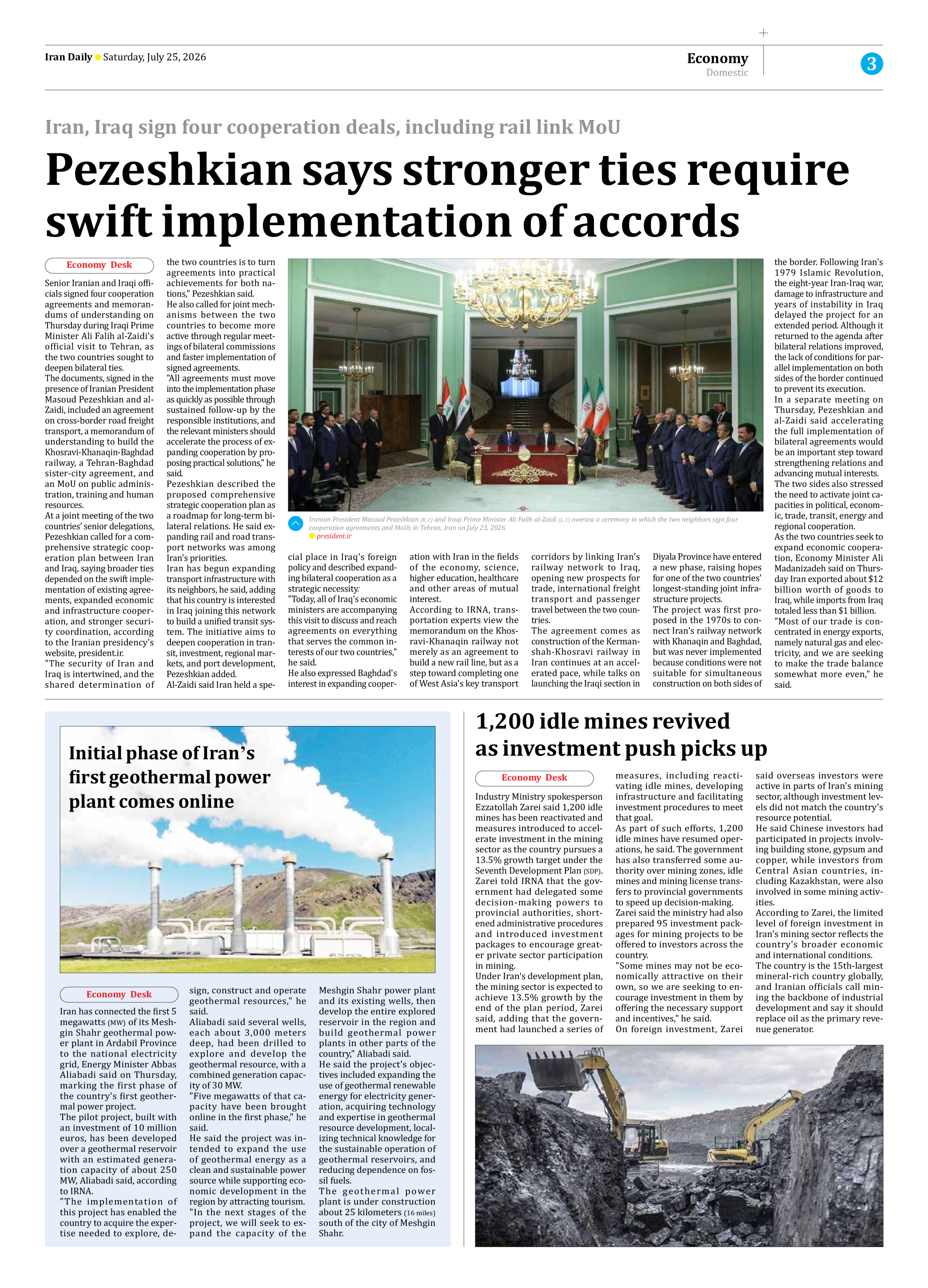
Senior Iranian and Iraqi officials signed four cooperation agreements and memorandums of understanding on Thursday during Iraqi Prime Minister Ali Falih al-Zaidi's official visit to Tehran, as the two countries sought to deepen bilateral ties.
The documents, signed in the presence of Iranian President Masoud Pezeshkian and al-Zaidi, included an agreement on cross-border road freight transport, a memorandum of understanding to build the Khosravi-Khanaqin-Baghdad railway, a Tehran-Baghdad sister-city agreement, and an MoU on public administration, training and human resources.
At a joint meeting of the two countries’ senior delegations, Pezeshkian called for a comprehensive strategic cooperation plan between Iran and Iraq, saying broader ties depended on the swift implementation of existing agreements, expanded economic and infrastructure cooperation, and stronger security coordination, according to the Iranian presidency's website, president.ir.
"The security of Iran and Iraq is intertwined, and the shared determination of the two countries is to turn agreements into practical achievements for both nations," Pezeshkian said.
He also called for joint mechanisms between the two countries to become more active through regular meetings of bilateral commissions and faster implementation of signed agreements.
"All agreements must move into the implementation phase as quickly as possible through sustained follow-up by the responsible institutions, and the relevant ministers should accelerate the process of expanding cooperation by proposing practical solutions," he said.
Pezeshkian described the proposed comprehensive strategic cooperation plan as a roadmap for long-term bilateral relations. He said expanding rail and road transport networks was among Iran's priorities.
Iran has begun expanding transport infrastructure with its neighbors, he said, adding that his country is interested in Iraq joining this network to build a unified transit system. The initiative aims to deepen cooperation in transit, investment, regional markets, and port development, Pezeshkian added.
Al-Zaidi said Iran held a special place in Iraq's foreign policy and described expanding bilateral cooperation as a strategic necessity.'
"Today, all of Iraq's economic ministers are accompanying this visit to discuss and reach agreements on everything that serves the common interests of our two countries," he said.
He also expressed Baghdad's interest in expanding cooperation with Iran in the fields of the economy, science, higher education, healthcare and other areas of mutual interest.
According to IRNA, transportation experts view the memorandum on the Khosravi-Khanaqin railway not merely as an agreement to build a new rail line, but as a step toward completing one of West Asia's key transport corridors by linking Iran's railway network to Iraq, opening new prospects for trade, international freight transport and passenger travel between the two countries.
The agreement comes as construction of the Kermanshah-Khosravi railway in Iran continues at an accelerated pace, while talks on launching the Iraqi section in Diyala Province have entered a new phase, raising hopes for one of the two countries' longest-standing joint infrastructure projects.
The project was first proposed in the 1970s to connect Iran's railway network with Khanaqin and Baghdad, but was never implemented because conditions were not suitable for simultaneous construction on both sides of the border. Following Iran's 1979 Islamic Revolution, the eight-year Iran-Iraq war, damage to infrastructure and years of instability in Iraq delayed the project for an extended period. Although it returned to the agenda after bilateral relations improved, the lack of conditions for parallel implementation on both sides of the border continued to prevent its execution.
In a separate meeting on Thursday, Pezeshkian and al-Zaidi said accelerating the full implementation of bilateral agreements would be an important step toward strengthening relations and advancing mutual interests.
The two sides also stressed the need to activate joint capacities in political, economic, trade, transit, energy and regional cooperation.
As the two countries seek to expand economic cooperation, Economy Minister Ali Madanizadeh said on Thursday Iran exported about $12 billion worth of goods to Iraq, while imports from Iraq totaled less than $1 billion.
"Most of our trade is concentrated in energy exports, namely natural gas and electricity, and we are seeking to make the trade balance somewhat more even," he said.