







Copy in clipboard...
Araghchi: Iran’s diplomacy met wit military action, not dialogue
Iran’s foreign minister said on Friday that Iran came under attack while it had chosen diplomacy to resolve disputes with the United States, noting that, “Response to diplomacy came not through negotiations but through military action.”
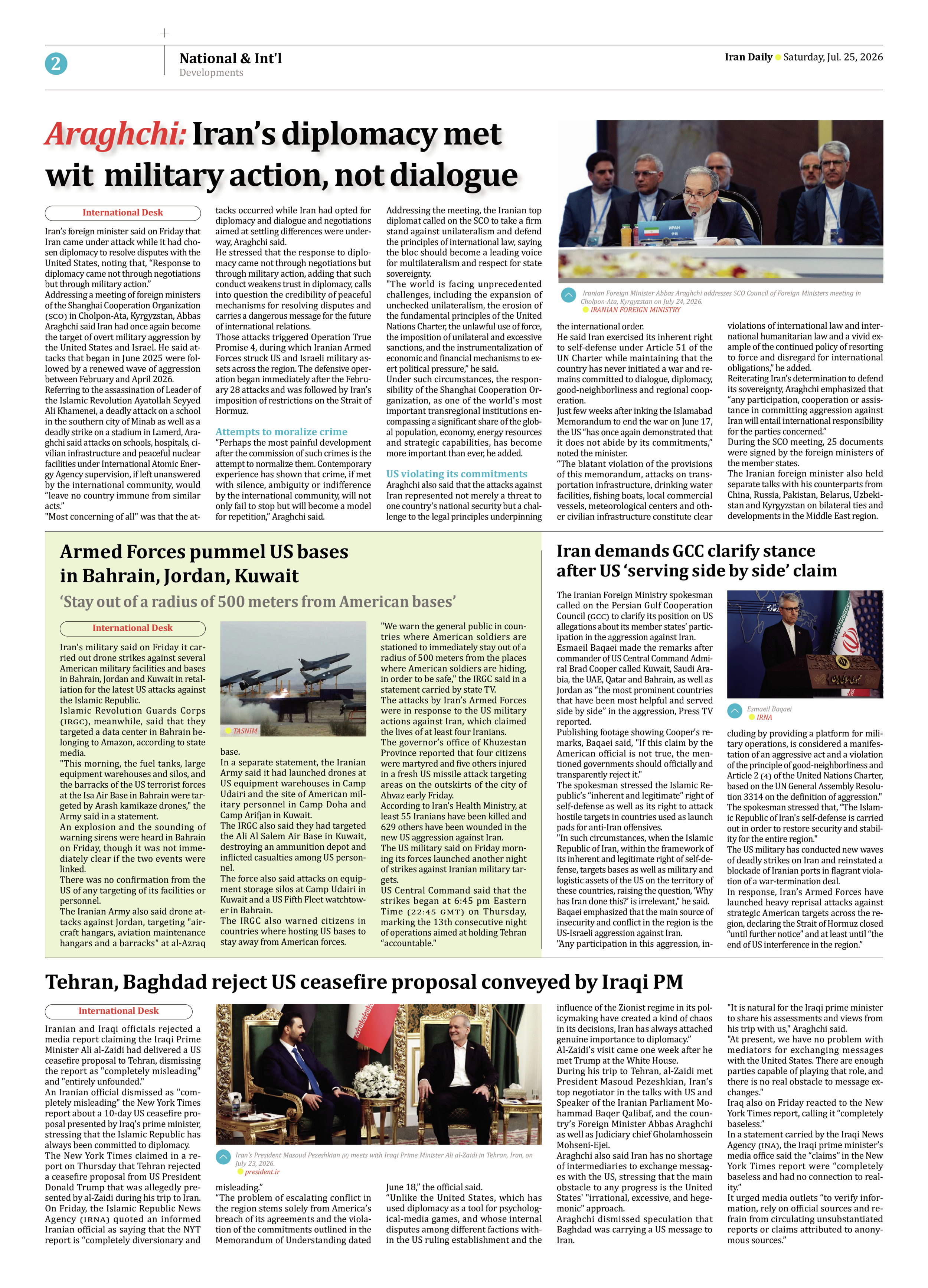
Addressing a meeting of foreign ministers of the Shanghai Cooperation Organization (SCO) in Cholpon-Ata, Kyrgyzstan, Abbas Araghchi said Iran had once again become the target of overt military aggression by the United States and Israel. He said attacks that began in June 2025 were followed by a renewed wave of aggression between February and April 2026.
Referring to the assassination of Leader of the Islamic Revolution Ayatollah Seyyed Ali Khamenei, a deadly attack on a school in the southern city of Minab as well as a deadly strike on a stadium in Lamerd, Araghchi said attacks on schools, hospitals, civilian infrastructure and peaceful nuclear facilities under International Atomic Energy Agency supervision, if left unanswered by the international community, would “leave no country immune from similar acts.”
"Most concerning of all" was that the attacks occurred while Iran had opted for diplomacy and dialogue and negotiations aimed at settling differences were underway, Araghchi said.
He stressed that the response to diplomacy came not through negotiations but through military action, adding that such conduct weakens trust in diplomacy, calls into question the credibility of peaceful mechanisms for resolving disputes and carries a dangerous message for the future of international relations.
Those attacks triggered Operation True Promise 4, during which Iranian Armed Forces struck US and Israeli military assets across the region. The defensive operation began immediately after the February 28 attacks and was followed by Iran’s imposition of restrictions on the Strait of Hormuz.
Attempts to moralize crime
“Perhaps the most painful development after the commission of such crimes is the attempt to normalize them. Contemporary experience has shown that crime, if met with silence, ambiguity or indifference by the international community, will not only fail to stop but will become a model for repetition,” Araghchi said.
Addressing the meeting, the Iranian top diplomat called on the SCO to take a firm stand against unilateralism and defend the principles of international law, saying the bloc should become a leading voice for multilateralism and respect for state sovereignty.
"The world is facing unprecedented challenges, including the expansion of unchecked unilateralism, the erosion of the fundamental principles of the United Nations Charter, the unlawful use of force, the imposition of unilateral and excessive sanctions, and the instrumentalization of economic and financial mechanisms to exert political pressure,” he said.
Under such circumstances, the responsibility of the Shanghai Cooperation Organization, as one of the world's most important transregional institutions encompassing a significant share of the global population, economy, energy resources and strategic capabilities, has become more important than ever, he added.
US violating its commitments
Araghchi also said that the attacks against Iran represented not merely a threat to one country's national security but a challenge to the legal principles underpinning the international order.
He said Iran exercised its inherent right to self-defense under Article 51 of the UN Charter while maintaining that the country has never initiated a war and remains committed to dialogue, diplomacy, good-neighborliness and regional cooperation.
Just few weeks after inking the Islamabad Memorandum to end the war on June 17, the US “has once again demonstrated that it does not abide by its commitments,” noted the minister.
“The blatant violation of the provisions of this memorandum, attacks on transportation infrastructure, drinking water facilities, fishing boats, local commercial vessels, meteorological centers and other civilian infrastructure constitute clear violations of international law and international humanitarian law and a vivid example of the continued policy of resorting to force and disregard for international obligations,” he added.
Reiterating Iran’s determination to defend its sovereignty, Araghchi emphasized that “any participation, cooperation or assistance in committing aggression against Iran will entail international responsibility for the parties concerned.”
During the SCO meeting, 25 documents were signed by the foreign ministers of the member states.
The Iranian foreign minister also held separate talks with his counterparts from China, Russia, Pakistan, Belarus, Uzbekistan and Kyrgyzstan on bilateral ties and developments in the Middle East region.