





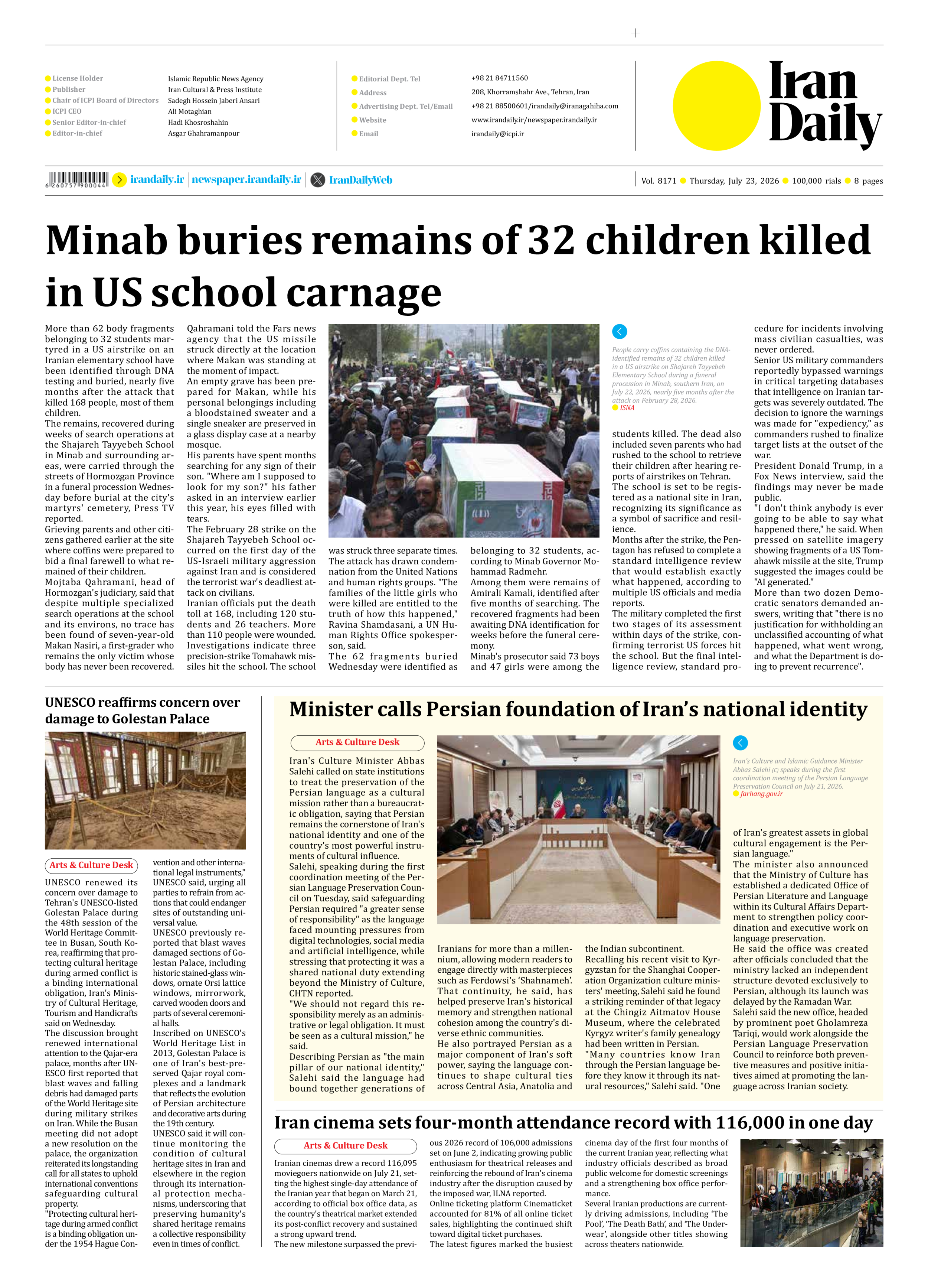


UNESCO reaffirms concern over damage to Golestan Palace
UNESCO renewed its concern over damage to Tehran's UNESCO-listed Golestan Palace during the 48th session of the World Heritage Committee in Busan, South Korea, reaffirming that protecting cultural heritage during armed conflict is a binding international obligation, Iran's Ministry of Cultural Heritage, Tourism and Handicrafts said on Wednesday.
The discussion brought renewed international attention to the Qajar-era palace, months after UNESCO first reported that blast waves and falling debris had damaged parts of the World Heritage site during military strikes on Iran. While the Busan meeting did not adopt a new resolution on the palace, the organization reiterated its longstanding call for all states to uphold international conventions safeguarding cultural property.
"Protecting cultural heritage during armed conflict is a binding obligation under the 1954 Hague Convention and other international legal instruments," UNESCO said, urging all parties to refrain from actions that could endanger sites of outstanding universal value.
UNESCO previously reported that blast waves damaged sections of Golestan Palace, including historic stained-glass windows, ornate Orsi lattice windows, mirrorwork, carved wooden doors and parts of several ceremonial halls.
Inscribed on UNESCO's World Heritage List in 2013, Golestan Palace is one of Iran's best-preserved Qajar royal complexes and a landmark that reflects the evolution of Persian architecture and decorative arts during the 19th century.
UNESCO said it will continue monitoring the condition of cultural heritage sites in Iran and elsewhere in the region through its international protection mechanisms, underscoring that preserving humanity's shared heritage remains a collective responsibility even in times of conflict.