





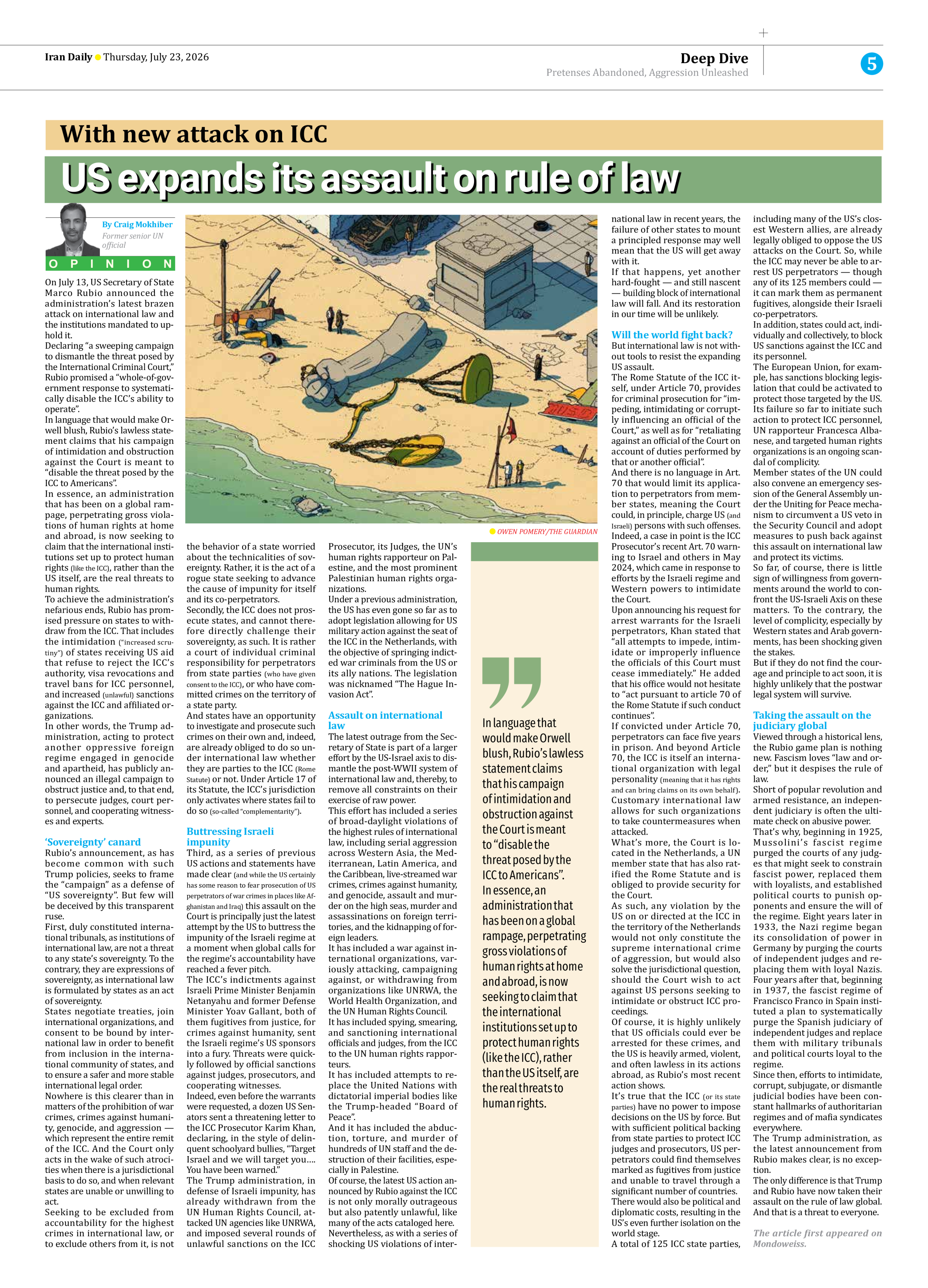


With new attack on ICC
US expands its assault on rule of law
By Craig Mokhiber
Former senior UN official
On July 13, US Secretary of State Marco Rubio announced the administration’s latest brazen attack on international law and the institutions mandated to uphold it.
Declaring “a sweeping campaign to dismantle the threat posed by the International Criminal Court,” Rubio promised a “whole-of-government response to systematically disable the ICC’s ability to operate”.
In language that would make Orwell blush, Rubio’s lawless statement claims that his campaign of intimidation and obstruction against the Court is meant to “disable the threat posed by the ICC to Americans”.
In essence, an administration that has been on a global rampage, perpetrating gross violations of human rights at home and abroad, is now seeking to claim that the international institutions set up to protect human rights (like the ICC), rather than the US itself, are the real threats to human rights.
To achieve the administration’s nefarious ends, Rubio has promised pressure on states to withdraw from the ICC. That includes the intimidation (“increased scrutiny”) of states receiving US aid that refuse to reject the ICC’s authority, visa revocations and travel bans for ICC personnel, and increased (unlawful) sanctions against the ICC and affiliated organizations.
In other words, the Trump administration, acting to protect another oppressive foreign regime engaged in genocide and apartheid, has publicly announced an illegal campaign to obstruct justice and, to that end, to persecute judges, court personnel, and cooperating witnesses and experts.
‘Sovereignty’ canard
Rubio’s announcement, as has become common with such Trump policies, seeks to frame the “campaign” as a defense of “US sovereignty”. But few will be deceived by this transparent ruse.
First, duly constituted international tribunals, as institutions of international law, are not a threat to any state’s sovereignty. To the contrary, they are expressions of sovereignty, as international law is formulated by states as an act of sovereignty.
States negotiate treaties, join international organizations, and consent to be bound by international law in order to benefit from inclusion in the international community of states, and to ensure a safer and more stable international legal order.
Nowhere is this clearer than in matters of the prohibition of war crimes, crimes against humanity, genocide, and aggression — which represent the entire remit of the ICC. And the Court only acts in the wake of such atrocities when there is a jurisdictional basis to do so, and when relevant states are unable or unwilling to act.
Seeking to be excluded from accountability for the highest crimes in international law, or to exclude others from it, is not the behavior of a state worried about the technicalities of sovereignty. Rather, it is the act of a rogue state seeking to advance the cause of impunity for itself and its co-perpetrators.
Secondly, the ICC does not prosecute states, and cannot therefore directly challenge their sovereignty, as such. It is rather a court of individual criminal responsibility for perpetrators from state parties (who have given consent to the ICC), or who have committed crimes on the territory of a state party.
And states have an opportunity to investigate and prosecute such crimes on their own and, indeed, are already obliged to do so under international law whether they are parties to the ICC (Rome Statute) or not. Under Article 17 of its Statute, the ICC’s jurisdiction only activates where states fail to do so (so-called “complementarity”).
Buttressing Israeli impunity
Third, as a series of previous US actions and statements have made clear (and while the US certainly has some reason to fear prosecution of US perpetrators of war crimes in places like Afghanistan and Iraq) this assault on the Court is principally just the latest attempt by the US to buttress the impunity of the Israeli regime at a moment when global calls for the regime’s accountability have reached a fever pitch.
The ICC’s indictments against Israeli Prime Minister Benjamin Netanyahu and former Defense Minister Yoav Gallant, both of them fugitives from justice, for crimes against humanity, sent the Israeli regime’s US sponsors into a fury. Threats were quickly followed by official sanctions against judges, prosecutors, and cooperating witnesses.
Indeed, even before the warrants were requested, a dozen US Senators sent a threatening letter to the ICC Prosecutor Karim Khan, declaring, in the style of delinquent schoolyard bullies, “Target Israel and we will target you….You have been warned.”
The Trump administration, in defense of Israeli impunity, has already withdrawn from the UN Human Rights Council, attacked UN agencies like UNRWA, and imposed several rounds of unlawful sanctions on the ICC Prosecutor, its Judges, the UN’s human rights rapporteur on Palestine, and the most prominent Palestinian human rights organizations.
Under a previous administration, the US has even gone so far as to adopt legislation allowing for US military action against the seat of the ICC in the Netherlands, with the objective of springing indicted war criminals from the US or its ally nations. The legislation was nicknamed “The Hague Invasion Act”.
Assault on international law
The latest outrage from the Secretary of State is part of a larger effort by the US-Israel axis to dismantle the post-WWII system of international law and, thereby, to remove all constraints on their exercise of raw power.
This effort has included a series of broad-daylight violations of the highest rules of international law, including serial aggression across Western Asia, the Mediterranean, Latin America, and the Caribbean, live-streamed war crimes, crimes against humanity, and genocide, assault and murder on the high seas, murder and assassinations on foreign territories, and the kidnapping of foreign leaders.
It has included a war against international organizations, variously attacking, campaigning against, or withdrawing from organizations like UNRWA, the World Health Organization, and the UN Human Rights Council.
It has included spying, smearing, and sanctioning international officials and judges, from the ICC to the UN human rights rapporteurs.
It has included attempts to replace the United Nations with dictatorial imperial bodies like the Trump-headed “Board of Peace”.
And it has included the abduction, torture, and murder of hundreds of UN staff and the destruction of their facilities, especially in Palestine.
Of course, the latest US action announced by Rubio against the ICC is not only morally outrageous but also patently unlawful, like many of the acts cataloged here.
Nevertheless, as with a series of shocking US violations of international law in recent years, the failure of other states to mount a principled response may well mean that the US will get away with it.
If that happens, yet another hard-fought — and still nascent — building block of international law will fall. And its restoration in our time will be unlikely.
Will the world fight back?
But international law is not without tools to resist the expanding US assault.
The Rome Statute of the ICC itself, under Article 70, provides for criminal prosecution for “impeding, intimidating or corruptly influencing an official of the Court,” as well as for “retaliating against an official of the Court on account of duties performed by that or another official”.
And there is no language in Art. 70 that would limit its application to perpetrators from member states, meaning the Court could, in principle, charge US (and Israeli) persons with such offenses.
Indeed, a case in point is the ICC Prosecutor’s recent Art. 70 warning to Israel and others in May 2024, which came in response to efforts by the Israeli regime and Western powers to intimidate the Court.
Upon announcing his request for arrest warrants for the Israeli perpetrators, Khan stated that “all attempts to impede, intimidate or improperly influence the officials of this Court must cease immediately.” He added that his office would not hesitate to “act pursuant to article 70 of the Rome Statute if such conduct continues”.
If convicted under Article 70, perpetrators can face five years in prison. And beyond Article 70, the ICC is itself an international organization with legal personality (meaning that it has rights and can bring claims on its own behalf). Customary international law allows for such organizations to take countermeasures when attacked.
What’s more, the Court is located in the Netherlands, a UN member state that has also ratified the Rome Statute and is obliged to provide security for the Court.
As such, any violation by the US on or directed at the ICC in the territory of the Netherlands would not only constitute the supreme international crime of aggression, but would also solve the jurisdictional question, should the Court wish to act against US persons seeking to intimidate or obstruct ICC proceedings.
Of course, it is highly unlikely that US officials could ever be arrested for these crimes, and the US is heavily armed, violent, and often lawless in its actions abroad, as Rubio’s most recent action shows.
It’s true that the ICC (or its state parties) have no power to impose decisions on the US by force. But with sufficient political backing from state parties to protect ICC judges and prosecutors, US perpetrators could find themselves marked as fugitives from justice and unable to travel through a significant number of countries.
There would also be political and diplomatic costs, resulting in the US’s even further isolation on the world stage.
A total of 125 ICC state parties, including many of the US’s closest Western allies, are already legally obliged to oppose the US attacks on the Court. So, while the ICC may never be able to arrest US perpetrators — though any of its 125 members could — it can mark them as permanent fugitives, alongside their Israeli co-perpetrators.
In addition, states could act, individually and collectively, to block US sanctions against the ICC and its personnel.
The European Union, for example, has sanctions blocking legislation that could be activated to protect those targeted by the US. Its failure so far to initiate such action to protect ICC personnel, UN rapporteur Francesca Albanese, and targeted human rights organizations is an ongoing scandal of complicity.
Member states of the UN could also convene an emergency session of the General Assembly under the Uniting for Peace mechanism to circumvent a US veto in the Security Council and adopt measures to push back against this assault on international law and protect its victims.
So far, of course, there is little sign of willingness from governments around the world to confront the US-Israeli Axis on these matters. To the contrary, the level of complicity, especially by Western states and Arab governments, has been shocking given the stakes.
But if they do not find the courage and principle to act soon, it is highly unlikely that the postwar legal system will survive.
Taking the assault on the judiciary global
Viewed through a historical lens, the Rubio game plan is nothing new. Fascism loves “law and order,” but it despises the rule of law.
Short of popular revolution and armed resistance, an independent judiciary is often the ultimate check on abusive power.
That’s why, beginning in 1925, Mussolini’s fascist regime purged the courts of any judges that might seek to constrain fascist power, replaced them with loyalists, and established political courts to punish opponents and ensure the will of the regime. Eight years later in 1933, the Nazi regime began its consolidation of power in Germany by purging the courts of independent judges and replacing them with loyal Nazis. Four years after that, beginning in 1937, the fascist regime of Francisco Franco in Spain instituted a plan to systematically purge the Spanish judiciary of independent judges and replace them with military tribunals and political courts loyal to the regime.
Since then, efforts to intimidate, corrupt, subjugate, or dismantle judicial bodies have been constant hallmarks of authoritarian regimes and of mafia syndicates everywhere.
The Trump administration, as the latest announcement from Rubio makes clear, is no exception.
The only difference is that Trump and Rubio have now taken their assault on the rule of law global. And that is a threat to everyone.
The article first appeared on
Mondoweiss.