







Attacks on Iran’s civilian infrastructure could be ‘crimes against humanity’: Expert
Professor Richard Falk is one of the world’s leading scholars of international law, Professor Emeritus at Princeton University, and former United Nations Special Rapporteur on the situation of human rights in the Occupied Palestinian Territory. Over several decades, his scholarship and public engagement have significantly shaped debates on international law, armed conflict, human rights, and global governance, establishing him as one of the most influential voices in the field. In this exclusive interview with Iran Daily, Professor Falk examines the legal implications of the reported attacks on Iran’s civilian infrastructure and assesses the capacity of the international legal system to respond to such incidents. He offers a critical assessment of double standards in the application of international law, discusses the structural limitations of the UN Security Council, and proposes legal and diplomatic avenues — including systematic evidence collection, international legal mechanisms, and civil society initiatives — to pursue accountability. The interview provides valuable insights into the challenges facing the contemporary international legal order and the legal and diplomatic options available to Iran.
By Asgar Ghahramanpour
Editor-in-chief
IRAN DAILY: In light of the reported attacks on Iran’s civilian infrastructure and public facilities, how should such actions be assessed under international humanitarian law? If substantiated, could these attacks constitute violations of international law?
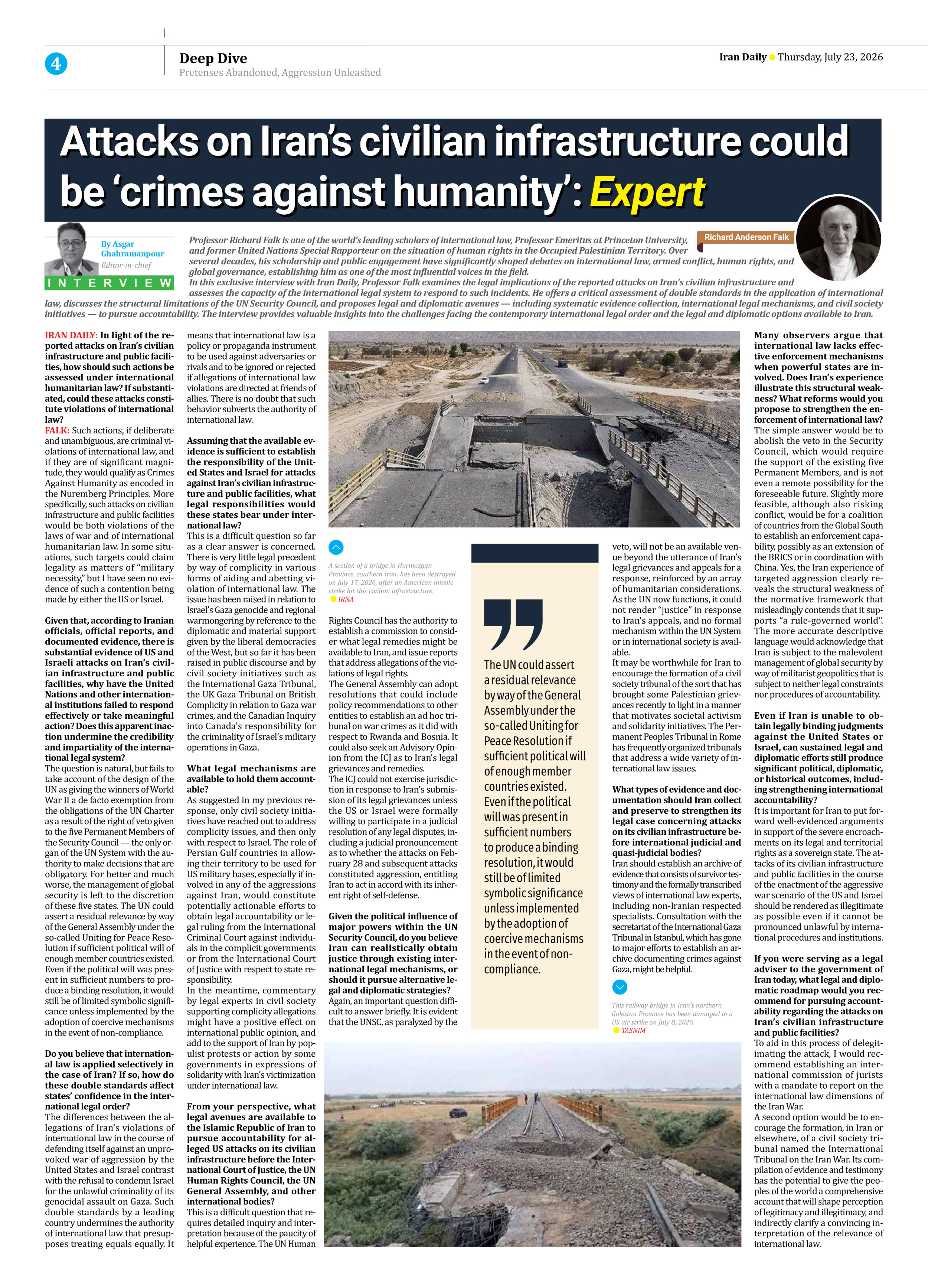
FALK: Such actions, if deliberate and unambiguous, are criminal violations of international law, and if they are of significant magnitude, they would qualify as Crimes Against Humanity as encoded in the Nuremberg Principles. More specifically, such attacks on civilian infrastructure and public facilities would be both violations of the laws of war and of international humanitarian law. In some situations, such targets could claim legality as matters of “military necessity,” but I have seen no evidence of such a contention being made by either the US or Israel.
Given that, according to Iranian officials, official reports, and documented evidence, there is substantial evidence of US and Israeli attacks on Iran’s civilian infrastructure and public facilities, why have the United Nations and other international institutions failed to respond effectively or take meaningful action? Does this apparent inaction undermine the credibility and impartiality of the international legal system?
The question is natural, but fails to take account of the design of the UN as giving the winners of World War II a de facto exemption from the obligations of the UN Charter as a result of the right of veto given to the five Permanent Members of the Security Council — the only organ of the UN System with the authority to make decisions that are obligatory. For better and much worse, the management of global security is left to the discretion of these five states. The UN could assert a residual relevance by way of the General Assembly under the so-called Uniting for Peace Resolution if sufficient political will of enough member countries existed. Even if the political will was present in sufficient numbers to produce a binding resolution, it would still be of limited symbolic significance unless implemented by the adoption of coercive mechanisms in the event of non-compliance.
Do you believe that international law is applied selectively in the case of Iran? If so, how do these double standards affect states’ confidence in the international legal order?
The differences between the allegations of Iran’s violations of international law in the course of defending itself against an unprovoked war of aggression by the United States and Israel contrast with the refusal to condemn Israel for the unlawful criminality of its genocidal assault on Gaza. Such double standards by a leading country undermines the authority of international law that presupposes treating equals equally. It means that international law is a policy or propaganda instrument to be used against adversaries or rivals and to be ignored or rejected if allegations of international law violations are directed at friends of allies. There is no doubt that such behavior subverts the authority of international law.
Assuming that the available evidence is sufficient to establish the responsibility of the United States and Israel for attacks against Iran’s civilian infrastructure and public facilities, what legal responsibilities would these states bear under international law?
This is a difficult question so far as a clear answer is concerned. There is very little legal precedent by way of complicity in various forms of aiding and abetting violation of international law. The issue has been raised in relation to Israel’s Gaza genocide and regional warmongering by reference to the diplomatic and material support given by the liberal democracies of the West, but so far it has been raised in public discourse and by civil society initiatives such as the International Gaza Tribunal, the UK Gaza Tribunal on British Complicity in relation to Gaza war crimes, and the Canadian Inquiry into Canada’s responsibility for the criminality of Israel’s military operations in Gaza.
What legal mechanisms are available to hold them accountable?
As suggested in my previous response, only civil society initiatives have reached out to address complicity issues, and then only with respect to Israel. The role of Persian Gulf countries in allowing their territory to be used for US military bases, especially if involved in any of the aggressions against Iran, would constitute potentially actionable efforts to obtain legal accountability or legal ruling from the International Criminal Court against individuals in the complicit governments or from the International Court of Justice with respect to state responsibility.
In the meantime, commentary by legal experts in civil society supporting complicity allegations might have a positive effect on international public opinion, and add to the support of Iran by populist protests or action by some governments in expressions of solidarity with Iran’s victimization under international law.
From your perspective, what legal avenues are available to the Islamic Republic of Iran to pursue accountability for alleged US attacks on its civilian infrastructure before the International Court of Justice, the UN Human Rights Council, the UN General Assembly, and other international bodies?
This is a difficult question that requires detailed inquiry and interpretation because of the paucity of helpful experience. The UN Human Rights Council has the authority to establish a commission to consider what legal remedies might be available to Iran, and issue reports that address allegations of the violations of legal rights.
The General Assembly can adopt resolutions that could include policy recommendations to other entities to establish an ad hoc tribunal on war crimes as it did with respect to Rwanda and Bosnia. It could also seek an Advisory Opinion from the ICJ as to Iran’s legal grievances and remedies.
The ICJ could not exercise jurisdiction in response to Iran’s submission of its legal grievances unless the US or Israel were formally willing to participate in a judicial resolution of any legal disputes, including a judicial pronouncement as to whether the attacks on February 28 and subsequent attacks constituted aggression, entitling Iran to act in accord with its inherent right of self-defense.
Given the political influence of major powers within the UN Security Council, do you believe Iran can realistically obtain justice through existing international legal mechanisms, or should it pursue alternative legal and diplomatic strategies?
Again, an important question difficult to answer briefly. It is evident that the UNSC, as paralyzed by the veto, will not be an available venue beyond the utterance of Iran’s legal grievances and appeals for a response, reinforced by an array of humanitarian considerations. As the UN now functions, it could not render “justice” in response to Iran’s appeals, and no formal mechanism within the UN System or in international society is available.
It may be worthwhile for Iran to encourage the formation of a civil society tribunal of the sort that has brought some Palestinian grievances recently to light in a manner that motivates societal activism and solidarity initiatives. The Permanent Peoples Tribunal in Rome has frequently organized tribunals that address a wide variety of international law issues.
What types of evidence and documentation should Iran collect and preserve to strengthen its legal case concerning attacks on its civilian infrastructure before international judicial and quasi-judicial bodies?
Iran should establish an archive of evidence that consists of survivor testimony and the formally transcribed views of international law experts, including non-Iranian respected specialists. Consultation with the secretariat of the International Gaza Tribunal in Istanbul, which has gone to major efforts to establish an archive documenting crimes against Gaza, might be helpful.
Many observers argue that international law lacks effective enforcement mechanisms when powerful states are involved. Does Iran’s experience illustrate this structural weakness? What reforms would you propose to strengthen the enforcement of international law?
The simple answer would be to abolish the veto in the Security Council, which would require the support of the existing five Permanent Members, and is not even a remote possibility for the foreseeable future. Slightly more feasible, although also risking conflict, would be for a coalition of countries from the Global South to establish an enforcement capability, possibly as an extension of the BRICS or in coordination with China. Yes, the Iran experience of targeted aggression clearly reveals the structural weakness of the normative framework that misleadingly contends that it supports “a rule-governed world”. The more accurate descriptive language would acknowledge that Iran is subject to the malevolent management of global security by way of militarist geopolitics that is subject to neither legal constraints nor procedures of accountability.
Even if Iran is unable to obtain legally binding judgments against the United States or Israel, can sustained legal and diplomatic efforts still produce significant political, diplomatic, or historical outcomes, including strengthening international accountability?
It is important for Iran to put forward well-evidenced arguments in support of the severe encroachments on its legal and territorial rights as a sovereign state. The attacks of its civilian infrastructure and public facilities in the course of the enactment of the aggressive war scenario of the US and Israel should be rendered as illegitimate as possible even if it cannot be pronounced unlawful by international procedures and institutions.
If you were serving as a legal adviser to the government of Iran today, what legal and diplomatic roadmap would you recommend for pursuing accountability regarding the attacks on Iran’s civilian infrastructure and public facilities?
To aid in this process of delegitimating the attack, I would recommend establishing an international commission of jurists with a mandate to report on the international law dimensions of the Iran War.
A second option would be to encourage the formation, in Iran or elsewhere, of a civil society tribunal named the International Tribunal on the Iran War. Its compilation of evidence and testimony has the potential to give the peoples of the world a comprehensive account that will shape perception of legitimacy and illegitimacy, and indirectly clarify a convincing interpretation of the relevance of international law.