







Iran to establish legal deterrence on global stage
Gov’t designated front man for legal prosecution of US-Israeli war crimes
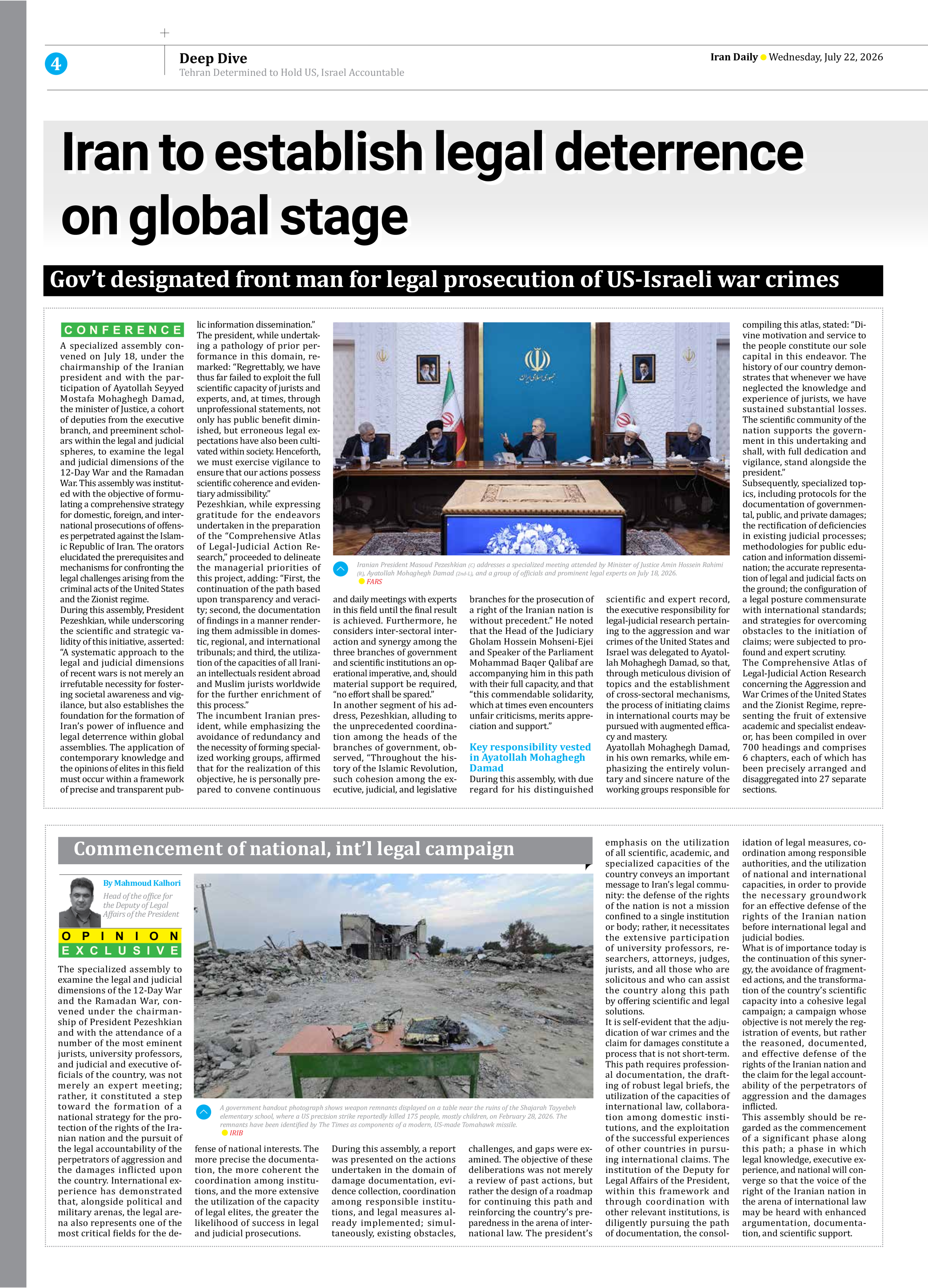
A specialized assembly convened on July 18, under the chairmanship of the Iranian president and with the participation of Ayatollah Seyyed Mostafa Mohaghegh Damad, the minister of Justice, a cohort of deputies from the executive branch, and preeminent scholars within the legal and judicial spheres, to examine the legal and judicial dimensions of the 12-Day War and the Ramadan War. This assembly was instituted with the objective of formulating a comprehensive strategy for domestic, foreign, and international prosecutions of offenses perpetrated against the Islamic Republic of Iran. The orators elucidated the prerequisites and mechanisms for confronting the legal challenges arising from the criminal acts of the United States and the Zionist regime.
During this assembly, President Pezeshkian, while underscoring the scientific and strategic validity of this initiative, asserted: “A systematic approach to the legal and judicial dimensions of recent wars is not merely an irrefutable necessity for fostering societal awareness and vigilance, but also establishes the foundation for the formation of Iran’s power of influence and legal deterrence within global assemblies. The application of contemporary knowledge and the opinions of elites in this field must occur within a framework of precise and transparent public information dissemination.”
The president, while undertaking a pathology of prior performance in this domain, remarked: “Regrettably, we have thus far failed to exploit the full scientific capacity of jurists and experts, and, at times, through unprofessional statements, not only has public benefit diminished, but erroneous legal expectations have also been cultivated within society. Henceforth, we must exercise vigilance to ensure that our actions possess scientific coherence and evidentiary admissibility.”
Pezeshkian, while expressing gratitude for the endeavors undertaken in the preparation of the “Comprehensive Atlas of Legal-Judicial Action Research,” proceeded to delineate the managerial priorities of this project, adding: “First, the continuation of the path based upon transparency and veracity; second, the documentation of findings in a manner rendering them admissible in domestic, regional, and international tribunals; and third, the utilization of the capacities of all Iranian intellectuals resident abroad and Muslim jurists worldwide for the further enrichment of this process.”
The incumbent Iranian president, while emphasizing the avoidance of redundancy and the necessity of forming specialized working groups, affirmed that for the realization of this objective, he is personally prepared to convene continuous and daily meetings with experts in this field until the final result is achieved. Furthermore, he considers inter-sectoral interaction and synergy among the three branches of government and scientific institutions an operational imperative, and, should material support be required, “no effort shall be spared.”
In another segment of his address, Pezeshkian, alluding to the unprecedented coordination among the heads of the branches of government, observed, “Throughout the history of the Islamic Revolution, such cohesion among the executive, judicial, and legislative branches for the prosecution of a right of the Iranian nation is without precedent.” He noted that the Head of the Judiciary Gholam Hossein Mohseni-Ejei and Speaker of the Parliament Mohammad Baqer Qalibaf are accompanying him in this path with their full capacity, and that “this commendable solidarity, which at times even encounters unfair criticisms, merits appreciation and support.”
Key responsibility vested in Ayatollah Mohaghegh Damad
During this assembly, with due regard for his distinguished scientific and expert record, the executive responsibility for legal-judicial research pertaining to the aggression and war crimes of the United States and Israel was delegated to Ayatollah Mohaghegh Damad, so that, through meticulous division of topics and the establishment of cross-sectoral mechanisms, the process of initiating claims in international courts may be pursued with augmented efficacy and mastery.
Ayatollah Mohaghegh Damad, in his own remarks, while emphasizing the entirely voluntary and sincere nature of the working groups responsible for compiling this atlas, stated: “Divine motivation and service to the people constitute our sole capital in this endeavor. The history of our country demonstrates that whenever we have neglected the knowledge and experience of jurists, we have sustained substantial losses. The scientific community of the nation supports the government in this undertaking and shall, with full dedication and vigilance, stand alongside the president.”
Subsequently, specialized topics, including protocols for the documentation of governmental, public, and private damages; the rectification of deficiencies in existing judicial processes; methodologies for public education and information dissemination; the accurate representation of legal and judicial facts on the ground; the configuration of a legal posture commensurate with international standards; and strategies for overcoming obstacles to the initiation of claims; were subjected to profound and expert scrutiny.
The Comprehensive Atlas of Legal-Judicial Action Research concerning the Aggression and War Crimes of the United States and the Zionist Regime, representing the fruit of extensive academic and specialist endeavor, has been compiled in over 700 headings and comprises 6 chapters, each of which has been precisely arranged and disaggregated into 27 separate sections.
Commencement of national, int’l legal campaign
By Mahmoud Kalhori
Head of the office for the Deputy of Legal Affairs of the President
The specialized assembly to examine the legal and judicial dimensions of the 12-Day War and the Ramadan War, convened under the chairmanship of President Pezeshkian and with the attendance of a number of the most eminent jurists, university professors, and judicial and executive officials of the country, was not merely an expert meeting; rather, it constituted a step toward the formation of a national strategy for the protection of the rights of the Iranian nation and the pursuit of the legal accountability of the perpetrators of aggression and the damages inflicted upon the country. International experience has demonstrated that, alongside political and military arenas, the legal arena also represents one of the most critical fields for the defense of national interests. The more precise the documentation, the more coherent the coordination among institutions, and the more extensive the utilization of the capacity of legal elites, the greater the likelihood of success in legal and judicial prosecutions.
During this assembly, a report was presented on the actions undertaken in the domain of damage documentation, evidence collection, coordination among responsible institutions, and legal measures already implemented; simultaneously, existing obstacles, challenges, and gaps were examined. The objective of these deliberations was not merely a review of past actions, but rather the design of a roadmap for continuing this path and reinforcing the country’s preparedness in the arena of international law. The president’s emphasis on the utilization of all scientific, academic, and specialized capacities of the country conveys an important message to Iran’s legal community: the defense of the rights of the nation is not a mission confined to a single institution or body; rather, it necessitates the extensive participation of university professors, researchers, attorneys, judges, jurists, and all those who are solicitous and who can assist the country along this path by offering scientific and legal solutions.
It is self-evident that the adjudication of war crimes and the claim for damages constitute a process that is not short-term. This path requires professional documentation, the drafting of robust legal briefs, the utilization of the capacities of international law, collaboration among domestic institutions, and the exploitation of the successful experiences of other countries in pursuing international claims. The institution of the Deputy for Legal Affairs of the President, within this framework and through coordination with other relevant institutions, is diligently pursuing the path of documentation, the consolidation of legal measures, coordination among responsible authorities, and the utilization of national and international capacities, in order to provide the necessary groundwork for an effective defense of the rights of the Iranian nation before international legal and judicial bodies.
What is of importance today is the continuation of this synergy, the avoidance of fragmented actions, and the transformation of the country’s scientific capacity into a cohesive legal campaign; a campaign whose objective is not merely the registration of events, but rather the reasoned, documented, and effective defense of the rights of the Iranian nation and the claim for the legal accountability of the perpetrators of aggression and the damages inflicted.
This assembly should be regarded as the commencement of a significant phase along this path; a phase in which legal knowledge, executive experience, and national will converge so that the voice of the right of the Iranian nation in the arena of international law may be heard with enhanced argumentation, documentation, and scientific support.
End of fragmented action, beginning of cohesive campaign
By Mohammad Darvishzadeh
President of the Iranian Law and Legal Research Institute
A specialized assembly to examine the legal and judicial dimensions of the two recent imposed wars convened on Saturday, under the chairmanship of Masoud Pezeshkian. This assembly, more than anything else, emphasized the necessity of formulating a cohesive strategy for the legal and judicial prosecution of war crimes and of ending the fragmentation of actions undertaken by various institutions. Mohammad Darvishzadeh, President of the Iranian Law and Legal Research Institute, announced during this assembly the compilation of the “Comprehensive Atlas of Legal-Judicial Action Research Concerning Aggression and War Crimes,” with the identification of over 700 legal issues. This document is intended to serve as the basis for the coordination of 35 institutions and for Iran’s cohesive entry into domestic and international legal prosecutions.
Darvishzadeh, speaking to the Iran Newspaper correspondent at yesterday’s assembly, stated: “What was introduced at the president’s meeting with jurists as the most significant achievement was the compilation of the ‘Comprehensive Atlas of Legal-Judicial Action Research Concerning Aggression and War Crimes.’ This document, which was prepared by the private Iranian Law and Legal Research Institute at the behest of the Strategic Deputy of the Presidency, endeavors to systematically identify, categorize, and translate into legal action all legal dimensions arising from aggression and war crimes.”
He also explained, regarding the choice of title for this atlas, that special legal precision was exercised in its nomenclature. For this reason, terms such as “12-Day War” or “America’s War” were not employed; rather, relying upon the definition of aggression in international instruments, including the definition of aggression resolution and the provisions of the International Criminal Court, the title “Aggression and War Crimes” was selected. Because, from the perspective of international law, the actions undertaken constitute instances of aggression and, in numerous instances, also constitute clear instances of war crimes. According to him, even the selection of terminology in legal documents carries significant legal implications, and for this reason, in the compilation of this atlas, efforts were made to formulate all concepts on the basis of the accepted terminology of international law.
Darvishzadeh also alluded to certain manifest examples of these crimes, such as the attack on the Shajareh Tayyebeh school in Minab, as well as the targeting of civilian areas and installations. “These constitute clear instances of war crimes that are susceptible to legal prosecution,” he added.
The president of the Iranian Law and Legal Research Institute, stating that “law is not merely a theoretical discipline,” further remarked that “in such circumstances, law functions as a strategic instrument and even a weapon.” According to him, many military achievements, after the conclusion of conflict, are consolidated in the form of documents and judicial opinions, and what transpires on the battlefield will ultimately be preserved in legal and judicial dossiers. Hence, precise documentation and legal planning, simultaneous with field developments, acquire decisive importance.
He also spoke of the extensive scope of this atlas and explained that the implementation of this roadmap is contingent upon more than 35 ministries, organizations, and related institutions. According to him, even institutions that at first glance do not have a direct connection to wartime issues, such as the National Library, will have specific missions in the areas of documentation, preservation of documents, and registration of records. Consequently, one can imagine the vast volume of responsibilities and legal matters that have been defined for institutions such as the Ministry of Defense, the Ministry of Justice, the Deputy for Legal Affairs of the Presidency, and the Judiciary.
“In addition to determining the role of institutions, the groundworks for initiating claims have also been identified. Accordingly, approximately 15 domestic, foreign, and international assemblies and platforms for the prosecution of cases, as well as nearly 18 policy-making areas related to these cases, have been enumerated so that it may be clear through which channel each matter should be pursued and which institution shall bear responsibility for each part.”
According to Darvishzadeh, the most important product of this project is the provision of a “roadmap” for the coordination of the country’s legal actions. A roadmap that specifies what duty each organization has, how it must coordinate with other institutions, and what process must be followed for documentation, consensus-building, prosecution, and execution of cases.
The President of the Iranian Law and Legal Research Institute, regarding the discussions held at Saturday’s assembly, also stated that the examinations revealed that many institutions had independently undertaken valuable actions, including the preparation of documentation protocols, the collection of documents, and the drafting of specialized reports; however, the principal problem had been the absence of communication and coordination among these actions. According to him, the President’s emphasis was likewise on this very issue: that fragmented activities must be interconnected within a unified structure.
On this basis, it was decided that a working group, comprising the Ministry of Justice, the Deputy for Legal Affairs of the Presidency, the Strategic Deputy, and other relevant institutions, should be formed under the supervision of Ayatollah Mohaghegh Damad, so that all of the country’s legal capacities may be mobilized along a single common path.
The former judge of the Supreme Court affirmed: “One should not offer definitive predictions regarding the final outcomes of this legal campaign because success in such cases is contingent upon the degree of preparedness, cohesion, planning, documentation, and coordination, and not merely upon the initiation of claims.”
He also alluded to certain gaps within the domestic legal system and remarked that it is necessary to design mechanisms whereby, simultaneously with compensating the victims for their damages, the authority for legal prosecution and the initiation of claims against the aggressor may also be obtained from them, so that the prosecution of cases before international assemblies and even the courts of other countries may be facilitated.
Iran should increase cost of indifference for other countries
By Sohrab
Rostami Kia
Policy researcher
During the 40-Day Imposed War, Iran’s infrastructure was subjected to attack. The military assault on vital infrastructure, including energy, water, and electricity installations, as well as scientific and academic centers, from the perspective of international law, is a clear instance of war crime and a flagrant violation of the fundamental principles of international humanitarian law. This piece endeavors, with a national perspective, to condemn the matter from humanitarian and legal dimensions and, from the standpoint of public interest, to address the duty of the various segments of Iranian society in relation to this approach.
Legally, pursuant to the Geneva Conventions and their Additional Protocols, the targeting of civilian infrastructure, particularly in the absence of direct military justification, is prohibited and shall place international responsibility on the aggressor state. Although our adversary, in its new approach, does not respect international law even in appearance and exerts pressure on international institutions, nevertheless, given the absence of substantiated justifications for the aggression against Iran, the legal prosecution of the aforementioned matter through international authorities and all relevant institutions, by the government and even by Iranian actors within and outside the borders, is not devoid of merit.
Another matter pertains to the historical test of nationalism for commentators, elites, members of the academic and artistic communities, and actors in various political, social, and civil arenas under these circumstances. From the perspective of domestic law and national sovereignty, infrastructure represents a symbol of development, independence, and national dignity. Its destruction entails not only economic and social harm, but also constitutes an overt attempt to undermine national will and disrupt public order. In such circumstances, nationalism in its genuine sense manifests itself not in slogans but in action: in the defense of territorial integrity, in the preservation of developmental achievements, and in the maintenance of national cohesion in the face of foreign aggression.
These voices of protest and the unity of the nation are best represented by the elites of that society, which can express themselves through cohesive media and academic statements, in poetry, literature, and art, and across the extensive social sphere so pervasively that the world becomes aware, on the one hand, of the depth of the enemy’s crimes and, on the other, of the resolve, unity, and solidarity of Iranians in difficult circumstances.
Of course, the official reactions of domestic institutions, the condemnations by a portion of the educated, and the declarations of senior state officials demonstrate efforts against this type of violence. However, in domestic and foreign condemnations by ordinary Iranian people, the capacity for national convergence has been and remains greater; nevertheless, it is essential that the media and diplomatic capacities, as well as activist Iranians within and outside the country, undertake measures such that the international community also responds practically and decisively to this flagrant violation of international law and that the cost of indifference toward it is elevated.
Silence in the face of this crime is not merely moral indifference, but shall also pave the way for its recurrence on a larger scale. Certain incorrect positions and behaviors on the part of some domestic movements should not cause numerous concerned critics, intellectuals, and commentators of society to neglect their national and human duty at the most critical juncture of contemporary history. One of the important deterrent factors against the continuation of the enemy’s aggression against the country or the success of their nefarious objectives is comprehensive national unity and solidarity in difficult circumstances of threat and assault. If understood, this renders inaction in the present situation meaningless.
Of course, alongside these matters, the military and field domain of the country also requires the comprehensive support of the nation and all segments of society for defense, the preservation of national reserves, and the establishment of equilibrium on the battlefield; and, of course, the country’s media management, on the basis of this sensitivity, requires transformation in the utilization of all popular and human capacities for resilience and the construction of national convergence. In the domain of economic management, diversification measures concerning infrastructure, scenario-based planning, the creation of alternative routes and networks, the engagement of the government, the private sector, and civil society for convergence in supplying the country’s essential needs, the protection of the current production capacity of goods and services, and the reconstruction of damages are also essential.
The article first appeared in the Persian-language newspaper Iran.