







Copy in clipboard...
Historic Chehel Sotoun columns show structural deformation after blast damage
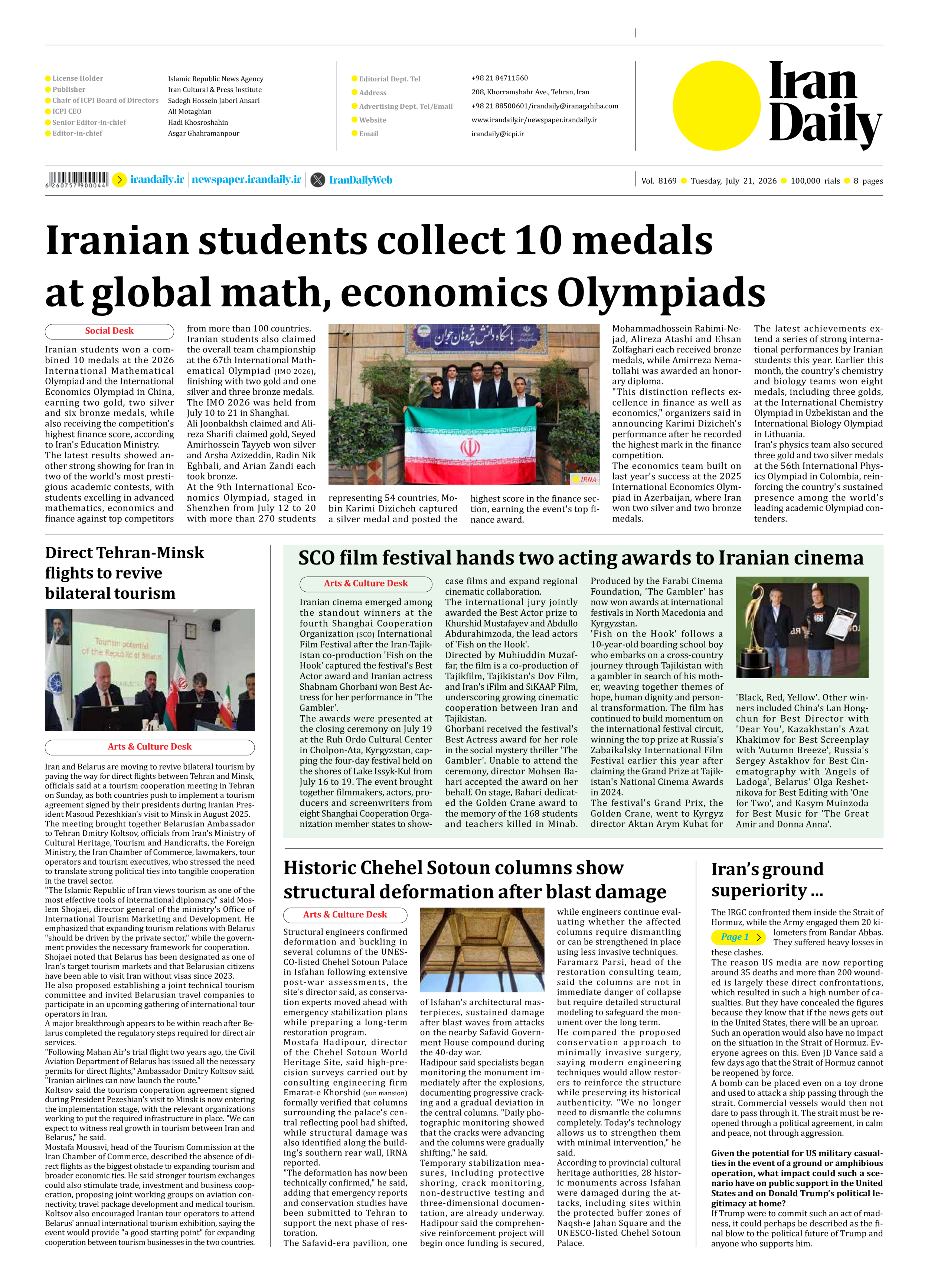
Structural engineers confirmed deformation and buckling in several columns of the UNESCO-listed Chehel Sotoun Palace in Isfahan following extensive post-war assessments, the site's director said, as conservation experts moved ahead with emergency stabilization plans while preparing a long-term restoration program.
Mostafa Hadipour, director of the Chehel Sotoun World Heritage Site, said high-precision surveys carried out by consulting engineering firm Emarat-e Khorshid (sun mansion) formally verified that columns surrounding the palace's central reflecting pool had shifted, while structural damage was also identified along the building's southern rear wall, IRNA reported.
"The deformation has now been technically confirmed," he said, adding that emergency reports and conservation studies have been submitted to Tehran to support the next phase of restoration.
The Safavid-era pavilion, one of Isfahan's architectural masterpieces, sustained damage after blast waves from attacks on the nearby Safavid Government House compound during the 40-day war.
Hadipour said specialists began monitoring the monument immediately after the explosions, documenting progressive cracking and a gradual deviation in the central columns. "Daily photographic monitoring showed that the cracks were advancing and the columns were gradually shifting," he said.
Temporary stabilization measures, including protective shoring, crack monitoring, non-destructive testing and three-dimensional documentation, are already underway. Hadipour said the comprehensive reinforcement project will begin once funding is secured, while engineers continue evaluating whether the affected columns require dismantling or can be strengthened in place using less invasive techniques.
Faramarz Parsi, head of the restoration consulting team, said the columns are not in immediate danger of collapse but require detailed structural modeling to safeguard the monument over the long term.
He compared the proposed conservation approach to minimally invasive surgery, saying modern engineering techniques would allow restorers to reinforce the structure while preserving its historical authenticity. "We no longer need to dismantle the columns completely. Today's technology allows us to strengthen them with minimal intervention," he said.
According to provincial cultural heritage authorities, 28 historic monuments across Isfahan were damaged during the attacks, including sites within the protected buffer zones of Naqsh-e Jahan Square and the UNESCO-listed Chehel Sotoun Palace.