





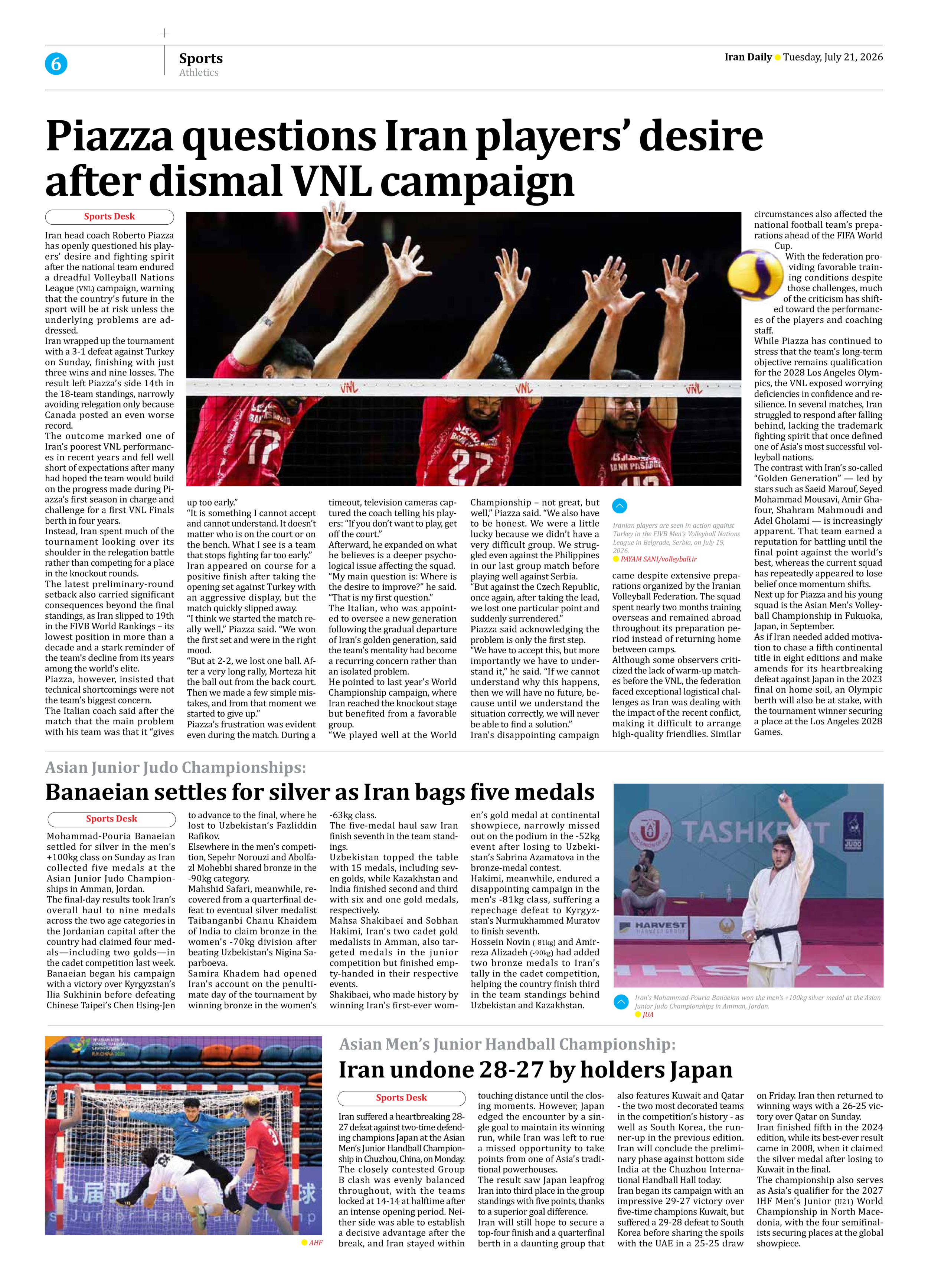


Piazza questions Iran players’ desire after dismal VNL campaign
Iran head coach Roberto Piazza has openly questioned his players’ desire and fighting spirit after the national team endured a dreadful Volleyball Nations League (VNL) campaign, warning that the country’s future in the sport will be at risk unless the underlying problems are addressed.
Iran wrapped up the tournament with a 3-1 defeat against Turkey on Sunday, finishing with just three wins and nine losses. The result left Piazza’s side 14th in the 18-team standings, narrowly avoiding relegation only because Canada posted an even worse record.
The outcome marked one of Iran’s poorest VNL performances in recent years and fell well short of expectations after many had hoped the team would build on the progress made during Piazza’s first season in charge and challenge for a first VNL Finals berth in four years.
Instead, Iran spent much of the tournament looking over its shoulder in the relegation battle rather than competing for a place in the knockout rounds.
The latest preliminary-round setback also carried significant consequences beyond the final standings, as Iran slipped to 19th in the FIVB World Rankings – its lowest position in more than a decade and a stark reminder of the team’s decline from its years among the world’s elite.
Piazza, however, insisted that technical shortcomings were not the team’s biggest concern.
The Italian coach said after the match that the main problem with his team was that it “gives up too early.”
“It is something I cannot accept and cannot understand. It doesn’t matter who is on the court or on the bench. What I see is a team that stops fighting far too early.”
Iran appeared on course for a positive finish after taking the opening set against Turkey with an aggressive display, but the match quickly slipped away.
“I think we started the match really well,” Piazza said. “We won the first set and were in the right mood.
“But at 2-2, we lost one ball. After a very long rally, Morteza hit the ball out from the back court. Then we made a few simple mistakes, and from that moment we started to give up.”
Piazza’s frustration was evident even during the match. During a timeout, television cameras captured the coach telling his players: “If you don’t want to play, get off the court.”
Afterward, he expanded on what he believes is a deeper psychological issue affecting the squad.
“My main question is: Where is the desire to improve?” he said. “That is my first question.”
The Italian, who was appointed to oversee a new generation following the gradual departure of Iran’s golden generation, said the team’s mentality had become a recurring concern rather than an isolated problem.
He pointed to last year’s World Championship campaign, where Iran reached the knockout stage but benefited from a favorable group.
“We played well at the World Championship – not great, but well,” Piazza said. “We also have to be honest. We were a little lucky because we didn’t have a very difficult group. We struggled even against the Philippines in our last group match before playing well against Serbia.
“But against the Czech Republic, once again, after taking the lead, we lost one particular point and suddenly surrendered.”
Piazza said acknowledging the problem is only the first step.
“We have to accept this, but more importantly we have to understand it,” he said. “If we cannot understand why this happens, then we will have no future, because until we understand the situation correctly, we will never be able to find a solution.”
Iran’s disappointing campaign came despite extensive preparations organized by the Iranian Volleyball Federation. The squad spent nearly two months training overseas and remained abroad throughout its preparation period instead of returning home between camps.
Although some observers criticized the lack of warm-up matches before the VNL, the federation faced exceptional logistical challenges as Iran was dealing with the impact of the recent conflict, making it difficult to arrange high-quality friendlies. Similar circumstances also affected the national football team’s preparations ahead of the FIFA World Cup.
With the federation providing favorable training conditions despite those challenges, much of the criticism has shifted toward the performances of the players and coaching staff.
While Piazza has continued to stress that the team’s long-term objective remains qualification for the 2028 Los Angeles Olympics, the VNL exposed worrying deficiencies in confidence and resilience. In several matches, Iran struggled to respond after falling behind, lacking the trademark fighting spirit that once defined one of Asia’s most successful volleyball nations.
The contrast with Iran’s so-called “Golden Generation” — led by stars such as Saeid Marouf, Seyed Mohammad Mousavi, Amir Ghafour, Shahram Mahmoudi and Adel Gholami — is increasingly apparent. That team earned a reputation for battling until the final point against the world’s best, whereas the current squad has repeatedly appeared to lose belief once momentum shifts.
Next up for Piazza and his young squad is the Asian Men’s Volleyball Championship in Fukuoka, Japan, in September.
As if Iran needed added motivation to chase a fifth continental title in eight editions and make amends for its heartbreaking defeat against Japan in the 2023 final on home soil, an Olympic berth will also be at stake, with the tournament winner securing a place at the Los Angeles 2028 Games.