







Tehran, Islamabad edge closer to halal trade agreement
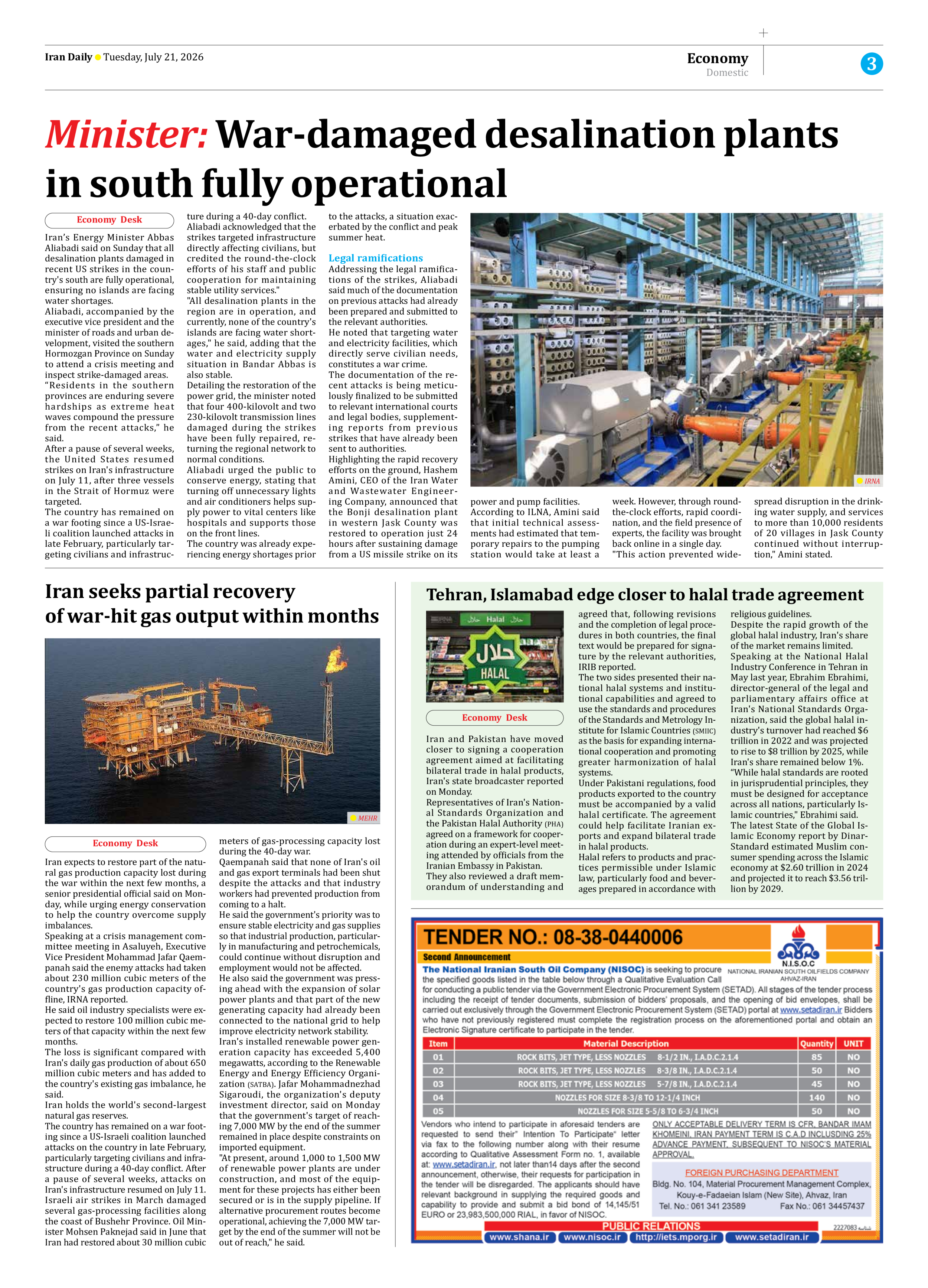
Iran and Pakistan have moved closer to signing a cooperation agreement aimed at facilitating bilateral trade in halal products, Iran's state broadcaster reported on Monday.
Representatives of Iran's National Standards Organization and the Pakistan Halal Authority (PHA) agreed on a framework for cooperation during an expert-level meeting attended by officials from the Iranian Embassy in Pakistan.
They also reviewed a draft memorandum of understanding and agreed that, following revisions and the completion of legal procedures in both countries, the final text would be prepared for signature by the relevant authorities, IRIB reported.
The two sides presented their national halal systems and institutional capabilities and agreed to use the standards and procedures of the Standards and Metrology Institute for Islamic Countries (SMIIC) as the basis for expanding international cooperation and promoting greater harmonization of halal systems.
Under Pakistani regulations, food products exported to the country must be accompanied by a valid halal certificate. The agreement could help facilitate Iranian exports and expand bilateral trade in halal products.
Halal refers to products and practices permissible under Islamic law, particularly food and beverages prepared in accordance with religious guidelines.
Despite the rapid growth of the global halal industry, Iran's share of the market remains limited.
Speaking at the National Halal Industry Conference in Tehran in May last year, Ebrahim Ebrahimi, director-general of the legal and parliamentary affairs office at Iran's National Standards Organization, said the global halal industry's turnover had reached $6 trillion in 2022 and was projected to rise to $8 trillion by 2025, while Iran's share remained below 1%.
“While halal standards are rooted in jurisprudential principles, they must be designed for acceptance across all nations, particularly Islamic countries," Ebrahimi said.
The latest State of the Global Islamic Economy report by DinarStandard estimated Muslim consumer spending across the Islamic economy at $2.60 trillion in 2024 and projected it to reach $3.56 trillion by 2029.