







Assault on Iran’s infrastructure revenge for strategic defeat
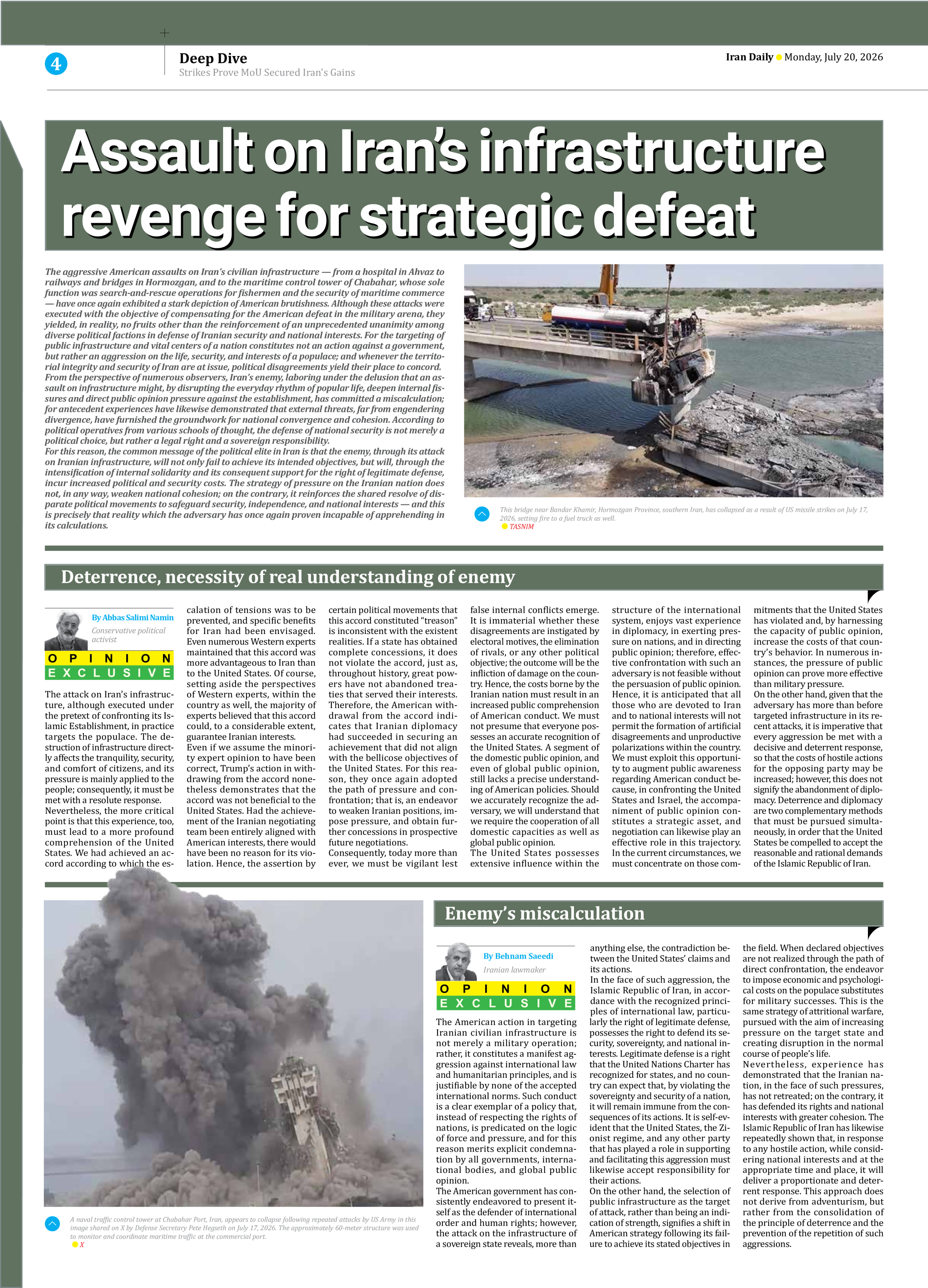
The aggressive American assaults on Iran’s civilian infrastructure — from a hospital in Ahvaz to railways and bridges in Hormozgan, and to the maritime control tower of Chabahar, whose sole function was search-and-rescue operations for fishermen and the security of maritime commerce — have once again exhibited a stark depiction of American brutishness. Although these attacks were executed with the objective of compensating for the American defeat in the military arena, they yielded, in reality, no fruits other than the reinforcement of an unprecedented unanimity among diverse political factions in defense of Iranian security and national interests. For the targeting of public infrastructure and vital centers of a nation constitutes not an action against a government, but rather an aggression on the life, security, and interests of a populace; and whenever the territorial integrity and security of Iran are at issue, political disagreements yield their place to concord. From the perspective of numerous observers, Iran’s enemy, laboring under the delusion that an assault on infrastructure might, by disrupting the everyday rhythm of popular life, deepen internal fissures and direct public opinion pressure against the establishment, has committed a miscalculation; for antecedent experiences have likewise demonstrated that external threats, far from engendering divergence, have furnished the groundwork for national convergence and cohesion. According to political operatives from various schools of thought, the defense of national security is not merely a political choice, but rather a legal right and a sovereign responsibility. For this reason, the common message of the political elite in Iran is that the enemy, through its attack on Iranian infrastructure, will not only fail to achieve its intended objectives, but will, through the intensification of internal solidarity and its consequent support for the right of legitimate defense, incur increased political and security costs. The strategy of pressure on the Iranian nation does not, in any way, weaken national cohesion; on the contrary, it reinforces the shared resolve of disparate political movements to safeguard security, independence, and national interests — and this is precisely that reality which the adversary has once again proven incapable of apprehending in its calculations.
Deterrence, necessity of real understanding of enemy
By Abbas Salimi Namin
Conservative political activist
The attack on Iran’s infrastructure, although executed under the pretext of confronting its Islamic Establishment, in practice targets the populace. The destruction of infrastructure directly affects the tranquility, security, and comfort of citizens, and its pressure is mainly applied to the people; consequently, it must be met with a resolute response.
Nevertheless, the more critical point is that this experience, too, must lead to a more profound comprehension of the United States. We had achieved an accord according to which the escalation of tensions was to be prevented, and specific benefits for Iran had been envisaged. Even numerous Western experts maintained that this accord was more advantageous to Iran than to the United States. Of course, setting aside the perspectives of Western experts, within the country as well, the majority of experts believed that this accord could, to a considerable extent, guarantee Iranian interests.
Even if we assume the minority expert opinion to have been correct, Trump’s action in withdrawing from the accord nonetheless demonstrates that the accord was not beneficial to the United States. Had the achievement of the Iranian negotiating team been entirely aligned with American interests, there would have been no reason for its violation. Hence, the assertion by certain political movements that this accord constituted “treason” is inconsistent with the existent realities. If a state has obtained complete concessions, it does not violate the accord, just as, throughout history, great powers have not abandoned treaties that served their interests. Therefore, the American withdrawal from the accord indicates that Iranian diplomacy had succeeded in securing an achievement that did not align with the bellicose objectives of the United States. For this reason, they once again adopted the path of pressure and confrontation; that is, an endeavor to weaken Iranian positions, impose pressure, and obtain further concessions in prospective future negotiations.
Consequently, today more than ever, we must be vigilant lest false internal conflicts emerge. It is immaterial whether these disagreements are instigated by electoral motives, the elimination of rivals, or any other political objective; the outcome will be the infliction of damage on the country. Hence, the costs borne by the Iranian nation must result in an increased public comprehension of American conduct. We must not presume that everyone possesses an accurate recognition of the United States. A segment of the domestic public opinion, and even of global public opinion, still lacks a precise understanding of American policies. Should we accurately recognize the adversary, we will understand that we require the cooperation of all domestic capacities as well as global public opinion.
The United States possesses extensive influence within the structure of the international system, enjoys vast experience in diplomacy, in exerting pressure on nations, and in directing public opinion; therefore, effective confrontation with such an adversary is not feasible without the persuasion of public opinion. Hence, it is anticipated that all those who are devoted to Iran and to national interests will not permit the formation of artificial disagreements and unproductive polarizations within the country.
We must exploit this opportunity to augment public awareness regarding American conduct because, in confronting the United States and Israel, the accompaniment of public opinion constitutes a strategic asset, and negotiation can likewise play an effective role in this trajectory. In the current circumstances, we must concentrate on those commitments that the United States has violated and, by harnessing the capacity of public opinion, increase the costs of that country’s behavior. In numerous instances, the pressure of public opinion can prove more effective than military pressure.
On the other hand, given that the adversary has more than before targeted infrastructure in its recent attacks, it is imperative that every aggression be met with a decisive and deterrent response, so that the costs of hostile actions for the opposing party may be increased; however, this does not signify the abandonment of diplomacy. Deterrence and diplomacy are two complementary methods that must be pursued simultaneously, in order that the United States be compelled to accept the reasonable and rational demands of the Islamic Republic of Iran.
Enemy’s miscalculation
By Behnam Saeedi
Iranian lawmaker
The American action in targeting Iranian civilian infrastructure is not merely a military operation; rather, it constitutes a manifest aggression against international law and humanitarian principles, and is justifiable by none of the accepted international norms. Such conduct is a clear exemplar of a policy that, instead of respecting the rights of nations, is predicated on the logic of force and pressure, and for this reason merits explicit condemnation by all governments, international bodies, and global public opinion.
The American government has consistently endeavored to present itself as the defender of international order and human rights; however, the attack on the infrastructure of a sovereign state reveals, more than anything else, the contradiction between the United States’ claims and its actions.
In the face of such aggression, the Islamic Republic of Iran, in accordance with the recognized principles of international law, particularly the right of legitimate defense, possesses the right to defend its security, sovereignty, and national interests. Legitimate defense is a right that the United Nations Charter has recognized for states, and no country can expect that, by violating the sovereignty and security of a nation, it will remain immune from the consequences of its actions. It is self-evident that the United States, the Zionist regime, and any other party that has played a role in supporting and facilitating this aggression must likewise accept responsibility for their actions.
On the other hand, the selection of public infrastructure as the target of attack, rather than being an indication of strength, signifies a shift in American strategy following its failure to achieve its stated objectives in the field. When declared objectives are not realized through the path of direct confrontation, the endeavor to impose economic and psychological costs on the populace substitutes for military successes. This is the same strategy of attritional warfare, pursued with the aim of increasing pressure on the target state and creating disruption in the normal course of people’s life.
Nevertheless, experience has demonstrated that the Iranian nation, in the face of such pressures, has not retreated; on the contrary, it has defended its rights and national interests with greater cohesion. The Islamic Republic of Iran has likewise repeatedly shown that, in response to any hostile action, while considering national interests and at the appropriate time and place, it will deliver a proportionate and deterrent response. This approach does not derive from adventurism, but rather from the consolidation of the principle of deterrence and the prevention of the repetition of such aggressions.
War against people of Iran
By Gholamreza Zarifian
Former university professor
One of the most fundamental principles of international humanitarian law is the immunity of civilian infrastructure during wartime. Vital facilities such as water and electricity networks, power plants, roads, bridges, medical centers, and hospitals are not merely a collection of physical structures; rather, they constitute the vital arteries of popular life. For this reason, international documents and regulations have not only condemned attacks on these infrastructures, but have, in numerous instances, treated such attacks as war crimes.
The rationale for this sensitivity is likewise clear; the destruction of infrastructure directly affects the lives of millions of citizens, and its consequences are not limited to financial damages. The outage of a power plant is not merely the extinguishing of household lights; this event can endanger the life of a patient undergoing cardiac surgery in the operating theater, disrupt the operations of hospital intensive care units, and remove vital medical services from public access. The destruction of bridges and communication routes likewise does not signify merely damage to a road; rather, it precipitates a crisis in relief operations, patient transport, the provision of essential commodities, and even the everyday existence of the populace.
From this perspective, the attack on public infrastructure must be regarded as an attack on the people because the primary and most direct victims thereof are ordinary citizens — those who play no direct role on the battlefield, yet bear the heaviest costs of war.
The thought-provoking point is that in a world that incessantly speaks of human dignity, human rights, and humanitarian values, we witness behaviors that stand in open contradiction with these very declared principles. Countries that introduce themselves as defenders of democracy, liberty, and human rights either maintain silence in the face of attacks on civilian infrastructure or even, through various forms, extend political and media support to the perpetrators. This duplicity has engendered serious questions within global public opinion concerning the integrity of the existent human rights regime.
In such circumstances, global public opinion is, more than before, capable of distinguishing between rhetoric and reality. The experience of recent wars has likewise demonstrated that the destruction of vital infrastructure is not a sign of strength, but rather a sign of incapacity to adhere to the humanitarian rules of warfare. The images and narratives pertaining to attacks on Iran’s bridges, service centers, and urban areas revive, within the public consciousness, the bitter memories of some of the most savage wars of the 20th century, and subject these actions to the judgment of the global conscience.
The human examples of these attacks, more than any legal argument, attest to the depth of the catastrophe. When, as a result of the targeting of a bridge or communication route, a family is bereaved, a mother loses her life, or a child sustains severe injuries, it is no longer possible to analyze these actions solely within the framework of military objectives; these are the direct consequences of a war on the lives of the people.
At the same time, this experience has once again demonstrated that, although defensive and military capacity is an undeniable necessity for the preservation of national security, it is not sufficient in itself. Countries that possess technological and armaments superiority are capable of inflicting extensive damage on infrastructure. Hence, in addition to strengthening defensive capacity, all national capacities — from social cohesion and active diplomacy to the utilization of legal and political instruments on the international stage — must be employed to confront such illegal and inhumane actions.
What ultimately matters is the protection of popular life and the safeguarding of those infrastructures on which the continuity of societal existence depends. The attack on these infrastructures, irrespective of any political or military justification, constitutes an action against fundamental human rights, and the awakened global conscience will, sooner or later, render its judgment thereon.
All of Iran is our home
By Fatemeh Mohajerani
Iranian government’s spokesperson
The geography of Iran is not merely the borders of its territory; it is the shared narrative of a people whose destinies are intertwined in every part of this land. For this reason, any aggression on any corner of this territory is a wound on the body of Iran.
From the very first hours of the recent criminal American attacks on our country’s soil, the government has defined its responsibility with this very perspective; a perspective that distinguishes not between north and south, east and west, or the center of the country, and regards the security, tranquility, and dignity of all Iranians as equally valuable.
For the government, Hormozgan, Bushehr, Khuzestan, Sistan and Baluchestan, and the other provinces that, in these days, have been more exposed to enemy aggression than other parts of the country, are inseparable parts of Iran — just as are Tehran, Tabriz, Mashhad, Shiraz, Kermanshah, or any other city. If the adversary endeavors, through the targeting of certain parts of the country, to create a sense of insecurity and fragmentation, our response shall be nothing other than the reinforcement of national solidarity and effective presence alongside the people.
In these days, the government does not perceive its duty solely as crisis management. Our responsibility is to preserve, insofar as possible, the normal course of popular life; to continue public services; to support relief and medical institutions; to secure essential needs; to maintain the stability of infrastructure; and to accompany those families that bear a greater burden.
Within this same framework, all executive bodies have been obligated to continue, with maximum capacity, the services required by the people without interruption, and to ensure that no disruption occurs in the provision of citizens’ basic needs.
What transpires in the field is the product of the round-the-clock collaboration of a collection of executive, relief, medical, and service-providing institutions. Many of these actions may not be exposed to the view of public opinion, but their outcome must be perceptible in the lives of the people, in the continuity of services, in attention to the afflicted, in the provision of essential commodities, in the maintenance of vital networks, and in the endeavor that will help families surmount these difficult days with the least possible concern.
In such circumstances, close communication with local administrators and the continuous receiving of field reports constitute an important part of the government’s decision-making process. Each province, in accordance with its own conditions, possesses different needs and requirements, and decisions are made accordingly. The objective is that the nation’s resources and capacities be placed, in a just manner and in proportion to circumstances, at the disposal of those people who, today, are more exposed to harm than others.
Alongside all executive measures, another important responsibility rests on the government; the preservation of public trust. The Iranian people have, throughout all historical periods, demonstrated that, in difficult days, the principal asset of the country is national solidarity and empathy. This asset is reinforced when the people are assured that the government stands beside them, hears their voices, pursues their concerns, and will spare no effort to alleviate hardships.
War does not proceed solely on the battlefield; the preservation of hope, tranquility, and social cohesion is likewise a part of that field.
The adversary endeavors to disseminate a sense of insecurity throughout the entire country and to create a distance between the people and officials. The government’s response to this strategy is its continuous presence alongside the people, the continuation of service, accountability, and the effort to resolve their issues. No province shall be left alone in this path, and no Iranian should feel excluded from the purview of government attention.
Simultaneously, planning for the compensation of damages, support for affected families, and the swiftest possible restoration of normal conditions to the affected regions constitute a part of the government’s responsibility, which will be pursued with seriousness. We believe that surmounting these difficult days is possible only through reliance on national capacity, popular empathy, and the continuation of service delivery.
Iran is the common home of us all. The security and tranquility of this home are not divisible, and no part of it is separate from another. If today a point of this territory has become the target of enemy attacks, all of Iran stands beside it, and the government deems itself obligated to remain, with all its capacity, alongside the people at that very point, until the day when tranquility returns to their lives. The government will continue its path with this same conviction; a conviction that is not a slogan, but rather the foundation of our action and accountability: All of Iran is our home.
The article first appeared in the
Persian-language newspaper Iran.