







Gov’t prioritizes war-scarred regions as summer power strains loom
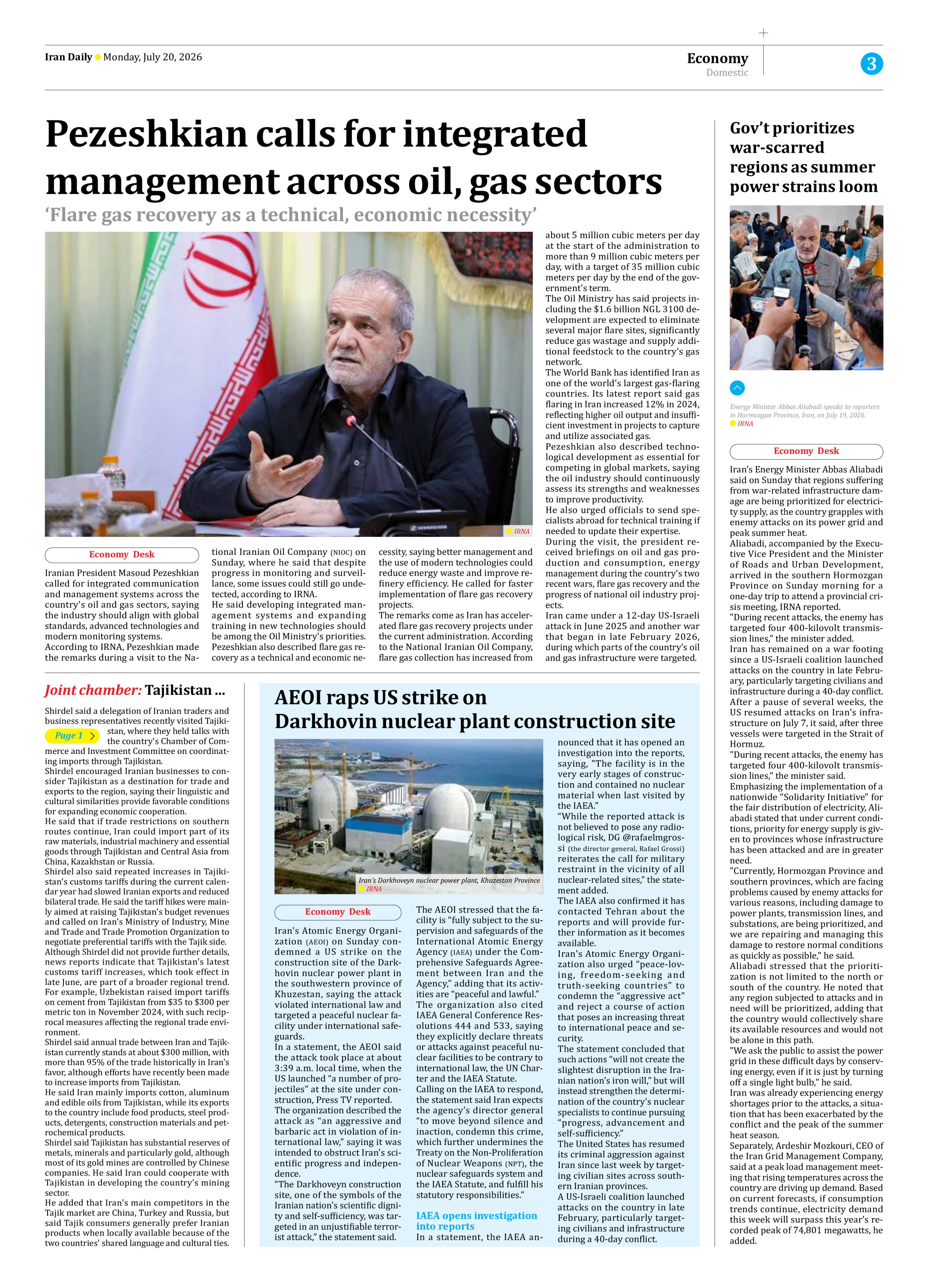
Iran’s Energy Minister Abbas Aliabadi said on Sunday that regions suffering from war-related infrastructure damage are being prioritized for electricity supply, as the country grapples with enemy attacks on its power grid and peak summer heat.
Aliabadi, accompanied by the Executive Vice President and the Minister of Roads and Urban Development, arrived in the southern Hormozgan Province on Sunday morning for a one-day trip to attend a provincial crisis meeting, IRNA reported.
"During recent attacks, the enemy has targeted four 400-kilovolt transmission lines," the minister added.
Iran has remained on a war footing since a US-Israeli coalition launched attacks on the country in late February, particularly targeting civilians and infrastructure during a 40-day conflict. After a pause of several weeks, the US resumed attacks on Iran's infrastructure on July 7, it said, after three vessels were targeted in the Strait of Hormuz.
"During recent attacks, the enemy has targeted four 400-kilovolt transmission lines," the minister said.
Emphasizing the implementation of a nationwide "Solidarity Initiative" for the fair distribution of electricity, Aliabadi stated that under current conditions, priority for energy supply is given to provinces whose infrastructure has been attacked and are in greater need.
"Currently, Hormozgan Province and southern provinces, which are facing problems caused by enemy attacks for various reasons, including damage to power plants, transmission lines, and substations, are being prioritized, and we are repairing and managing this damage to restore normal conditions as quickly as possible," he said.
Aliabadi stressed that the prioritization is not limited to the north or south of the country. He noted that any region subjected to attacks and in need will be prioritized, adding that the country would collectively share its available resources and would not be alone in this path.
"We ask the public to assist the power grid in these difficult days by conserving energy, even if it is just by turning off a single light bulb," he said.
Iran was already experiencing energy shortages prior to the attacks, a situation that has been exacerbated by the conflict and the peak of the summer heat season.
Separately, Ardeshir Mozkouri, CEO of the Iran Grid Management Company, said at a peak load management meeting that rising temperatures across the country are driving up demand. Based on current forecasts, if consumption trends continue, electricity demand this week will surpass this year’s recorded peak of 74,801 megawatts, he added.