







Tehran, Bishkek sign cultural pact to foster arts, heritage cooperation
Salehi says Iranian civilization has long paired peace with defense of national dignity
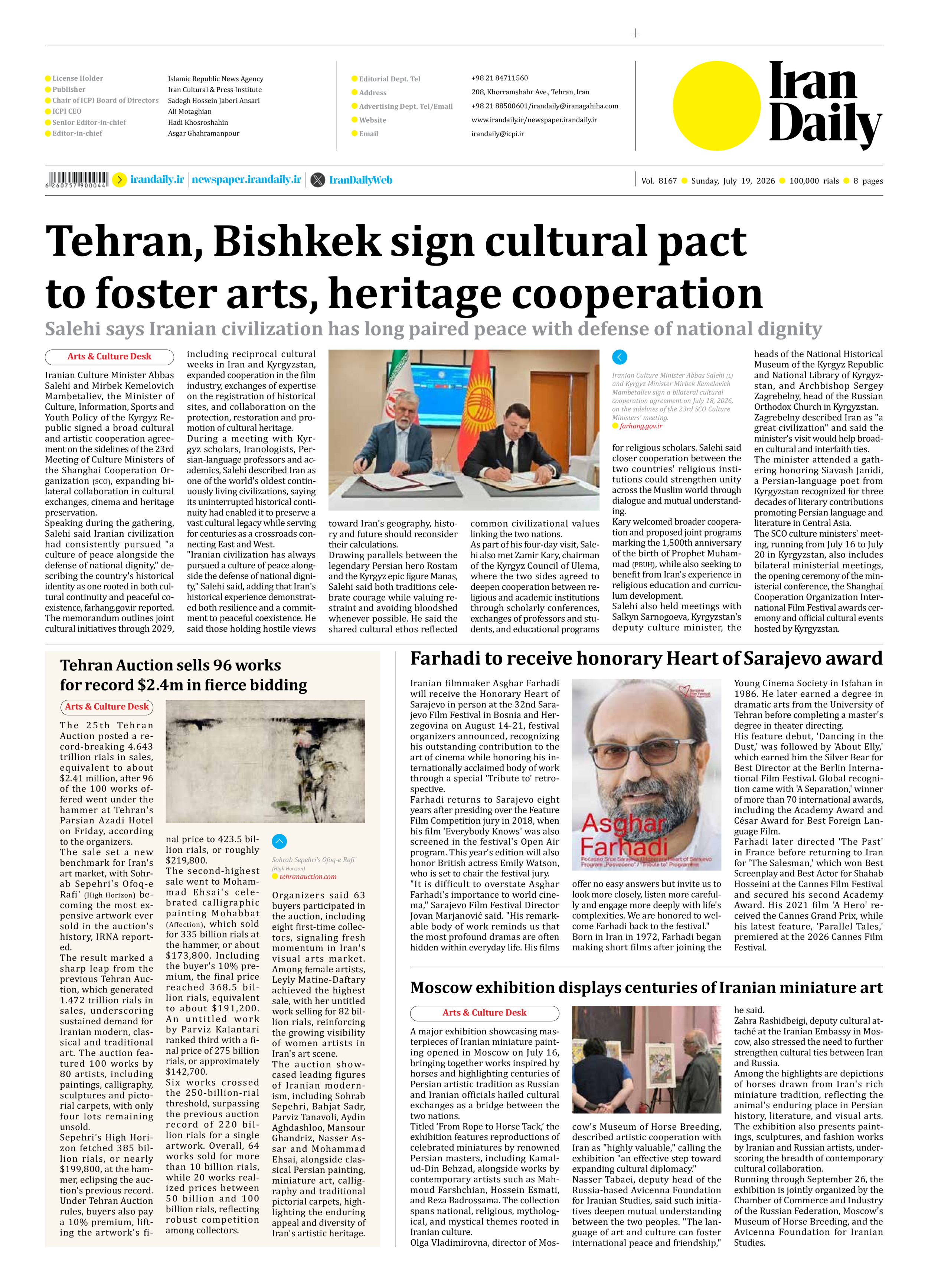
Iranian Culture Minister Abbas Salehi and Mirbek Kemelovich Mambetaliev, the Minister of Culture, Information, Sports and Youth Policy of the Kyrgyz Republic signed a broad cultural and artistic cooperation agreement on the sidelines of the 23rd Meeting of Culture Ministers of the Shanghai Cooperation Organization (SCO), expanding bilateral collaboration in cultural exchanges, cinema and heritage preservation.
Speaking during the gathering, Salehi said Iranian civilization had consistently pursued "a culture of peace alongside the defense of national dignity," describing the country's historical identity as one rooted in both cultural continuity and peaceful coexistence, farhang.gov.ir reported.
The memorandum outlines joint cultural initiatives through 2029, including reciprocal cultural weeks in Iran and Kyrgyzstan, expanded cooperation in the film industry, exchanges of expertise on the registration of historical sites, and collaboration on the protection, restoration and promotion of cultural heritage.
During a meeting with Kyrgyz scholars, Iranologists, Persian-language professors and academics, Salehi described Iran as one of the world's oldest continuously living civilizations, saying its uninterrupted historical continuity had enabled it to preserve a vast cultural legacy while serving for centuries as a crossroads connecting East and West.
"Iranian civilization has always pursued a culture of peace alongside the defense of national dignity," Salehi said, adding that Iran's historical experience demonstrated both resilience and a commitment to peaceful coexistence. He said those holding hostile views toward Iran's geography, history and future should reconsider their calculations.
Drawing parallels between the legendary Persian hero Rostam and the Kyrgyz epic figure Manas, Salehi said both traditions celebrate courage while valuing restraint and avoiding bloodshed whenever possible. He said the shared cultural ethos reflected common civilizational values linking the two nations.
As part of his four-day visit, Salehi also met Zamir Kary, chairman of the Kyrgyz Council of Ulema, where the two sides agreed to deepen cooperation between religious and academic institutions through scholarly conferences, exchanges of professors and students, and educational programs for religious scholars. Salehi said closer cooperation between the two countries' religious institutions could strengthen unity across the Muslim world through dialogue and mutual understanding.
Kary welcomed broader cooperation and proposed joint programs marking the 1,500th anniversary of the birth of Prophet Muhammad (PBUH), while also seeking to benefit from Iran's experience in religious education and curriculum development.
Salehi also held meetings with Salkyn Sarnogoeva, Kyrgyzstan's deputy culture minister, the heads of the National Historical Museum of the Kyrgyz Republic and National Library of Kyrgyzstan, and Archbishop Sergey Zagrebelny, head of the Russian Orthodox Church in Kyrgyzstan.
Zagrebelny described Iran as "a great civilization" and said the minister's visit would help broaden cultural and interfaith ties.
The minister attended a gathering honoring Siavash Janidi, a Persian-language poet from Kyrgyzstan recognized for three decades of literary contributions promoting Persian language and literature in Central Asia.
The SCO culture ministers' meeting, running from July 16 to July 20 in Kyrgyzstan, also includes bilateral ministerial meetings, the opening ceremony of the ministerial conference, the Shanghai Cooperation Organization International Film Festival awards ceremony and official cultural events hosted by Kyrgyzstan.