







Development-oriented middle class prevents collapse of Iranian society
Iranian society in recent years has encountered economic difficulties and certain social fissures, yet the experience of the recent war demonstrated that some dissatisfactions do not necessarily signify national rupture. Ali Asghar Saeedi, sociologist and associate professor at the University of Tehran, in an exclusive interview with Iran Newspaper while emphasizing the role of historical memory, national identity, social resilience, and the formation of a cultural middle class, states that external threat activates more profound layers of Iranian identity, and this very phenomenon engenders national solidarity. He simultaneously warns that this social capital will prove durable only if, subsequent to the US-Israeli war on Iran, it is accompanied by reforms in administrative methods, economic reconstruction, and the provision of public welfare. The translated interview that you shall read below concerns this fundamental question: why, despite certain internal dissatisfactions, Iranian society achieved cohesion when confronted with external threat, and how might this social capital be preserved and transformed into development in the postwar era?
Ali Asghar Saeedi
IRAN: Iran withstood the military aggression of the United States and Israel, and this very resistance prevented the aggressors from attaining their objectives. In what do you discern the secret and origins of this national resistance? Which components thereof appeared most worthy of contemplation to you?
SAEEDI: Your question, from the perspective of political sociology, historical sociology, and studies pertaining to social resilience, is extremely significant. Answering this question necessitates extensive field research, and I am unaware whether such research has been conducted. Nevertheless, if we endeavor to synthesize the viewpoints of specialists — what domestic analysts and experts have propounded to date concerning the secret of Iran’s resistance under conditions of external pressure, prolonged sanction, internal social crises, and direct warfare — several principal axes may be accentuated.
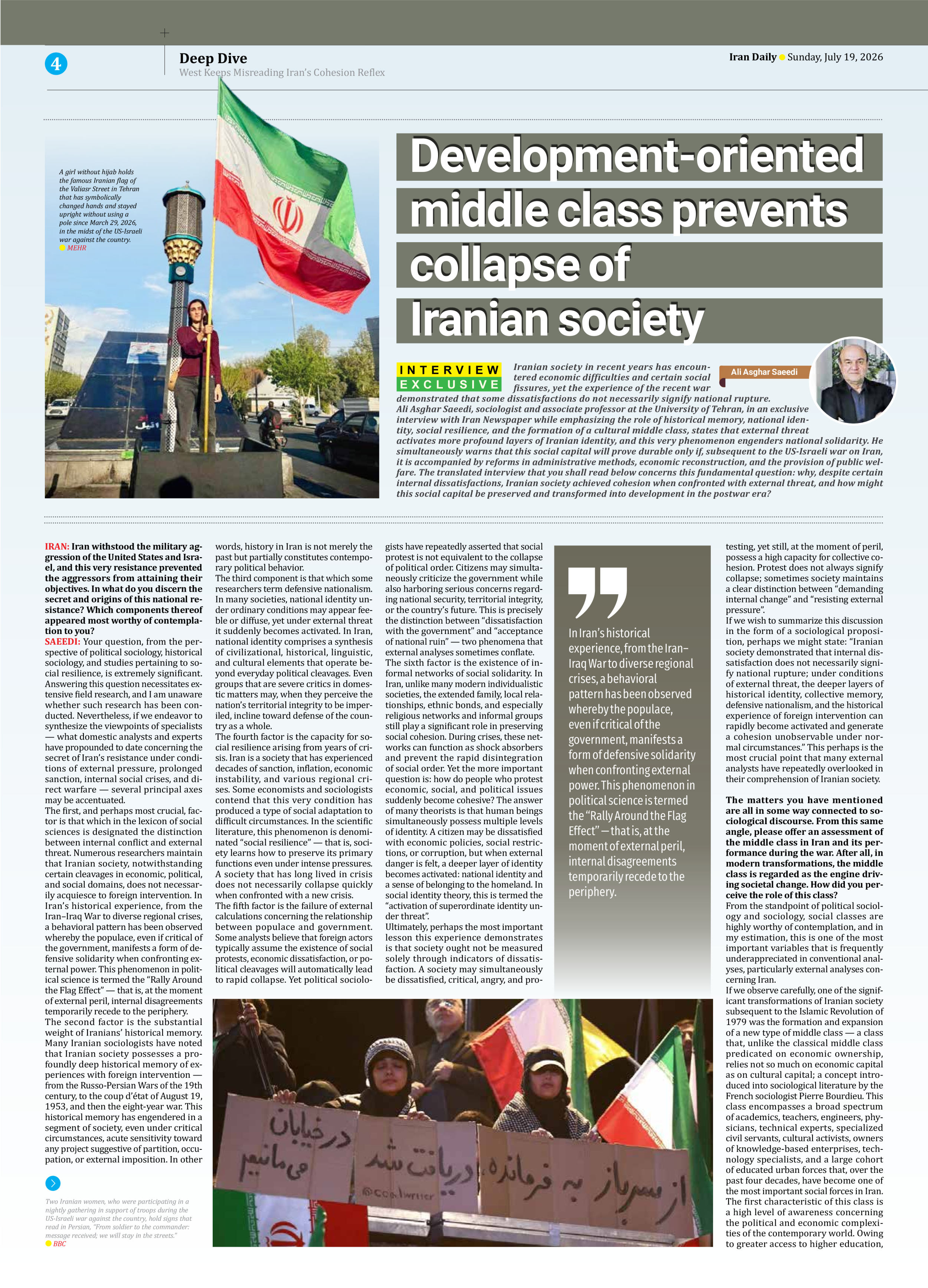
The first, and perhaps most crucial, factor is that which in the lexicon of social sciences is designated the distinction between internal conflict and external threat. Numerous researchers maintain that Iranian society, notwithstanding certain cleavages in economic, political, and social domains, does not necessarily acquiesce to foreign intervention. In Iran’s historical experience, from the Iran–Iraq War to diverse regional crises, a behavioral pattern has been observed whereby the populace, even if critical of the government, manifests a form of defensive solidarity when confronting external power. This phenomenon in political science is termed the “Rally Around the Flag Effect” — that is, at the moment of external peril, internal disagreements temporarily recede to the periphery.
The second factor is the substantial weight of Iranians’ historical memory. Many Iranian sociologists have noted that Iranian society possesses a profoundly deep historical memory of experiences with foreign intervention — from the Russo-Persian Wars of the 19th century, to the coup d’état of August 19, 1953, and then the eight-year war. This historical memory has engendered in a segment of society, even under critical circumstances, acute sensitivity toward any project suggestive of partition, occupation, or external imposition. In other words, history in Iran is not merely the past but partially constitutes contemporary political behavior.
The third component is that which some researchers term defensive nationalism. In many societies, national identity under ordinary conditions may appear feeble or diffuse, yet under external threat it suddenly becomes activated. In Iran, national identity comprises a synthesis of civilizational, historical, linguistic, and cultural elements that operate beyond everyday political cleavages. Even groups that are severe critics in domestic matters may, when they perceive the nation’s territorial integrity to be imperiled, incline toward defense of the country as a whole.
The fourth factor is the capacity for social resilience arising from years of crisis. Iran is a society that has experienced decades of sanction, inflation, economic instability, and various regional crises. Some economists and sociologists contend that this very condition has produced a type of social adaptation to difficult circumstances. In the scientific literature, this phenomenon is denominated “social resilience” — that is, society learns how to preserve its primary functions even under intense pressures. A society that has long lived in crisis does not necessarily collapse quickly when confronted with a new crisis.
The fifth factor is the failure of external calculations concerning the relationship between populace and government. Some analysts believe that foreign actors typically assume the existence of social protests, economic dissatisfaction, or political cleavages will automatically lead to rapid collapse. Yet political sociologists have repeatedly asserted that social protest is not equivalent to the collapse of political order. Citizens may simultaneously criticize the government while also harboring serious concerns regarding national security, territorial integrity, or the country’s future. This is precisely the distinction between “dissatisfaction with the government” and “acceptance of national ruin” — two phenomena that external analyses sometimes conflate.
The sixth factor is the existence of informal networks of social solidarity. In Iran, unlike many modern individualistic societies, the extended family, local relationships, ethnic bonds, and especially religious networks and informal groups still play a significant role in preserving social cohesion. During crises, these networks can function as shock absorbers and prevent the rapid disintegration of social order. Yet the more important question is: how do people who protest economic, social, and political issues suddenly become cohesive? The answer of many theorists is that human beings simultaneously possess multiple levels of identity. A citizen may be dissatisfied with economic policies, social restrictions, or corruption, but when external danger is felt, a deeper layer of identity becomes activated: national identity and a sense of belonging to the homeland. In social identity theory, this is termed the “activation of superordinate identity under threat”.
Ultimately, perhaps the most important lesson this experience demonstrates is that society ought not be measured solely through indicators of dissatisfaction. A society may simultaneously be dissatisfied, critical, angry, and protesting, yet still, at the moment of peril, possess a high capacity for collective cohesion. Protest does not always signify collapse; sometimes society maintains a clear distinction between “demanding internal change” and “resisting external pressure”.
If we wish to summarize this discussion in the form of a sociological proposition, perhaps we might state: “Iranian society demonstrated that internal dissatisfaction does not necessarily signify national rupture; under conditions of external threat, the deeper layers of historical identity, collective memory, defensive nationalism, and the historical experience of foreign intervention can rapidly become activated and generate a cohesion unobservable under normal circumstances.” This perhaps is the most crucial point that many external analysts have repeatedly overlooked in their comprehension of Iranian society.
The matters you have mentioned are all in some way connected to sociological discourse. From this same angle, please offer an assessment of the middle class in Iran and its performance during the war. After all, in modern transformations, the middle class is regarded as the engine driving societal change. How did you perceive the role of this class?
From the standpoint of political sociology and sociology, social classes are highly worthy of contemplation, and in my estimation, this is one of the most important variables that is frequently underappreciated in conventional analyses, particularly external analyses concerning Iran.
If we observe carefully, one of the significant transformations of Iranian society subsequent to the Islamic Revolution of 1979 was the formation and expansion of a new type of middle class — a class that, unlike the classical middle class predicated on economic ownership, relies not so much on economic capital as on cultural capital; a concept introduced into sociological literature by the French sociologist Pierre Bourdieu. This class encompasses a broad spectrum of academics, teachers, engineers, physicians, technical experts, specialized civil servants, cultural activists, owners of knowledge-based enterprises, technology specialists, and a large cohort of educated urban forces that, over the past four decades, have become one of the most important social forces in Iran.
The first characteristic of this class is a high level of awareness concerning the political and economic complexities of the contemporary world. Owing to greater access to higher education,
media, specialized knowledge, and global communications, this class can usually comprehend the real consequences of war, foreign intervention, and the collapse of political order better than other social groups. Contrary to the prevailing assumption that political dissatisfaction necessarily leads to welcoming any change in the political system, this class often understands that external attack or political instability can generate a chain of uncontrollable consequences: excessive depreciation of currency, breakdown of public services, large-scale emigration of elites, destruction of infrastructure, economic insecurity, and even partition or civil war.
The second important characteristic of this class is its preference for development over chaos. The new middle class is generally not a revolutionary class. In the literature of development sociology, it is stated that the middle class, rather than desiring fundamental transformation, seeks gradual reform and sustainable development. The reason is clear: this class has made the greatest investment in education, expertise, profession, and foresight, and any severe instability could destroy that long-term capital. For this reason, even if under normal conditions it criticizes economic, social, or cultural policies, at the moment it perceives the overall structure of the country to be exposed to external threat, it alters its behavior.
The third characteristic is the intense dependence of this class upon institutional order and modern infrastructure. Unlike traditional classes, whose economic life may be partially independent of complex modern structures, the new middle class has organized its daily existence in direct connection with the university, the banking system, the internet, the specialized labor market, formal education, modern commerce, digital communications, and bureaucratic structures. For this reason, this class knows better than others that foreign war or political collapse would destroy precisely these infrastructures before anything else.
The fourth characteristic is rational calculation. This class typically regulates its political action not merely on the basis of emotions but rather on a cost-benefit calculus. Under normal conditions, it may criticize, advance political and social demands in the public sphere, participate in certain protests, or abstain from certain elections, but when confronted with external danger, a rational reassessment occurs. This class asks: “Is the available alternative superior to the current condition, or will its costs prove far more costly?”
This is why, under conditions of external threat, the behavior of this class usually changes. This change does not necessarily signify active political support; rather, it sometimes manifests as a temporary suspension of criticism. I want to use this point to recommend to officials that, should war unfortunately commence again, they should not disconnect the internet because even if access to the internet and the public sphere remains open and the possibility of continued criticism persists, a segment of this class will consciously reduce its level of criticism or remain silent, and many of them will express support, because their mental priority will have shifted from “demanding change” to “preventing collapse”.
From a theoretical perspective, one may say this class distinguishes between two conditions: first, dissatisfaction with the performance of internal structures; second, a threat to the existence of the country. These two are not identical for them. An individual may criticize internal policies yet still believe that foreign war or severe instability would eliminate any possibility of future development.
Another important point is that the Iranian middle class over recent decades has become intensely globalized. This class studies the experiences of various countries and observes contemporary examples: Iraq after 2003, Libya after 2011, Syria during its war. For a significant portion of this class, these experiences constitute a historical warning, demonstrating that the collapse of the central government, whether by external force or externally instigated, even if initiated under the slogan of freedom or change, can lead to years of instability.
Consequently, one may argue that one of the most important factors in Iran’s social resistance to external pressure is not merely nationalist sentiments or political mobilization but rather the presence of a broad, educated, forward-looking, and development-oriented cultural middle class — a class that, although it may criticize many existing conditions, at the moment of external threat, owing to greater awareness of the costs of collapse, prefers to prevent the country from entering a path of chaos. Perhaps one of the significant errors of many analysts from foreign forces is precisely this: they assume every critical society is necessarily a society ripe for collapse, whereas the existence of a development-oriented middle class can produce exactly the opposite outcome.
The American-Israeli war against Iran brought together numerous political forces with diverse positions in solidarity against foreign aggression. What is your proposal for the continuation of such solidarity?
The 40-day war brought together diverse political and social forces against external aggression — both domestically and abroad — but one must distinguish between “wartime solidarity” and “sustainable postwar cohesion”. Wartime solidarity typically forms due to the presence of a common threat, and after the danger subsides, political, economic, and social disagreements reemerge. Therefore, expecting the same silence and unanimity to persist is neither realistic nor necessarily desirable. What can be preserved is the national core of this solidarity: the acceptance that Iran is the common homeland of all Iranians and that political disagreement should not lead to exclusion or reliance upon foreign intervention. I observed many compatriots abroad who, despite the hardships they had witnessed in the past, were intensely concerned about Iran.
For the sustainability of this social capital, several actions are essential.
First, no faction should interpret the people’s resistance as complete endorsement of itself. Many people stood up to defend the country.
Second, a distinction must be made between the domestic critic and the one aligned with the enemy. A citizen may simultaneously be a critic yet loyal to Iran.
Third, postwar solidarity must be reciprocated with openness, the reduction of certain restrictions, the hearing of diverse groups’ voices, and genuine popular participation.
Fourth, economic reconstruction, inflation control, an increase in employment and public services, and the reduction of insecurity regarding the future must be placed at the center of postwar policies. National solidarity is not preserved by slogans alone; it must have tangible effects on people’s daily lives. Among these, the new middle class plays an important role.
During wartime, this class, due to its awareness of the consequences of collapse and instability, may temporarily reduce its criticism. After the war, it expects to have a share in the administration of the country and that development, stability, civil liberties, and connection with the world will be strengthened. Consequently, preserving the very unity of the wartime period is not possible, but it can be transformed into a kind of “solidarity amid disagreement”. The condition for this is that the government respond to the people’s solidarity with trust, governance reform, justice, development, and the acceptance of pluralism. The people granted the country an opportunity for survival during the war; postwar policy must grant the people an opportunity for participation and a better life.
Alongside popular solidarity, we witnessed an increase in political cohesion and inter-institutional coordination at the national level, which appears to have prevented the collapse of the country’s administrative structure. How do you evaluate the government’s role in this coordination and cohesion?
In my estimation, if we wish to evaluate the government’s role in this war from the perspective of the sociology of the state, we must distinguish between public contestation and governance capacity. These two are not necessarily identical. A government may face serious challenges in public satisfaction yet simultaneously possess high institutional capacity for crisis management; and vice versa.
In the case of Iran, one point that many domestic and foreign analysts have noted is that, contrary to the expectations of some observers, the country’s administrative structure did not disintegrate during the war. Ministries, provincial governorates, service institutions, relief networks, the health sector, the energy network, banks, security councils, and military and law enforcement forces were able, despite intense pressure, to maintain their primary functions. This is what in the literature of political science is termed institutional resilience.
The experience of many countries demonstrates that the onset of state collapse usually occurs when essential services such as electricity, water, healthcare, transportation, the banking system, and commodity distribution cease to function. In Iran, despite damages, these services did not completely halt, and this very fact contributed to the preservation of relative social calm. Recent research also emphasizes that war does not necessarily lead to the collapse of institutions and that the quality of governance during crisis plays a decisive role in preventing collapse.
Nevertheless, the experience of various countries shows that success in war management transforms into sustainable capital only when the mobilization and coordination capacity of the crisis period is converted, in the postwar era, into efficient governance, economic reconstruction, increased public trust, and institutional reforms.
The article first appeared in the
Persian-language newspaper Iran.