





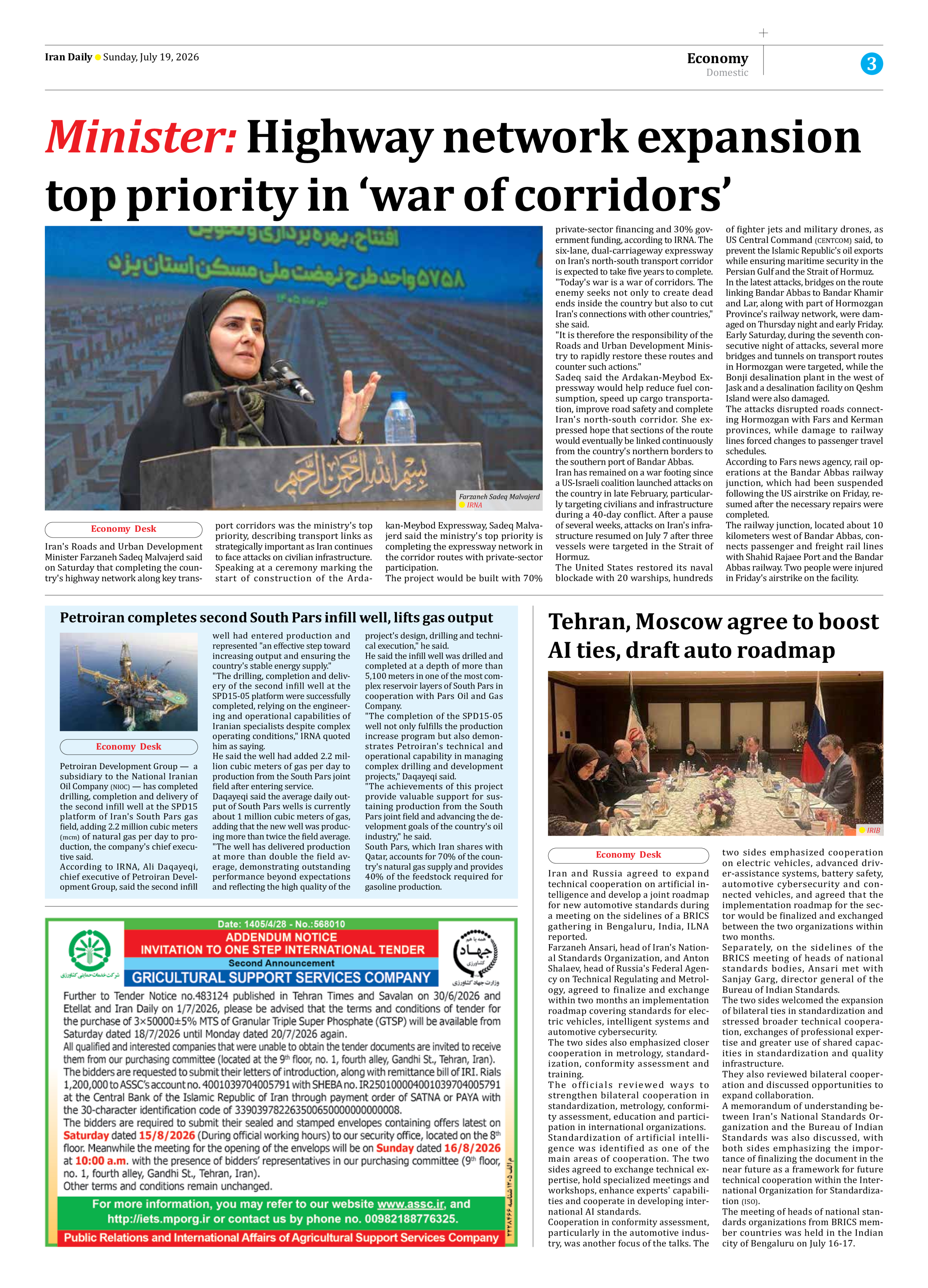


Minister: Highway network expansion top priority in ‘war of corridors’
Iran's Roads and Urban Development Minister Farzaneh Sadeq Malvajerd said on Saturday that completing the country's highway network along key transport corridors was the ministry's top priority, describing transport links as strategically important as Iran continues to face attacks on civilian infrastructure.
Speaking at a ceremony marking the start of construction of the Ardakan-Meybod Expressway, Sadeq Malvajerd said the ministry's top priority is completing the expressway network in the corridor routes with private-sector participation.
The project would be built with 70% private-sector financing and 30% government funding, according to IRNA. The six-lane, dual-carriageway expressway on Iran's north-south transport corridor is expected to take five years to complete.
"Today's war is a war of corridors. The enemy seeks not only to create dead ends inside the country but also to cut Iran's connections with other countries," she said.
"It is therefore the responsibility of the Roads and Urban Development Ministry to rapidly restore these routes and counter such actions."
Sadeq said the Ardakan-Meybod Expressway would help reduce fuel consumption, speed up cargo transportation, improve road safety and complete Iran's north-south corridor. She expressed hope that sections of the route would eventually be linked continuously from the country's northern borders to the southern port of Bandar Abbas.
Iran has remained on a war footing since a US-Israeli coalition launched attacks on the country in late February, particularly targeting civilians and infrastructure during a 40-day conflict. After a pause of several weeks, attacks on Iran's infrastructure resumed on July 7 after three vessels were targeted in the Strait of Hormuz.
The United States restored its naval blockade with 20 warships, hundreds of fighter jets and military drones, as US Central Command (CENTCOM) said, to prevent the Islamic Republic's oil exports while ensuring maritime security in the Persian Gulf and the Strait of Hormuz.
In the latest attacks, bridges on the route linking Bandar Abbas to Bandar Khamir and Lar, along with part of Hormozgan Province's railway network, were damaged on Thursday night and early Friday. Early Saturday, during the seventh consecutive night of attacks, several more bridges and tunnels on transport routes in Hormozgan were targeted, while the Bonji desalination plant in the west of Jask and a desalination facility on Qeshm Island were also damaged.
The attacks disrupted roads connecting Hormozgan with Fars and Kerman provinces, while damage to railway lines forced changes to passenger travel schedules.
According to Fars news agency, rail operations at the Bandar Abbas railway junction, which had been suspended following the US airstrike on Friday, resumed after the necessary repairs were completed.
The railway junction, located about 10 kilometers west of Bandar Abbas, connects passenger and freight rail lines with Shahid Rajaee Port and the Bandar Abbas railway. Two people were injured in Friday's airstrike on the facility.