







Iran-US disagreement over paragraph 5 most formidable impediment
The violation of numerous paragraphs of the Islamabad Memorandum of Understanding (MoU) by the United States, coupled with the American claims regarding the cessation of the cease-fire, alongside media conjectures concerning the start of a novel round of technical dialogues between Iran and the United States, have imposed a state of contradiction and obscurity upon the political and diplomatic atmosphere. The recent American assaults upon points within the territorial confines of Iran have, moreover, served as the commencement of a fresh period of military and political hostilities between the two polities. Washington, simultaneously, claims that Tehran has violated the provisional Islamabad accord, whereas, according to Iran’s interpretation, any navigation through the Strait of Hormuz must proceed in accordance with the arrangements designated by Iran, and any endeavor to convey vessels through the southern corridor of this waterway, absent coordination with Iran, shall entail consequences. Tehran, cognizant of the significance of resolving this matter with the accompaniment and cooperation of Oman, aspires to formulate a mechanism that, while providing the groundwork for the execution of the Islamabad understanding, shall likewise furnish the conditions for the exercise of sovereignty by the two neighbors over this waterway. The Saturday journey of Abbas Araghchi, Iran’s minister of Foreign Affairs, to Muscat may, similarly, be evaluated within this identical framework. Existent evidence, inclusive of Iran’s actions and determinations in recent weeks, indicates that, for Tehran, the implementation of the memorandum’s paragraphs, as a document that seeks to safeguard the nation’s interests, occupies a position of primacy, and this priority shall remain valid for so long as the condition of securing interests is realized. In this same context, an interview has been conducted with Kourosh Ahmadi, a former Iranian diplomat and analyst of international affairs, concerning the prevailing status of Iran-US negotiations and the challenges that confront them.
Kourosh Ahmadi
The Memorandum of Understanding signed between Iran and the United States currently finds itself at one of its most critical junctures: Donald Trump, in contradictory statements, simultaneously speaks of the termination of the cease-fire and of the continuation of negotiations. How may this existing condition be analyzed?
AHMADI: Yes, the condition that has materialized is, to a certain degree, ambiguous. Still, little information is available concerning the July 7 incident in the Persian Gulf. Iran has neither claimed responsibility for the attack upon two or three vessels on that day; nor, however, has it denied it. Subsequent to these events, a series of aggressions was perpetrated against targets along Iran’s coastlines and, on one occasion, against two bridges near Aq Qala, in Golestan Province. The assault upon these two bridges, in particular, bore significant indications and was of considerable importance.
Perhaps one may state that the revocation of the oil and petrochemical sanctions waiver was the most momentous development over the past week. This waiver was comprehensive and without flaw; in such a manner that it enabled the participation of sanctioned Iranian entities, including those companies affiliated with the Islamic Revolutionary Guard Corps, permitted the export of petroleum and petrochemical products from Iranian origin to the United States, and allowed for the settlement of transaction funds in US dollars, and encompassed additional instances of this nature.
Donald Trump has, furthermore, declared the end of the cease-fire, although, simultaneously, he has also spoken of the possibility of continuing negotiations. For so long as the parties retain the capacity for dialogue, one may remain hopeful for a return to the path of negotiation.
The reinstatement of oil sanctions, the imposition of novel sanctions, and military aggression each, in their own manner, violate the paragraphs of the Islamabad MoU. Now, the critical question is for how much longer this document shall endure beneath the weight of these pressures?
Precisely so. The revocation of the waiver issued by the US Department of the Treasury concerning petroleum and petrochemical products constitutes a violation of paragraph 10 of the Memorandum of Understanding. Military attacks, likewise, are deemed a contravention of the entirety of this understanding. On the opposing side, the United States claims that Iran has not implemented paragraph five and, furthermore, asserts that the Tuesday attacks upon several vessels were perpetrated by Iran and thus constituted a breach of the memorandum.
Consequently, as of today, the Memorandum of Understanding is apparently nullified; however, the issue is that at least one of the two mediators, namely Pakistan, continues to pursue, with seriousness, the perpetuation of the process and the salvaging of the memorandum.
Certain analysts maintain that the continuation of the current state of affairs shall lead to a war more extensive than the 40-Day War, whereas a number of others contend that the exchanges of fire between the two sides constitute a kind of accumulation of leverage for the negotiating table. In light of the prevailing trajectory and evidence, which of the two analyses is closer to the factual reality on the ground?
At present, and at this juncture, I do not align myself with those analysts who suggest the likelihood of a large-scale war. However, I do believe that the probability of a return to a widespread and full-scale war, which prior to July 7 seemed impossible, has risen over the past week.
Certainly, for Trump, it would be a politically egregious debacle to concede that all paragraphs of the Memorandum of Understanding, except the paragraph pertaining to the Strait of Hormuz, are to be implemented. In other words, should the paragraph concerning the Strait of Hormuz remain unexecuted, Trump shall become utterly discredited within the domestic politics of the United States and, to a certain extent, regarding the standing of that nation on the international stage.
Of course, between the pre-July 7 condition and all-out war, certain intermediate states exist; among them, Trump’s reversion to the maritime blockade of Iran’s ports, to which I previously alluded. In such a condition, limited military attacks — that is, low-intensity warfare — in the manner witnessed over the past week, may likewise persist. This is a condition that ought not to be acceptable for Iran. Iran’s socio-economic circumstances do not permit the formation of such a state.
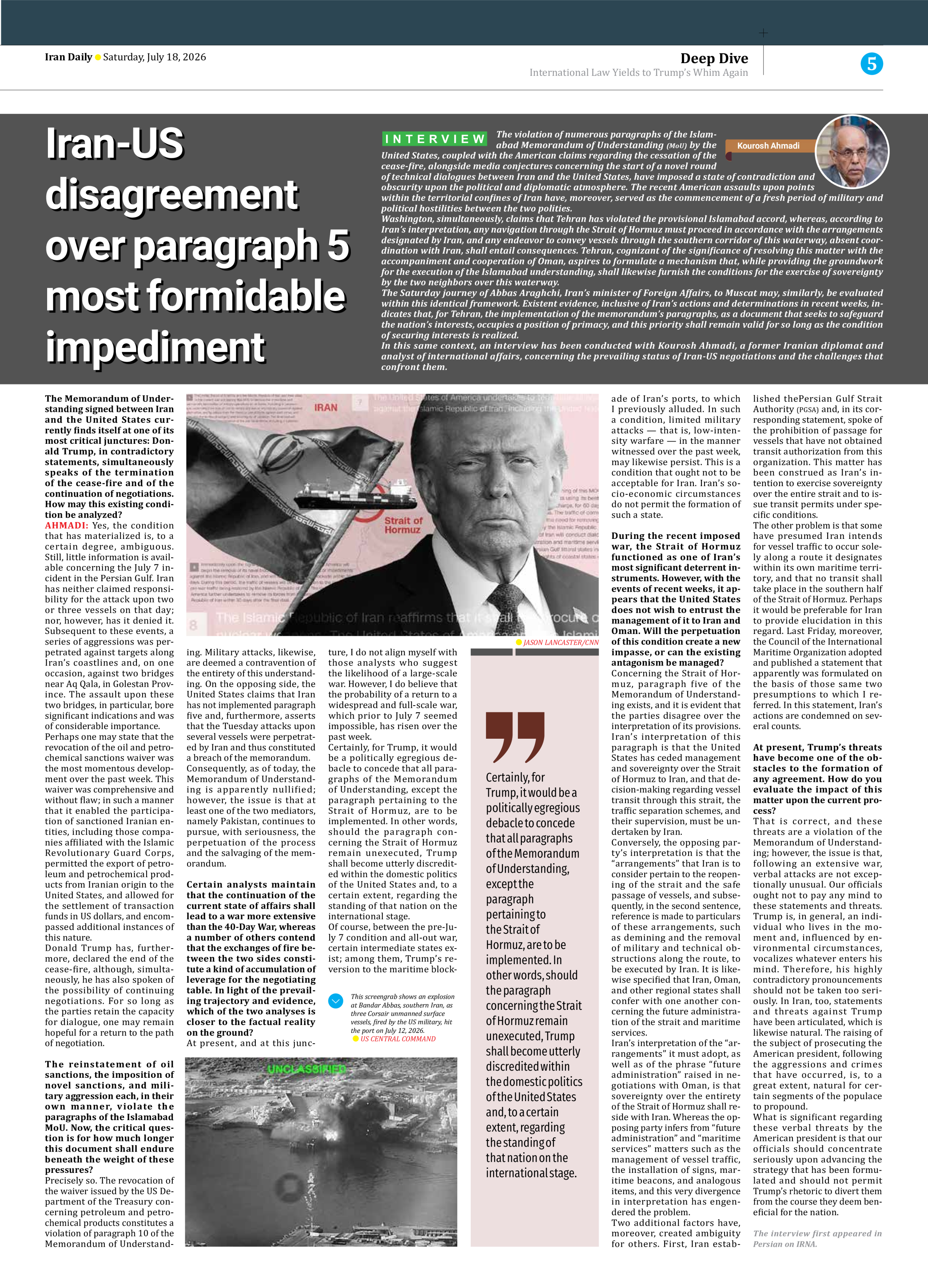
During the recent imposed war, the Strait of Hormuz functioned as one of Iran’s most significant deterrent instruments. However, with the events of recent weeks, it appears that the United States does not wish to entrust the management of it to Iran and Oman. Will the perpetuation of this condition create a new impasse, or can the existing antagonism be managed?
Concerning the Strait of Hormuz, paragraph five of the Memorandum of Understanding exists, and it is evident that the parties disagree over the interpretation of its provisions. Iran’s interpretation of this paragraph is that the United States has ceded management and sovereignty over the Strait of Hormuz to Iran, and that decision-making regarding vessel transit through this strait, the traffic separation schemes, and their supervision, must be undertaken by Iran.
Conversely, the opposing party’s interpretation is that the “arrangements” that Iran is to consider pertain to the reopening of the strait and the safe passage of vessels, and subsequently, in the second sentence, reference is made to particulars of these arrangements, such as demining and the removal of military and technical obstructions along the route, to be executed by Iran. It is likewise specified that Iran, Oman, and other regional states shall confer with one another concerning the future administration of the strait and maritime services.
Iran’s interpretation of the “arrangements” it must adopt, as well as of the phrase “future administration” raised in negotiations with Oman, is that sovereignty over the entirety of the Strait of Hormuz shall reside with Iran. Whereas the opposing party infers from “future administration” and “maritime services” matters such as the management of vessel traffic, the installation of signs, maritime beacons, and analogous items, and this very divergence in interpretation has engendered the problem.
Two additional factors have, moreover, created ambiguity for others. First, Iran established thePersian Gulf Strait Authority (PGSA) and, in its corresponding statement, spoke of the prohibition of passage for vessels that have not obtained transit authorization from this organization. This matter has been construed as Iran’s intention to exercise sovereignty over the entire strait and to issue transit permits under specific conditions.
The other problem is that some have presumed Iran intends for vessel traffic to occur solely along a route it designates within its own maritime territory, and that no transit shall take place in the southern half of the Strait of Hormuz. Perhaps it would be preferable for Iran to provide elucidation in this regard. Last Friday, moreover, the Council of the International Maritime Organization adopted and published a statement that apparently was formulated on the basis of those same two presumptions to which I referred. In this statement, Iran’s actions are condemned on several counts.
At present, Trump’s threats have become one of the obstacles to the formation of any agreement. How do you evaluate the impact of this matter upon the current process?
That is correct, and these threats are a violation of the Memorandum of Understanding; however, the issue is that, following an extensive war, verbal attacks are not exceptionally unusual. Our officials ought not to pay any mind to these statements and threats. Trump is, in general, an individual who lives in the moment and, influenced by environmental circumstances, vocalizes whatever enters his mind. Therefore, his highly contradictory pronouncements should not be taken too seriously. In Iran, too, statements and threats against Trump have been articulated, which is likewise natural. The raising of the subject of prosecuting the American president, following the aggressions and crimes that have occurred, is, to a great extent, natural for certain segments of the populace to propound.
What is significant regarding these verbal threats by the American president is that our officials should concentrate seriously upon advancing the strategy that has been formulated and should not permit Trump’s rhetoric to divert them from the course they deem beneficial for the nation.
The interview first appeared in Persian on IRNA.