





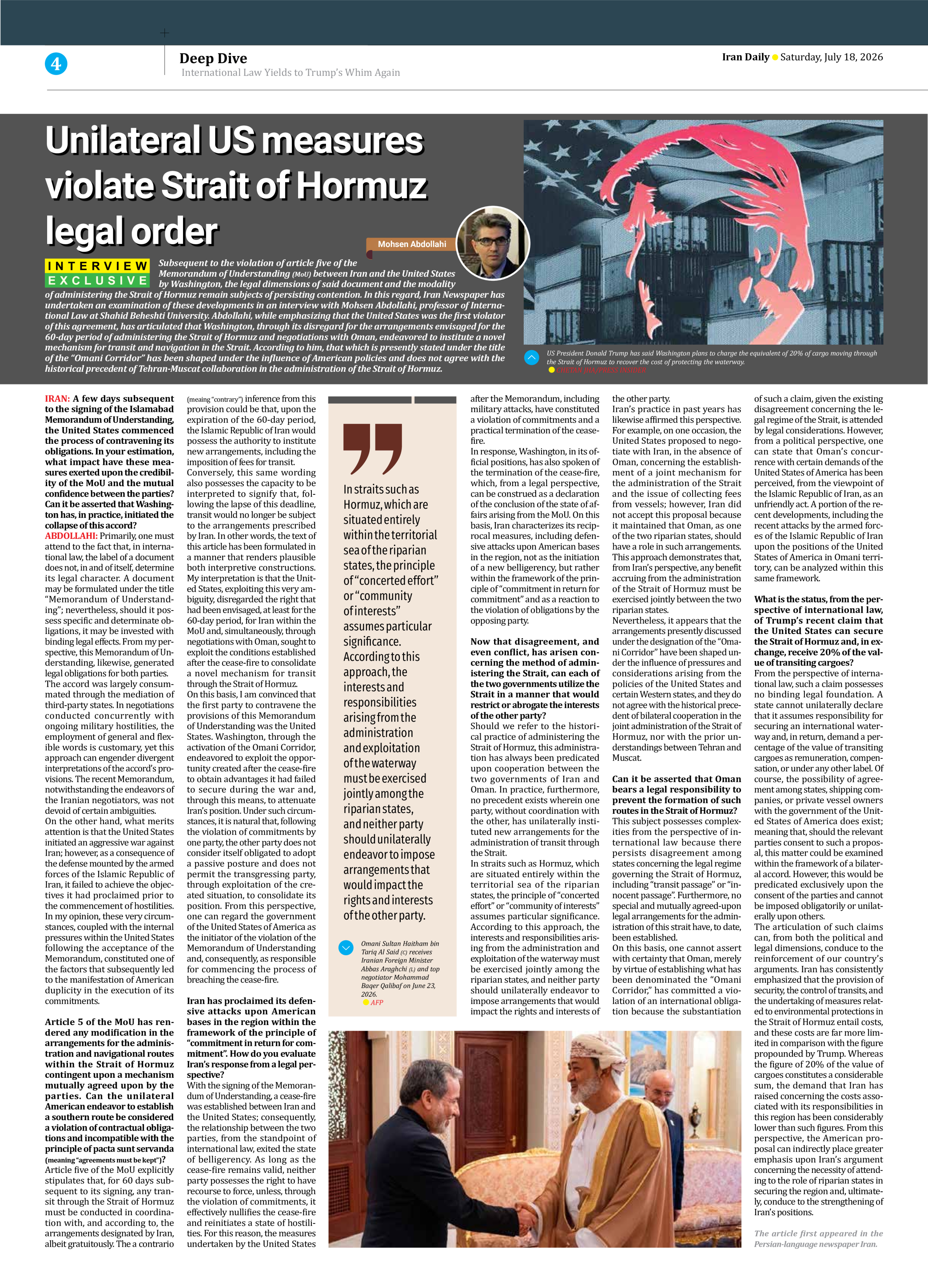


Unilateral US measures violate Strait of Hormuz legal order
Subsequent to the violation of article five of the Memorandum of Understanding (MoU) between Iran and the United States by Washington, the legal dimensions of said document and the modality of administering the Strait of Hormuz remain subjects of persisting contention. In this regard, Iran Newspaper has undertaken an examination of these developments in an interview with Mohsen Abdollahi, professor of International Law at Shahid Beheshti University. Abdollahi, while emphasizing that the United States was the first violator of this agreement, has articulated that Washington, through its disregard for the arrangements envisaged for the 60-day period of administering the Strait of Hormuz and negotiations with Oman, endeavored to institute a novel mechanism for transit and navigation in the Strait. According to him, that which is presently stated under the title of the “Omani Corridor” has been shaped under the influence of American policies and does not agree with the historical precedent of Tehran-Muscat collaboration in the administration of the Strait of Hormuz.
Mohsen Abdollahi
IRAN: A few days subsequent to the signing of the Islamabad Memorandum of Understanding, the United States commenced the process of contravening its obligations. In your estimation, what impact have these measures exerted upon the credibility of the MoU and the mutual confidence between the parties? Can it be asserted that Washington has, in practice, initiated the collapse of this accord?
ABDOLLAHI: Primarily, one must attend to the fact that, in international law, the label of a document does not, in and of itself, determine its legal character. A document may be formulated under the title “Memorandum of Understanding”; nevertheless, should it possess specific and determinate obligations, it may be invested with binding legal effects. From my perspective, this Memorandum of Understanding, likewise, generated legal obligations for both parties.
The accord was largely consummated through the mediation of third-party states. In negotiations conducted concurrently with ongoing military hostilities, the employment of general and flexible words is customary, yet this approach can engender divergent interpretations of the accord’s provisions. The recent Memorandum, notwithstanding the endeavors of the Iranian negotiators, was not devoid of certain ambiguities.
On the other hand, what merits attention is that the United States initiated an aggressive war against Iran; however, as a consequence of the defense mounted by the armed forces of the Islamic Republic of Iran, it failed to achieve the objectives it had proclaimed prior to the commencement of hostilities. In my opinion, these very circumstances, coupled with the internal pressures within the United States following the acceptance of the Memorandum, constituted one of the factors that subsequently led to the manifestation of American duplicity in the execution of its commitments.
Article 5 of the MoU has rendered any modification in the arrangements for the administration and navigational routes within the Strait of Hormuz contingent upon a mechanism mutually agreed upon by the parties. Can the unilateral American endeavor to establish a southern route be considered a violation of contractual obligations and incompatible with the principle of pacta sunt servanda (meaning “agreements must be kept”)?
Article five of the MoU explicitly stipulates that, for 60 days subsequent to its signing, any transit through the Strait of Hormuz must be conducted in coordination with, and according to, the arrangements designated by Iran, albeit gratuitously. The a contrario (meaing “contrary”) inference from this provision could be that, upon the expiration of the 60-day period, the Islamic Republic of Iran would possess the authority to institute new arrangements, including the imposition of fees for transit.
Conversely, this same wording also possesses the capacity to be interpreted to signify that, following the lapse of this deadline, transit would no longer be subject to the arrangements prescribed by Iran. In other words, the text of this article has been formulated in a manner that renders plausible both interpretive constructions. My interpretation is that the United States, exploiting this very ambiguity, disregarded the right that had been envisaged, at least for the 60-day period, for Iran within the MoU and, simultaneously, through negotiations with Oman, sought to exploit the conditions established after the cease-fire to consolidate a novel mechanism for transit through the Strait of Hormuz.
On this basis, I am convinced that the first party to contravene the provisions of this Memorandum of Understanding was the United States. Washington, through the activation of the Omani Corridor, endeavored to exploit the opportunity created after the cease-fire to obtain advantages it had failed to secure during the war and, through this means, to attenuate Iran’s position. Under such circumstances, it is natural that, following the violation of commitments by one party, the other party does not consider itself obligated to adopt a passive posture and does not permit the transgressing party, through exploitation of the created situation, to consolidate its position. From this perspective, one can regard the government of the United States of America as the initiator of the violation of the Memorandum of Understanding and, consequently, as responsible for commencing the process of breaching the cease-fire.
Iran has proclaimed its defensive attacks upon American bases in the region within the framework of the principle of “commitment in return for commitment”. How do you evaluate Iran’s response from a legal perspective?
With the signing of the Memorandum of Understanding, a cease-fire was established between Iran and the United States; consequently, the relationship between the two parties, from the standpoint of international law, exited the state of belligerency. As long as the cease-fire remains valid, neither party possesses the right to have recourse to force, unless, through the violation of commitments, it effectively nullifies the cease-fire and reinitiates a state of hostilities. For this reason, the measures undertaken by the United States after the Memorandum, including military attacks, have constituted a violation of commitments and a practical termination of the cease-fire.
In response, Washington, in its official positions, has also spoken of the termination of the cease-fire, which, from a legal perspective, can be construed as a declaration of the conclusion of the state of affairs arising from the MoU. On this basis, Iran characterizes its reciprocal measures, including defensive attacks upon American bases in the region, not as the initiation of a new belligerency, but rather within the framework of the principle of “commitment in return for commitment” and as a reaction to the violation of obligations by the opposing party.
Now that disagreement, and even conflict, has arisen concerning the method of administering the Strait, can each of the two governments utilize the Strait in a manner that would restrict or abrogate the interests of the other party?
Should we refer to the historical practice of administering the Strait of Hormuz, this administration has always been predicated upon cooperation between the two governments of Iran and Oman. In practice, furthermore, no precedent exists wherein one party, without coordination with the other, has unilaterally instituted new arrangements for the administration of transit through the Strait.
In straits such as Hormuz, which are situated entirely within the territorial sea of the riparian states, the principle of “concerted effort” or “community of interests” assumes particular significance. According to this approach, the interests and responsibilities arising from the administration and exploitation of the waterway must be exercised jointly among the riparian states, and neither party should unilaterally endeavor to impose arrangements that would impact the rights and interests of the other party.
Iran’s practice in past years has likewise affirmed this perspective. For example, on one occasion, the United States proposed to negotiate with Iran, in the absence of Oman, concerning the establishment of a joint mechanism for the administration of the Strait and the issue of collecting fees from vessels; however, Iran did not accept this proposal because it maintained that Oman, as one of the two riparian states, should have a role in such arrangements. This approach demonstrates that, from Iran’s perspective, any benefit accruing from the administration of the Strait of Hormuz must be exercised jointly between the two riparian states.
Nevertheless, it appears that the arrangements presently discussed under the designation of the “Omani Corridor” have been shaped under the influence of pressures and considerations arising from the policies of the United States and certain Western states, and they do not agree with the historical precedent of bilateral cooperation in the joint administration of the Strait of Hormuz, nor with the prior understandings between Tehran and Muscat.
Can it be asserted that Oman bears a legal responsibility to prevent the formation of such routes in the Strait of Hormuz?
This subject possesses complexities from the perspective of international law because there persists disagreement among states concerning the legal regime governing the Strait of Hormuz, including “transit passage” or “innocent passage”. Furthermore, no special and mutually agreed-upon legal arrangements for the administration of this strait have, to date, been established.
On this basis, one cannot assert with certainty that Oman, merely by virtue of establishing what has been denominated the “Omani Corridor,” has committed a violation of an international obligation because the substantiation of such a claim, given the existing disagreement concerning the legal regime of the Strait, is attended by legal considerations. However, from a political perspective, one can state that Oman’s concurrence with certain demands of the United States of America has been perceived, from the viewpoint of the Islamic Republic of Iran, as an unfriendly act. A portion of the recent developments, including the recent attacks by the armed forces of the Islamic Republic of Iran upon the positions of the United States of America in Omani territory, can be analyzed within this same framework.
What is the status, from the perspective of international law, of Trump’s recent claim that the United States can secure the Strait of Hormuz and, in exchange, receive 20% of the value of transiting cargoes?
From the perspective of international law, such a claim possesses no binding legal foundation. A state cannot unilaterally declare that it assumes responsibility for securing an international waterway and, in return, demand a percentage of the value of transiting cargoes as remuneration, compensation, or under any other label. Of course, the possibility of agreement among states, shipping companies, or private vessel owners with the government of the United States of America does exist; meaning that, should the relevant parties consent to such a proposal, this matter could be examined within the framework of a bilateral accord. However, this would be predicated exclusively upon the consent of the parties and cannot be imposed obligatorily or unilaterally upon others.
The articulation of such claims can, from both the political and legal dimensions, conduce to the reinforcement of our country’s arguments. Iran has consistently emphasized that the provision of security, the control of transits, and the undertaking of measures related to environmental protections in the Strait of Hormuz entail costs, and these costs are far more limited in comparison with the figure propounded by Trump. Whereas the figure of 20% of the value of cargoes constitutes a considerable sum, the demand that Iran has raised concerning the costs associated with its responsibilities in this region has been considerably lower than such figures. From this perspective, the American proposal can indirectly place greater emphasis upon Iran’s argument concerning the necessity of attending to the role of riparian states in securing the region and, ultimately, conduce to the strengthening of Iran’s positions.
The article first appeared in the
Persian-language newspaper Iran.