





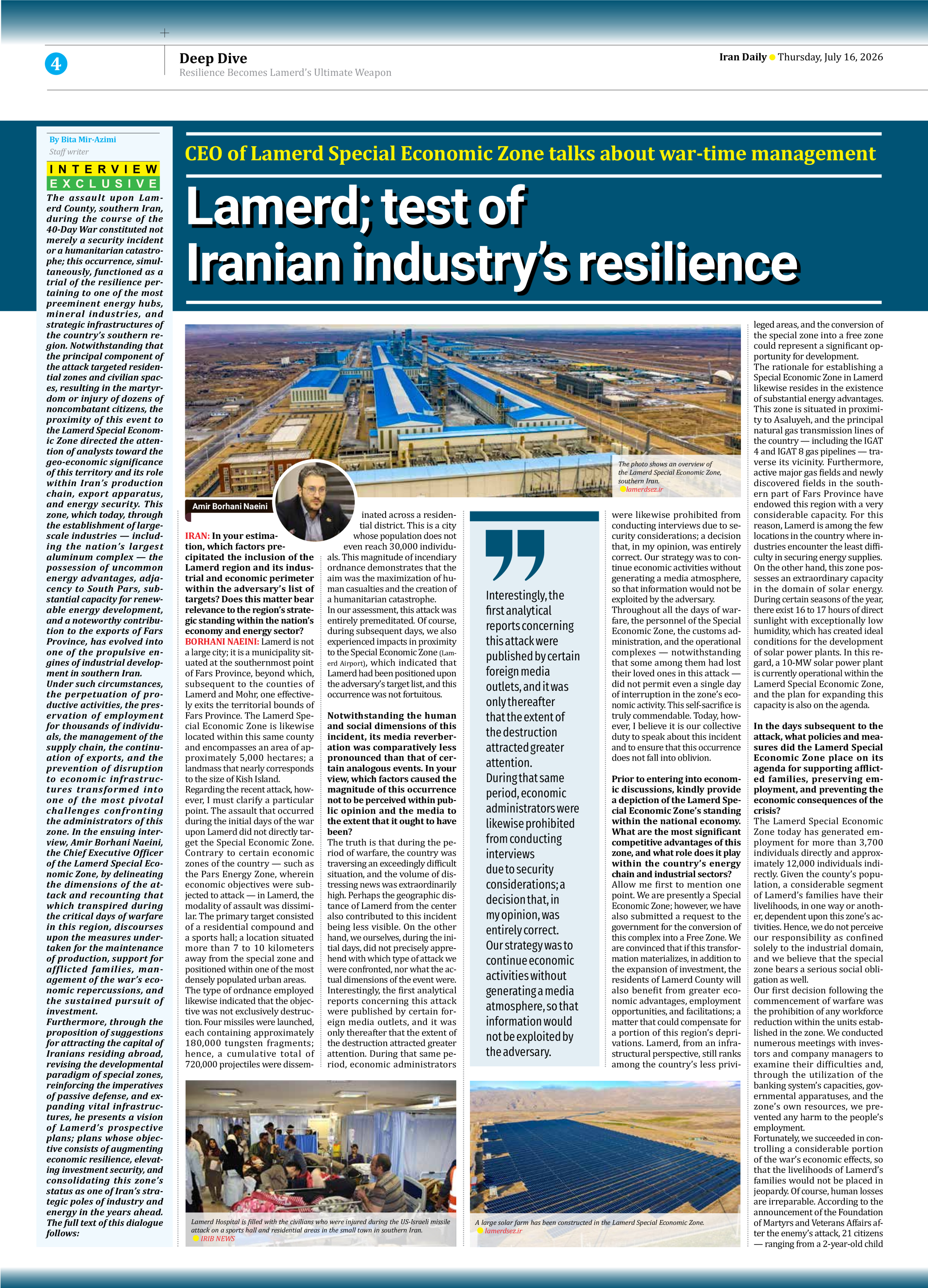


CEO of Lamerd Special Economic Zone talks about war-time management
Lamerd; test of Iranian industry’s resilience
The assault upon Lamerd County, southern Iran, during the course of the 40-Day War constituted not merely a security incident or a humanitarian catastrophe; this occurrence, simultaneously, functioned as a trial of the resilience pertaining to one of the most preeminent energy hubs, mineral industries, and strategic infrastructures of the country’s southern region. Notwithstanding that the principal component of the attack targeted residential zones and civilian spaces, resulting in the martyrdom or injury of dozens of noncombatant citizens, the proximity of this event to the Lamerd Special Economic Zone directed the attention of analysts toward the geo-economic significance of this territory and its role within Iran’s production chain, export apparatus, and energy security. This zone, which today, through the establishment of large-scale industries — including the nation’s largest aluminum complex — the possession of uncommon energy advantages, adjacency to South Pars, substantial capacity for renewable energy development, and a noteworthy contribution to the exports of Fars Province, has evolved into one of the propulsive engines of industrial development in southern Iran. Under such circumstances, the perpetuation of productive activities, the preservation of employment for thousands of individuals, the management of the supply chain, the continuation of exports, and the prevention of disruption to economic infrastructures transformed into one of the most pivotal challenges confronting the administrators of this zone. In the ensuing interview, Amir Borhani Naeini, the Chief Executive Officer of the Lamerd Special Economic Zone, by delineating the dimensions of the attack and recounting that which transpired during the critical days of warfare in this region, discourses upon the measures undertaken for the maintenance of production, support for afflicted families, management of the war’s economic repercussions, and the sustained pursuit of investment. Furthermore, through the proposition of suggestions for attracting the capital of Iranians residing abroad, revising the developmental paradigm of special zones, reinforcing the imperatives of passive defense, and expanding vital infrastructures, he presents a vision of Lamerd’s prospective plans; plans whose objective consists of augmenting economic resilience, elevating investment security, and consolidating this zone’s status as one of Iran’s strategic poles of industry and energy in the years ahead. The full text of this dialogue follows:
By Bita Mir-Azimi
Staff writer
IRAN: In your estimation, which factors precipitated the inclusion of the Lamerd region and its industrial and economic perimeter within the adversary’s list of targets? Does this matter bear relevance to the region’s strategic standing within the nation’s economy and energy sector?
BORHANI NAEINI: Lamerd is not a large city; it is a municipality situated at the southernmost point of Fars Province, beyond which, subsequent to the counties of Lamerd and Mohr, one effectively exits the territorial bounds of Fars Province. The Lamerd Special Economic Zone is likewise located within this same county and encompasses an area of approximately 5,000 hectares; a landmass that nearly corresponds to the size of Kish Island.
Regarding the recent attack, however, I must clarify a particular point. The assault that occurred during the initial days of the war upon Lamerd did not directly target the Special Economic Zone. Contrary to certain economic zones of the country — such as the Pars Energy Zone, wherein economic objectives were subjected to attack — in Lamerd, the modality of assault was dissimilar. The primary target consisted of a residential compound and a sports hall; a location situated more than 7 to 10 kilometers away from the special zone and positioned within one of the most densely populated urban areas.
The type of ordnance employed likewise indicated that the objective was not exclusively destruction. Four missiles were launched, each containing approximately 180,000 tungsten fragments; hence, a cumulative total of 720,000 projectiles were disseminated across a residential district. This is a city whose population does not even reach 30,000 individuals. This magnitude of incendiary ordnance demonstrates that the aim was the maximization of human casualties and the creation of a humanitarian catastrophe.
In our assessment, this attack was entirely premeditated. Of course, during subsequent days, we also experienced impacts in proximity to the Special Economic Zone (Lamerd Airport), which indicated that Lamerd had been positioned upon the adversary’s target list, and this occurrence was not fortuitous.
Notwithstanding the human and social dimensions of this incident, its media reverberation was comparatively less pronounced than that of certain analogous events. In your view, which factors caused the magnitude of this occurrence not to be perceived within public opinion and the media to the extent that it ought to have been?
The truth is that during the period of warfare, the country was traversing an exceedingly difficult situation, and the volume of distressing news was extraordinarily high. Perhaps the geographic distance of Lamerd from the center also contributed to this incident being less visible. On the other hand, we ourselves, during the initial days, did not precisely apprehend with which type of attack we were confronted, nor what the actual dimensions of the event were.
Interestingly, the first analytical reports concerning this attack were published by certain foreign media outlets, and it was only thereafter that the extent of the destruction attracted greater attention. During that same period, economic administrators were likewise prohibited from conducting interviews due to security considerations; a decision that, in my opinion, was entirely correct. Our strategy was to continue economic activities without generating a media atmosphere, so that information would not be exploited by the adversary.
Throughout all the days of warfare, the personnel of the Special Economic Zone, the customs administration, and the operational complexes — notwithstanding that some among them had lost their loved ones in this attack — did not permit even a single day of interruption in the zone’s economic activity. This self-sacrifice is truly commendable. Today, however, I believe it is our collective duty to speak about this incident and to ensure that this occurrence does not fall into oblivion.
Prior to entering into economic discussions, kindly provide a depiction of the Lamerd Special Economic Zone’s standing within the national economy. What are the most significant competitive advantages of this zone, and what role does it play within the country’s energy chain and industrial sectors?
Allow me first to mention one point. We are presently a Special Economic Zone; however, we have also submitted a request to the government for the conversion of this complex into a Free Zone. We are convinced that if this transformation materializes, in addition to the expansion of investment, the residents of Lamerd County will also benefit from greater economic advantages, employment opportunities, and facilitations; a matter that could compensate for a portion of this region’s deprivations. Lamerd, from an infrastructural perspective, still ranks among the country’s less privileged areas, and the conversion of the special zone into a free zone could represent a significant opportunity for development.
The rationale for establishing a Special Economic Zone in Lamerd likewise resides in the existence of substantial energy advantages. This zone is situated in proximity to Asaluyeh, and the principal natural gas transmission lines of the country — including the IGAT 4 and IGAT 8 gas pipelines — traverse its vicinity. Furthermore, active major gas fields and newly discovered fields in the southern part of Fars Province have endowed this region with a very considerable capacity. For this reason, Lamerd is among the few locations in the country where industries encounter the least difficulty in securing energy supplies.
On the other hand, this zone possesses an extraordinary capacity in the domain of solar energy. During certain seasons of the year, there exist 16 to 17 hours of direct sunlight with exceptionally low humidity, which has created ideal conditions for the development of solar power plants. In this regard, a 10-MW solar power plant is currently operational within the Lamerd Special Economic Zone, and the plan for expanding this capacity is also on the agenda.
In the days subsequent to the attack, what policies and measures did the Lamerd Special Economic Zone place on its agenda for supporting afflicted families, preserving employment, and preventing the economic consequences of the crisis?
The Lamerd Special Economic Zone today has generated employment for more than 3,700 individuals directly and approximately 12,000 individuals indirectly. Given the county’s population, a considerable segment of Lamerd’s families have their livelihoods, in one way or another, dependent upon this zone’s activities. Hence, we do not perceive our responsibility as confined solely to the industrial domain, and we believe that the special zone bears a serious social obligation as well.
Our first decision following the commencement of warfare was the prohibition of any workforce reduction within the units established in the zone. We conducted numerous meetings with investors and company managers to examine their difficulties and, through the utilization of the banking system’s capacities, governmental apparatuses, and the zone’s own resources, we prevented any harm to the people’s employment.
Fortunately, we succeeded in controlling a considerable portion of the war’s economic effects, so that the livelihoods of Lamerd’s families would not be placed in jeopardy. Of course, human losses are irreparable. According to the announcement of the Foundation of Martyrs and Veterans Affairs after the enemy’s attack, 21 citizens — ranging from a 2‑year‑old child to merchants, elites, medical personnel, volleyball players, football players, and various strata of the populace — were martyred, and 128 innocent human beings were injured; many of our colleagues likewise endured severe psychological and emotional traumas. For this reason, in addition to financial support, we arranged programs for the provision of counseling services, psychological assistance, and social support for the affected families.
Our emphasis was that these families should not feel abandoned within the city or the industry. In all programs — including Workers’ Day ceremonies, Industry Day events, and other gatherings of the zone — we endeavored to have the families of the martyrs and the afflicted present alongside us. Perhaps these measures constitute only a small fraction of our duty; nevertheless, we firmly believe we must not permit these families to experience a sense of oblivion.
At the same time, we also had colleagues who themselves were martyred in this incident. Mr. Farhad Najafi, our veteran colleague from the customs administration of the Lamerd Special Zone, attained the exalted rank of martyrdom during the US-Israeli missile attack on Lamerd’s residential areas. Filling their vacancies is impossible; however, we have striven, within the framework of the law, to support their families and to facilitate the continuation of their life paths.
One of the principal concerns under such conditions is the preservation of production continuity and the prevention of disruption to the supply chain. What effect did warfare and the resultant restrictions exert upon industrial activities, the procurement of raw materials, and the zone’s commerce, and how were these challenges managed?
We must adopt a realistic perspective; warfare and maritime restrictions certainly influenced the country’s economic activities, including those of the Lamerd Special Economic Zone. We encountered limitations in the importation of goods, maritime transportation, and certain supply chains. To assert that there was no effect would be inconsistent with reality.
Of course, prior to the commencement of warfare, we had planned for such contingencies. Our objective was to secure the raw materials required by industries for a minimum of six months in advance. Fortunately, we succeeded in procuring more than 80% of the projected demand — particularly for the aluminum industry and its downstream and upstream sectors — and, consequently, this industry’s market did not confront a serious deficit.
This achievement was not solely the result of the special zone’s efforts; rather, it was the outcome of extensive cooperation from the government. From the president himself to the Ministry of Economy, the Islamic Republic of Iran Customs Administration, the banking network, and other institutions, all parties contributed and, through the facilitation of processes, prevented the production chain from being halted. Admittedly, a portion of the zone’s developmental and export programs were affected by the wartime conditions; nevertheless, our most important objective — the preservation of production continuity and the prevention of a crisis in raw material supply — was, fortunately, realized.
Whereas many anticipated that industrial activities would suffer interruption, the Lamerd Special Economic Zone sustained its operational tempo. What were the most critical factors underlying this success in maintaining production and service delivery under wartime conditions?
Not even for a single day was the Lamerd Special Economic Zone closed. The city’s atmosphere was such that everyone felt they must work with heightened motivation and not permit the enemy to achieve its objective. Perhaps I could state that, on certain days, the volume of activity and service provision even surpassed that of ordinary periods. Civil engineering projects, road construction, infrastructure development, and executive activities likewise continued throughout the entire duration of warfare and were not interrupted.
Of course, for the preservation of personnel safety, we implemented protocols commensurate with wartime conditions; these included the reduction of nonessential staff presence, remote work for certain employees — particularly women whose attendance was not mandatory — and the reduction of workforce density across various sectors. Our aim was that, should an incident occur, the least harm would befall the personnel. However, the zone’s primary activity — production, customs services, and project execution — proceeded without interruption.
The occurrence of such crises typically exerts an influence upon the investment climate. What impact did this event have upon the confidence of domestic and foreign investors, and what measures have been undertaken to preserve or reinforce this confidence?
Without any doubt, the sanctions and security threats of recent years — and particularly the recent warfare — have affected the trajectory of investment. A considerable portion of Lamerd’s populace has, for many years, engaged in economic activities in Persian Gulf countries such as Bahrain, Kuwait, Qatar, and other regional states, and many of them are desirous of transferring their capital to their birthplace. Unfortunately, however, the atmosphere that has been created has caused these individuals to encounter numerous difficulties; these range from apprehensions regarding travel to Iran to banking restrictions, account freezes, asset seizures, and complications arising from the exceptional circumstances. It is natural that such an atmosphere would influence investors’ decisions.
In your remarks, you alluded to the investment capacity of Iranians residing in Persian Gulf countries. Given the region’s new circumstances, which policies could channel the capital of expatriate Iranians toward special economic zones, particularly Lamerd?
Fortunately, investment projects are currently being implemented with vigor, and contrary to certain perceptions, capital attraction in the zone has not ceased. Of course, one must remain realistic. To assert that sanctions or warfare exert no effect upon the economy and investment would be an incorrect interpretation. These conditions certainly impact the business environment.
One of our serious concerns pertains to Iranians and individuals of Iranian descent who own businesses and capital in Persian Gulf countries — especially the UAE, Bahrain, Kuwait, and Qatar — and who are interested in investing in their homeland. Unfortunately, subsequent to the warfare, many of these individuals have faced restrictions, including banking difficulties, legal limitations, and anxieties concerning the security of their assets.
For this reason, we have proposed to the government the establishment of a government‑guaranteed fund for the attraction of expatriate Iranian capital; a fund that, through the creation of security and confidence, could facilitate the repatriation of capital to the country. We have initiated preliminary studies for this project, and the matter is also under review in joint sessions with the Ministry of Economic Affairs and Finance and the Supreme Council of Free and Special Economic Zones. This plan has not yet been finalized; nevertheless, I believe it possesses the potential to become a national model.
What effect did the enemy’s recent attack have upon production, employment, and exports within the Lamerd Special Economic Zone?
In the domain of production, fortunately, none of the zone’s factories ceased operations, and the production process continued. In the export sector, however, we were compelled to modify our methods. Prior to the warfare, the majority of exports were conducted through southern ports such as Bandar Parsian and Bandar Shahid Rajaei. However, with the imposition of maritime restrictions, a portion of products was redirected to the domestic market and the commodity exchange, while another portion was exported via land routes — including through Iraq and Turkey. Thus, the export pattern changed, and, naturally, the volume of exports was affected during that period. Nevertheless, the crucial point was that the production cycle did not cease, and the zone’s industries continued their operations.
What lessons did the recent warfare impart for the enhancement of resilience in the country’s industrial and economic infrastructures? Is it necessary to revise the developmental model of special economic zones and the requirements of passive defense?
One of the most significant lessons of this warfare was the imperative of revising crisis management training and passive defense protocols. Over the past years, numerous educational courses have been conducted; however, experience demonstrated that, at the moment of crisis, what truly matters is the operational preparedness of personnel. Therefore, training must transition from a purely theoretical mode toward applied and operational instruction.
Another important matter is the revision of the special economic zone development model. In the past, from an economic perspective, it was rational for each special zone to concentrate exclusively upon a single industry; however, from the standpoint of passive defense, the complete concentration of an industrial chain within a single zone generates vulnerability. If a zone that encompasses the entire capacity of an industry were to be targeted, a large segment of the country’s production chain would suffer disruption. For this reason, I believe that the diversification of industries within special zones must be augmented; in such a manner that, alongside mineral industries, a portion of petrochemical, refining, and other industries also develop within these zones. This diversification would enhance the country’s economic resilience and mitigate the risk of concentration. Of course, a complete transformation of the national industrial development map is not feasible in the short term; nevertheless, this matter has today become one of the principal axes of governmental programs and passive defense requirements.
What vision do you envision for the reconstruction, development, and resilience enhancement of this zone? Within this vision, is there also a place for adherence to principles pertaining to environmental protection?
The important point is the emphasis upon development simultaneous with environmental preservation. We have repeatedly stated that economic development, capital attraction, and infrastructure creation are important to us; however, if this development comes at the cost of environmental damage, we shall not accept it. For this reason, environmental protection constitutes a red line for the Lamerd Special Economic Zone.
Over the past year, we have implemented projects such as an air quality online monitoring system, and this process will continue. Furthermore, the head of the Environmental Protection Organization has visited the zone’s projects, and environmental programs are being pursued with seriousness. Alongside this matter, we have also drawn upon the experiences of other special zones so that the zone’s future development will be grounded in principles of sustainability and environmental conservation.
On the other hand, the government has today arrived at the conclusion that the development of free and special economic zones represents one of the important strategies for the country’s economic growth. We, too, with this same approach, are pursuing the program for converting the Lamerd Special Economic Zone into a Free Zone. Additionally, proposals for the amendment of economic incentives — including tax exemptions, regulatory facilitations, and the reduction of investment costs — have been submitted to the Ministry of Economic Affairs and Finance; if realized, these could accelerate the zone’s developmental momentum.
In the infrastructure domain, we have also set a target that, over the next 5 years, approximately 70% to 75% of the zone’s infrastructure — comprising water networks, electricity, roads, facilities, and service networks — will be completed. The development of renewable energy is likewise one of our principal priorities. Today, the Lamerd Special Economic Zone ranks among the country’s leading regions in the development of solar power plants, and we shall continue this trajectory with determination.
Alongside this, the most significant infrastructural project for the coming years is the water transfer from the Persian Gulf to the Lamerd Special Economic Zone; a project whose executive operations have commenced, whose contractor has been selected, a portion of whose pipeline route has been laid, and whose desalination plant construction and transmission line phases are also scheduled.
Our vision is for Lamerd to become one of the country’s important poles of industry, energy, and investment; a zone wherein economic development, employment, investment security, environmental sustainability, and public welfare are realized simultaneously.
The article first appeared in the
Persian-language newspaper Iran.