





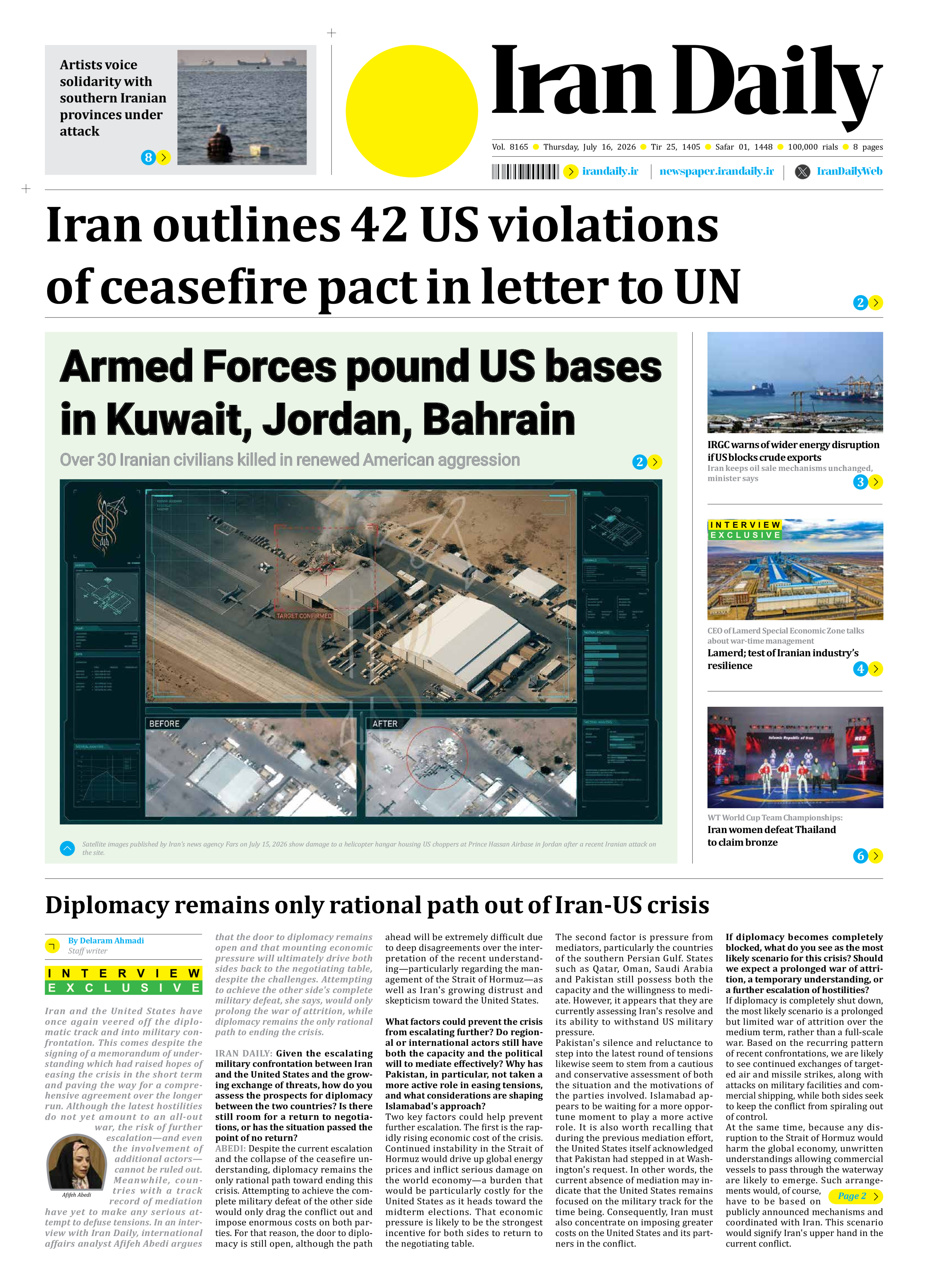


Diplomacy remains only rational path out of Iran-US crisis
By Delaram Ahmadi
Staff writer
Iran and the United States have once again veered off the diplomatic track and into military confrontation. This comes despite the signing of a memorandum of understanding which had raised hopes of easing the crisis in the short term and paving the way for a comprehensive agreement over the longer run. Although the latest hostilities do not yet amount to an all-out war, the risk of further escalation—and even the involvement of additional actors—cannot be ruled out. Meanwhile, countries with a track record of mediation have yet to make any serious attempt to defuse tensions. In an interview with Iran Daily, international affairs analyst Afifeh Abedi argues that the door to diplomacy remains open and that mounting economic pressure will ultimately drive both sides back to the negotiating table, despite the challenges. Attempting to achieve the other side's complete military defeat, she says, would only prolong the war of attrition, while diplomacy remains the only rational path to ending the crisis.
IRAN DAILY: Given the escalating military confrontation between Iran and the United States and the growing exchange of threats, how do you assess the prospects for diplomacy between the two countries? Is there still room for a return to negotiations, or has the situation passed the point of no return?
ABEDI: Despite the current escalation and the collapse of the ceasefire understanding, diplomacy remains the only rational path toward ending this crisis. Attempting to achieve the complete military defeat of the other side would only drag the conflict out and impose enormous costs on both parties. For that reason, the door to diplomacy is still open, although the path ahead will be extremely difficult due to deep disagreements over the interpretation of the recent understanding—particularly regarding the management of the Strait of Hormuz—as well as Iran's growing distrust and skepticism toward the United States.
What factors could prevent the crisis from escalating further? Do regional or international actors still have both the capacity and the political will to mediate effectively? Why has Pakistan, in particular, not taken a more active role in easing tensions, and what considerations are shaping Islamabad's approach?
Two key factors could help prevent further escalation. The first is the rapidly rising economic cost of the crisis. Continued instability in the Strait of Hormuz would drive up global energy prices and inflict serious damage on the world economy—a burden that would be particularly costly for the United States as it heads toward the midterm elections. That economic pressure is likely to be the strongest incentive for both sides to return to the negotiating table.
The second factor is pressure from mediators, particularly the countries of the southern Persian Gulf. States such as Qatar, Oman, Saudi Arabia and Pakistan still possess both the capacity and the willingness to mediate. However, it appears that they are currently assessing Iran's resolve and its ability to withstand US military pressure.
Pakistan's silence and reluctance to step into the latest round of tensions likewise seem to stem from a cautious and conservative assessment of both the situation and the motivations of the parties involved. Islamabad appears to be waiting for a more opportune moment to play a more active role. It is also worth recalling that during the previous mediation effort, the United States itself acknowledged that Pakistan had stepped in at Washington's request. In other words, the current absence of mediation may indicate that the United States remains focused on the military track for the time being. Consequently, Iran must also concentrate on imposing greater costs on the United States and its partners in the conflict.
If diplomacy becomes completely blocked, what do you see as the most likely scenario for this crisis? Should we expect a prolonged war of attrition, a temporary understanding, or a further escalation of hostilities?
If diplomacy is completely shut down, the most likely scenario is a prolonged but limited war of attrition over the medium term, rather than a full-scale war. Based on the recurring pattern of recent confrontations, we are likely to see continued exchanges of targeted air and missile strikes, along with attacks on military facilities and commercial shipping, while both sides seek to keep the conflict from spiraling out of control.
At the same time, because any disruption to the Strait of Hormuz would harm the global economy, unwritten understandings allowing commercial vessels to pass through the waterway are likely to emerge. Such arrangements would, of course, have to be based on publicly announced mechanisms and coordinated with Iran. This scenario would signify Iran's upper hand in the current conflict.
Page 2