







Rooein; scenic village of apple orchards, handwoven crafts
Rooein, a terraced village in Esfarayen, North Khorasan Province, is considered one of Iran’s most beautiful stepped villages and among the country’s most popular rural tourism destinations.
With a history of more than 500 years, ancient hills, and a scenic settlement, the village is also known as the “Village of Apple Blossoms” due to its extensive apple orchards.
Located 26 kilometers north of Esfarayen and 52 kilometers southeast of Bojnurd, the capital of North Khorasan Province, Rooein lies seven kilometers from the Esfarayen-Bojnurd road, at an altitude of 1,670 meters above sea level, at the end of the Rooein River valley in the Aladagh Mountains, according to ISNA.
The village is one of the green and pleasant-weather areas of Esfarayen, situated on the southern slopes of the Aladagh Mountains and inside one of its picturesque valleys. Its winding alleys, traditional architecture, stepped houses, and beautiful apple orchards attract numerous visitors every year.
Upon entering Rooein, the beauty of its gardens blends with the soothing sound of the river flowing through the village, creating a unique harmony of nature’s most pleasant melodies and offering visitors a refreshing experience for both body and soul.
The Rooein River divides the village into two parts. The main historic core of the village is located on the left side of the river, where its earthen and clay stepped architecture has created a distinctive landscape.
Built on a steep slope, Rooein features narrow and often steep alleys. However, the implementation of rural development projects has made movement easier for residents and visitors. The stepped design of the houses is arranged in such a way that the courtyard of one house serves as the rooftop of another. Because of this unique architecture, Rooein is often called the “Masouleh of North Khorasan Province.”
At the center of the village stand the Jaame Mosque and the shrine of Imamzadeh Seyyed Eshaq, who is believed to be a descendant of Imam Musa al-Kadhim (AS) and is highly respected by local residents. A small traditional market is also located near these two sites.
The people of Rooein speak Persian. The historic village has a history of more than five centuries, while the presence of 600-year-old plane trees and the ancient Rooein hill indicate its long historical background.
The right side of the river is mostly covered with interconnected orchards and charming garden paths, with only a few buildings scattered among them. Visitors can reach these houses by crossing an iron bridge built over the river.
The gardens on the left side of the river are known as “Nasar.” Local residents use this name because these gardens are located in an area that remains shaded for much of the day due to its geographical position.
Walking through the winding and enchanting garden paths of Nasar, the orchards gradually extend toward higher elevations and eventually reach the spring area, the largest public recreational spring in the village and a popular destination for visitors from across the province and the country.
The word Rooein is said to mean “growth” or “sprouting,” and the village is believed to have received this name because of its abundant greenery. The combination of mountainous landscapes, plentiful water resources, lush vegetation, and beautiful gardens has created a captivating environment in the area.
Beyond its natural attractions, Rooein’s handicrafts have turned it into a unique destination. The village is nationally known as the “Textile Capital of Iran.”
It is said to be Iran’s first textile craft village, where almost every woman owns a traditional weaving loom at home. Samples of their handmade products, from floor coverings to traditional bundles, can be found throughout their houses and beside the shelves.
In the past, there were around 120 traditional Chador-Shab weaving looms in the village. After electric machines entered the market and replaced traditional looms, support from the Handicrafts Department of the Cultural Heritage, Tourism and Handicrafts Organization helped bring traditional weaving back into local homes.
“When one of the village girls got married, her dowry included 20 Chador-Shabs, 50 bath towels, and 30 traditional tablecloths. But young people today have become more fashion-oriented,” says a handicraft entrepreneur from Rooein, a model tourism village in North Khorasan.
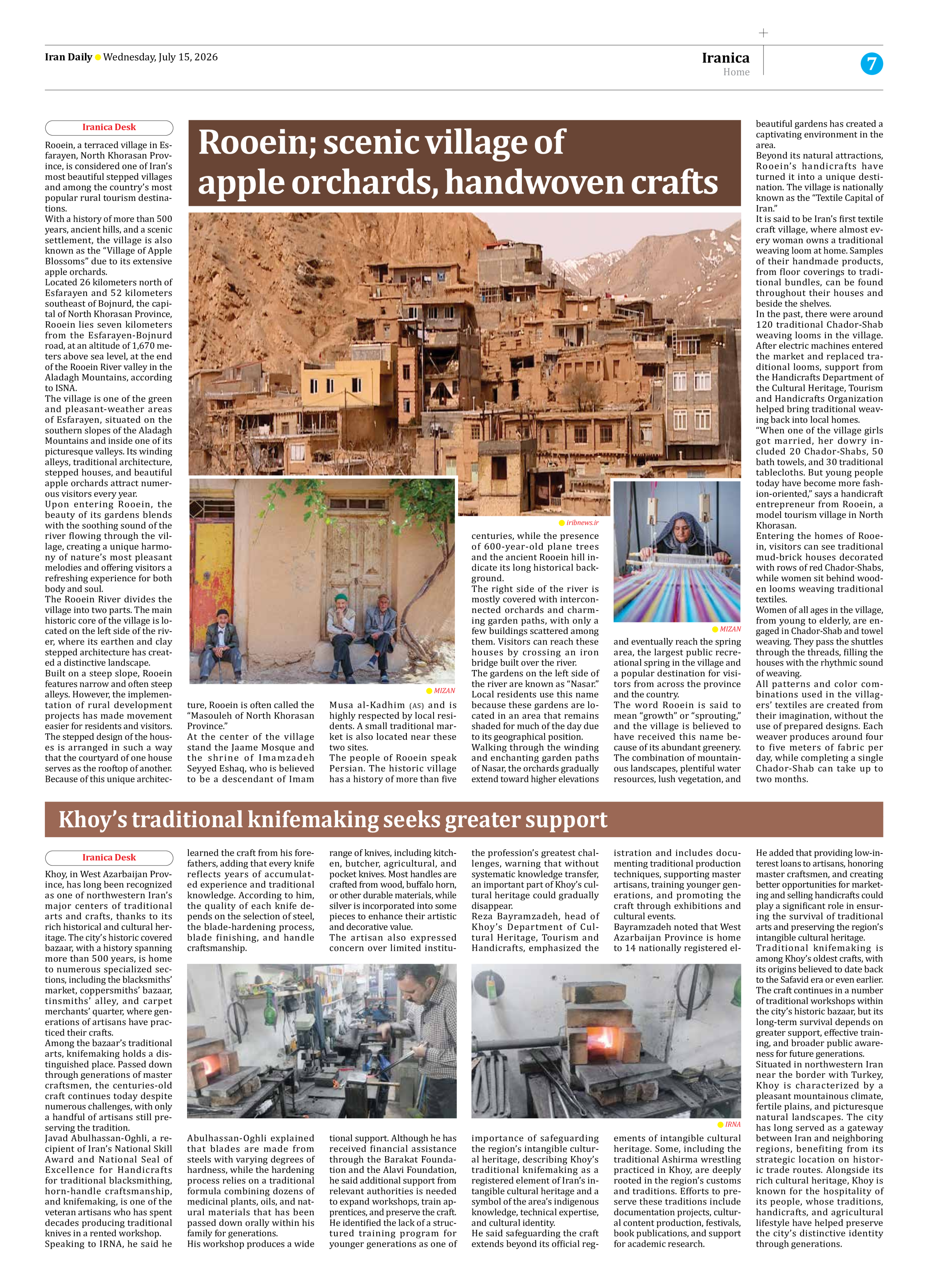
Entering the homes of Rooein, visitors can see traditional mud-brick houses decorated with rows of red Chador-Shabs, while women sit behind wooden looms weaving traditional textiles.
Women of all ages in the village, from young to elderly, are engaged in Chador-Shab and towel weaving. They pass the shuttles through the threads, filling the houses with the rhythmic sound of weaving.
All patterns and color combinations used in the villagers’ textiles are created from their imagination, without the use of prepared designs. Each weaver produces around four to five meters of fabric per day, while completing a single Chador-Shab can take up to two months.