







Cairo in Washington’s strategic calculus
From crisis management to shaping regional balance
Former member of
Egyptian Parliament
Protracted conflicts, persistent US-Iran tensions, instability in the Red Sea, threats to critical maritime corridors, and mounting energy security concerns have compelled Western capitals to reassess the role of regional powers capable of generating stability rather than merely responding to crises.
US perceptions of the region have evolved considerably over the past several years. Instead of relying primarily on direct military intervention or placing exclusive faith in traditional alliances, US policymakers, major media organizations, and leading think tanks have increasingly focused on identifying regional powers capable of preventing systemic instability and containing escalating crises. Within this framework, Egypt has emerged as a country that cannot be overlooked, owing not only to its strategic geographic position but also to its political weight and its ability to engage simultaneously with rival actors across the region.
This growing significance rests on clear strategic foundations. Nearly 12 percent of global trade passes through the Suez Canal, while the security of the Red Sea has become one of the defining challenges facing the international economy. Regional instability over the past two years has significantly disrupted maritime traffic and reduced canal revenues, elevating Egypt’s stability and the security of these sea lanes from regional concerns to matters of global strategic significance. At the same time, the United States continues to provide Egypt with approximately $1.3 billion in annual military assistance, underscoring Cairo’s enduring place within Washington’s long-term strategic calculus.
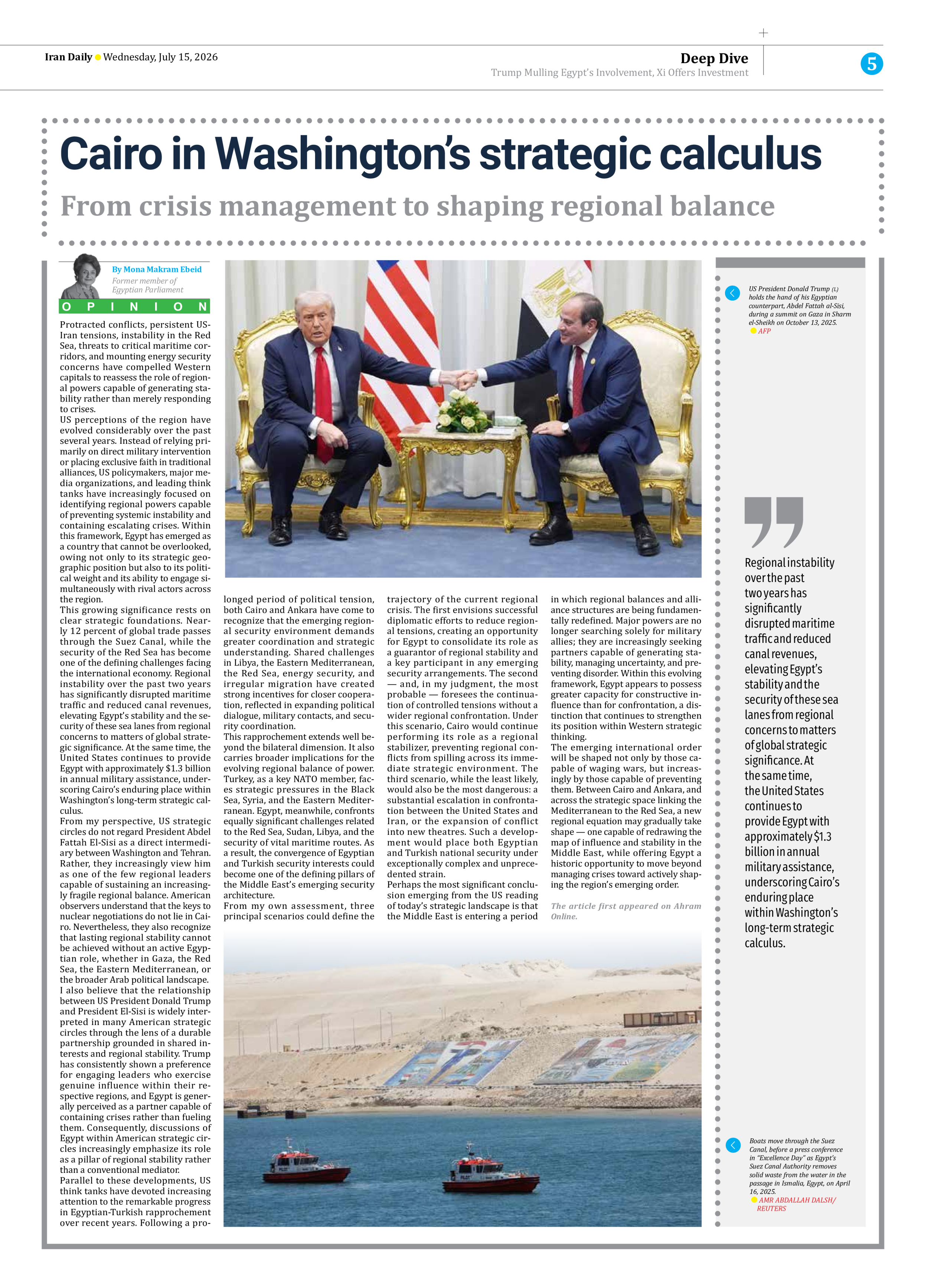
From my perspective, US strategic circles do not regard President Abdel Fattah El-Sisi as a direct intermediary between Washington and Tehran. Rather, they increasingly view him as one of the few regional leaders capable of sustaining an increasingly fragile regional balance. American observers understand that the keys to nuclear negotiations do not lie in Cairo. Nevertheless, they also recognize that lasting regional stability cannot be achieved without an active Egyptian role, whether in Gaza, the Red Sea, the Eastern Mediterranean, or the broader Arab political landscape.
I also believe that the relationship between US President Donald Trump and President El-Sisi is widely interpreted in many American strategic circles through the lens of a durable partnership grounded in shared interests and regional stability. Trump has consistently shown a preference for engaging leaders who exercise genuine influence within their respective regions, and Egypt is generally perceived as a partner capable of containing crises rather than fueling them. Consequently, discussions of Egypt within American strategic circles increasingly emphasize its role as a pillar of regional stability rather than a conventional mediator.
Parallel to these developments, US think tanks have devoted increasing attention to the remarkable progress in Egyptian-Turkish rapprochement over recent years. Following a prolonged period of political tension, both Cairo and Ankara have come to recognize that the emerging regional security environment demands greater coordination and strategic understanding. Shared challenges in Libya, the Eastern Mediterranean, the Red Sea, energy security, and irregular migration have created strong incentives for closer cooperation, reflected in expanding political dialogue, military contacts, and security coordination.
This rapprochement extends well beyond the bilateral dimension. It also carries broader implications for the evolving regional balance of power. Turkey, as a key NATO member, faces strategic pressures in the Black Sea, Syria, and the Eastern Mediterranean. Egypt, meanwhile, confronts equally significant challenges related to the Red Sea, Sudan, Libya, and the security of vital maritime routes. As a result, the convergence of Egyptian and Turkish security interests could become one of the defining pillars of the Middle East’s emerging security architecture.
From my own assessment, three principal scenarios could define the trajectory of the current regional crisis. The first envisions successful diplomatic efforts to reduce regional tensions, creating an opportunity for Egypt to consolidate its role as a guarantor of regional stability and a key participant in any emerging security arrangements. The second — and, in my judgment, the most probable — foresees the continuation of controlled tensions without a wider regional confrontation. Under this scenario, Cairo would continue performing its role as a regional stabilizer, preventing regional conflicts from spilling across its immediate strategic environment. The third scenario, while the least likely, would also be the most dangerous: a substantial escalation in confrontation between the United States and Iran, or the expansion of conflict into new theatres. Such a development would place both Egyptian and Turkish national security under exceptionally complex and unprecedented strain.
Perhaps the most significant conclusion emerging from the US reading of today’s strategic landscape is that the Middle East is entering a period in which regional balances and alliance structures are being fundamentally redefined. Major powers are no longer searching solely for military allies; they are increasingly seeking partners capable of generating stability, managing uncertainty, and preventing disorder. Within this evolving framework, Egypt appears to possess greater capacity for constructive influence than for confrontation, a distinction that continues to strengthen its position within Western strategic thinking.
The emerging international order will be shaped not only by those capable of waging wars, but increasingly by those capable of preventing them. Between Cairo and Ankara, and across the strategic space linking the Mediterranean to the Red Sea, a new regional equation may gradually take shape — one capable of redrawing the map of influence and stability in the Middle East, while offering Egypt a historic opportunity to move beyond managing crises toward actively shaping the region’s emerging order.
The article first appeared on Ahram
Online.