





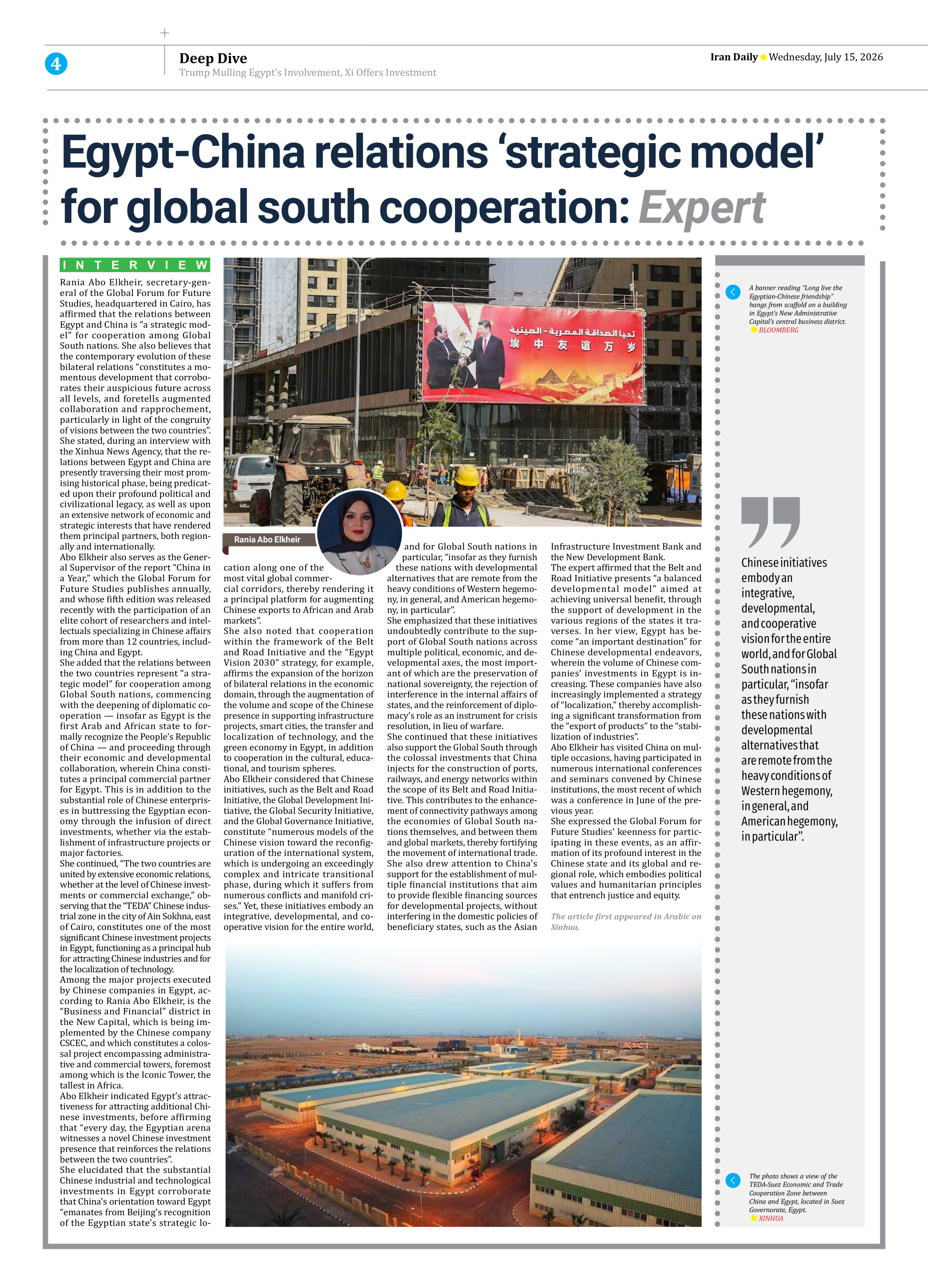


Egypt-China relations ‘strategic model’ for global south cooperation: Expert
Rania Abo Elkheir, secretary-general of the Global Forum for Future Studies, headquartered in Cairo, has affirmed that the relations between Egypt and China is “a strategic model” for cooperation among Global South nations. She also believes that the contemporary evolution of these bilateral relations “constitutes a momentous development that corroborates their auspicious future across all levels, and foretells augmented collaboration and rapprochement, particularly in light of the congruity of visions between the two countries”.
She stated, during an interview with the Xinhua News Agency, that the relations between Egypt and China are presently traversing their most promising historical phase, being predicated upon their profound political and civilizational legacy, as well as upon an extensive network of economic and strategic interests that have rendered them principal partners, both regionally and internationally.
Abo Elkheir also serves as the General Supervisor of the report “China in a Year,” which the Global Forum for Future Studies publishes annually, and whose fifth edition was released recently with the participation of an elite cohort of researchers and intellectuals specializing in Chinese affairs from more than 12 countries, including China and Egypt.
She added that the relations between the two countries represent “a strategic model” for cooperation among Global South nations, commencing with the deepening of diplomatic cooperation — insofar as Egypt is the first Arab and African state to formally recognize the People’s Republic of China — and proceeding through their economic and developmental collaboration, wherein China constitutes a principal commercial partner for Egypt. This is in addition to the substantial role of Chinese enterprises in buttressing the Egyptian economy through the infusion of direct investments, whether via the establishment of infrastructure projects or major factories.
She continued, “The two countries are united by extensive economic relations, whether at the level of Chinese investments or commercial exchange,” observing that the “TEDA” Chinese industrial zone in the city of Ain Sokhna, east of Cairo, constitutes one of the most significant Chinese investment projects in Egypt, functioning as a principal hub for attracting Chinese industries and for the localization of technology.
Among the major projects executed by Chinese companies in Egypt, according to Rania Abo Elkheir, is the “Business and Financial” district in the New Capital, which is being implemented by the Chinese company CSCEC, and which constitutes a colossal project encompassing administrative and commercial towers, foremost among which is the Iconic Tower, the tallest in Africa.
Abo Elkheir indicated Egypt’s attractiveness for attracting additional Chinese investments, before affirming that “every day, the Egyptian arena witnesses a novel Chinese investment presence that reinforces the relations between the two countries”.
She elucidated that the substantial Chinese industrial and technological investments in Egypt corroborate that China’s orientation toward Egypt “emanates from Beijing’s recognition of the Egyptian state’s strategic location along one of the most vital global commercial corridors, thereby rendering it a principal platform for augmenting Chinese exports to African and Arab markets”.
She also noted that cooperation within the framework of the Belt and Road Initiative and the “Egypt Vision 2030” strategy, for example, affirms the expansion of the horizon of bilateral relations in the economic domain, through the augmentation of the volume and scope of the Chinese presence in supporting infrastructure projects, smart cities, the transfer and localization of technology, and the green economy in Egypt, in addition to cooperation in the cultural, educational, and tourism spheres.
Abo Elkheir considered that Chinese initiatives, such as the Belt and Road Initiative, the Global Development Initiative, the Global Security Initiative, and the Global Governance Initiative, constitute “numerous models of the Chinese vision toward the reconfiguration of the international system, which is undergoing an exceedingly complex and intricate transitional phase, during which it suffers from numerous conflicts and manifold crises.” Yet, these initiatives embody an integrative, developmental, and cooperative vision for the entire world, and for Global South nations in particular, “insofar as they furnish these nations with developmental alternatives that are remote from the heavy conditions of Western hegemony, in general, and American hegemony, in particular”.
She emphasized that these initiatives undoubtedly contribute to the support of Global South nations across multiple political, economic, and developmental axes, the most important of which are the preservation of national sovereignty, the rejection of interference in the internal affairs of states, and the reinforcement of diplomacy’s role as an instrument for crisis resolution, in lieu of warfare.
She continued that these initiatives also support the Global South through the colossal investments that China injects for the construction of ports, railways, and energy networks within the scope of its Belt and Road Initiative. This contributes to the enhancement of connectivity pathways among the economies of Global South nations themselves, and between them and global markets, thereby fortifying the movement of international trade. She also drew attention to China’s support for the establishment of multiple financial institutions that aim to provide flexible financing sources for developmental projects, without interfering in the domestic policies of beneficiary states, such as the Asian Infrastructure Investment Bank and the New Development Bank.
The expert affirmed that the Belt and Road Initiative presents “a balanced developmental model” aimed at achieving universal benefit, through the support of development in the various regions of the states it traverses. In her view, Egypt has become “an important destination” for Chinese developmental endeavors, wherein the volume of Chinese companies’ investments in Egypt is increasing. These companies have also increasingly implemented a strategy of “localization,” thereby accomplishing a significant transformation from the “export of products” to the “stabilization of industries”.
Abo Elkheir has visited China on multiple occasions, having participated in numerous international conferences and seminars convened by Chinese institutions, the most recent of which was a conference in June of the previous year.
She expressed the Global Forum for Future Studies’ keenness for participating in these events, as an affirmation of its profound interest in the Chinese state and its global and regional role, which embodies political values and humanitarian principles that entrench justice and equity.
The article first appeared in Arabic on Xinhua.