







Subtleties of solidarity at Ayatollah Khamenei’s funeral in Iraq
Academic director at the Arab Center for Research and Policy Studies
Last June, Haider al-Kilabi, a member of the Iraqi parliament closely associated with the country’s Popular Mobilization Forces (PMF), visited the Iranian Embassy in Baghdad, together with several other parliamentarians, to thank Iran’s ambassador for conveying their request that some of the planned funeral ceremonies for Ayatollah Seyyed Ali Khamenei be held in Iraq (the multiday procession between July 3 and July 9 included several cities across Iran and Iraq).
As has since become evident, Iranian authorities devoted extraordinary attention to the symbolism and spectacle of the funeral to send a message that the Islamic Republic continues to enjoy broad popular legitimacy — not only within Iran but across the wider Shia and Islamic worlds, particularly in countries where factions belonging to the transnational “Axis of Resistance” are active. Political performance is integral to the expression of power everywhere. Participation in these rituals, and the performance of the roles assigned within them, serves to reaffirm and normalize existing relations of power.
It is evident that many Iranians, regardless of their views of the regime itself, regard Ayatollah Khamenei’s death in an American-Israeli act of aggression as a sacrifice worthy of mourning, and perhaps even of pride. Here was a leader who gave his life in the course of defending his country during wartime. These sentiments are readily apparent in conversations among Iranians both inside and outside the country and across social media platforms. They suggest that many participants in the mourning are motivated by genuine emotion rather than theatrical performance. This does not diminish the fact that the regime sees this sympathy — which transcends ideological divisions and is not driven by fear or political conformity — as an opportunity to renew and expand its legitimacy. Whether it succeeds will depend largely on the choices it makes once the immediate emotional response begins to fade.
But what of the Iraqis awaiting the supreme leader’s coffin?
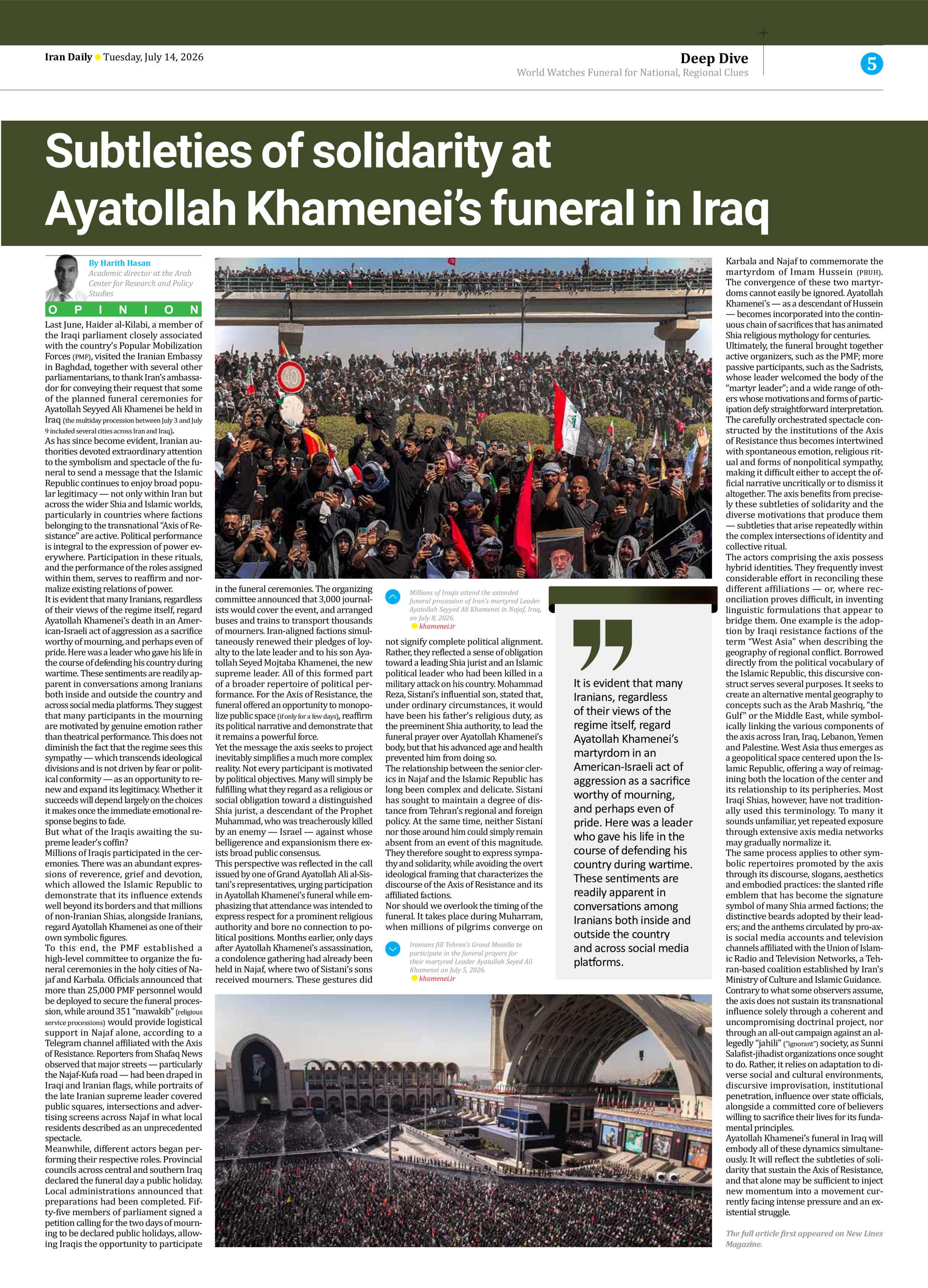
Millions of Iraqis participated in the ceremonies. There was an abundant expressions of reverence, grief and devotion, which allowed the Islamic Republic to demonstrate that its influence extends well beyond its borders and that millions of non-Iranian Shias, alongside Iranians, regard Ayatollah Khamenei as one of their own symbolic figures.
To this end, the PMF established a high-level committee to organize the funeral ceremonies in the holy cities of Najaf and Karbala. Officials announced that more than 25,000 PMF personnel would be deployed to secure the funeral procession, while around 351 “mawakib” (religious service processions) would provide logistical support in Najaf alone, according to a Telegram channel affiliated with the Axis of Resistance. Reporters from Shafaq News observed that major streets — particularly the Najaf-Kufa road — had been draped in Iraqi and Iranian flags, while portraits of the late Iranian supreme leader covered public squares, intersections and advertising screens across Najaf in what local residents described as an unprecedented spectacle.
Meanwhile, different actors began performing their respective roles. Provincial councils across central and southern Iraq declared the funeral day a public holiday. Local administrations announced that preparations had been completed. Fifty-five members of parliament signed a petition calling for the two days of mourning to be declared public holidays, allowing Iraqis the opportunity to participate in the funeral ceremonies. The organizing committee announced that 3,000 journalists would cover the event, and arranged buses and trains to transport thousands of mourners. Iran-aligned factions simultaneously renewed their pledges of loyalty to the late leader and to his son Ayatollah Seyed Mojtaba Khamenei, the new supreme leader. All of this formed part of a broader repertoire of political performance. For the Axis of Resistance, the funeral offered an opportunity to monopolize public space (if only for a few days), reaffirm its political narrative and demonstrate that it remains a powerful force.
Yet the message the axis seeks to project inevitably simplifies a much more complex reality. Not every participant is motivated by political objectives. Many will simply be fulfilling what they regard as a religious or social obligation toward a distinguished Shia jurist, a descendant of the Prophet Muhammad, who was treacherously killed by an enemy — Israel — against whose belligerence and expansionism there exists broad public consensus.
This perspective was reflected in the call issued by one of Grand Ayatollah Ali al-Sistani’s representatives, urging participation in Ayatollah Khamenei’s funeral while emphasizing that attendance was intended to express respect for a prominent religious authority and bore no connection to political positions. Months earlier, only days after Ayatollah Khamenei’s assassination, a condolence gathering had already been held in Najaf, where two of Sistani’s sons received mourners. These gestures did not signify complete political alignment. Rather, they reflected a sense of obligation toward a leading Shia jurist and an Islamic political leader who had been killed in a military attack on his country. Mohammad Reza, Sistani’s influential son, stated that, under ordinary circumstances, it would have been his father’s religious duty, as the preeminent Shia authority, to lead the funeral prayer over Ayatollah Khamenei’s body, but that his advanced age and health prevented him from doing so.
The relationship between the senior clerics in Najaf and the Islamic Republic has long been complex and delicate. Sistani has sought to maintain a degree of distance from Tehran’s regional and foreign policy. At the same time, neither Sistani nor those around him could simply remain absent from an event of this magnitude. They therefore sought to express sympathy and solidarity, while avoiding the overt ideological framing that characterizes the discourse of the Axis of Resistance and its affiliated factions.
Nor should we overlook the timing of the funeral. It takes place during Muharram, when millions of pilgrims converge on Karbala and Najaf to commemorate the martyrdom of Imam Hussein (PBUH). The convergence of these two martyrdoms cannot easily be ignored. Ayatollah Khamenei’s — as a descendant of Hussein — becomes incorporated into the continuous chain of sacrifices that has animated Shia religious mythology for centuries.
Ultimately, the funeral brought together active organizers, such as the PMF; more passive participants, such as the Sadrists, whose leader welcomed the body of the “martyr leader”; and a wide range of others whose motivations and forms of participation defy straightforward interpretation.
The carefully orchestrated spectacle constructed by the institutions of the Axis of Resistance thus becomes intertwined with spontaneous emotion, religious ritual and forms of nonpolitical sympathy, making it difficult either to accept the official narrative uncritically or to dismiss it altogether. The axis benefits from precisely these subtleties of solidarity and the diverse motivations that produce them — subtleties that arise repeatedly within the complex intersections of identity and collective ritual.
The actors comprising the axis possess hybrid identities. They frequently invest considerable effort in reconciling these different affiliations — or, where reconciliation proves difficult, in inventing linguistic formulations that appear to bridge them. One example is the adoption by Iraqi resistance factions of the term “West Asia” when describing the geography of regional conflict. Borrowed directly from the political vocabulary of the Islamic Republic, this discursive construct serves several purposes. It seeks to create an alternative mental geography to concepts such as the Arab Mashriq, “the Gulf” or the Middle East, while symbolically linking the various components of the axis across Iran, Iraq, Lebanon, Yemen and Palestine. West Asia thus emerges as a geopolitical space centered upon the Islamic Republic, offering a way of reimagining both the location of the center and its relationship to its peripheries. Most Iraqi Shias, however, have not traditionally used this terminology. To many it sounds unfamiliar, yet repeated exposure through extensive axis media networks may gradually normalize it.
The same process applies to other symbolic repertoires promoted by the axis through its discourse, slogans, aesthetics and embodied practices: the slanted rifle emblem that has become the signature symbol of many Shia armed factions; the distinctive beards adopted by their leaders; and the anthems circulated by pro-axis social media accounts and television channels affiliated with the Union of Islamic Radio and Television Networks, a Tehran-based coalition established by Iran’s Ministry of Culture and Islamic Guidance.
Contrary to what some observers assume, the axis does not sustain its transnational influence solely through a coherent and uncompromising doctrinal project, nor through an all-out campaign against an allegedly “jahili” (“ignorant”) society, as Sunni Salafist-jihadist organizations once sought to do. Rather, it relies on adaptation to diverse social and cultural environments, discursive improvisation, institutional penetration, influence over state officials, alongside a committed core of believers willing to sacrifice their lives for its fundamental principles.
Ayatollah Khamenei’s funeral in Iraq will embody all of these dynamics simultaneously. It will reflect the subtleties of solidarity that sustain the Axis of Resistance, and that alone may be sufficient to inject new momentum into a movement currently facing intense pressure and an existential struggle.
The full article first appeared on New Lines Magazine.