







Khameh Duzi faces challenges, renewal efforts in Nimruz
In the scorching winds of Sistan and Baluchestan Province — where history is tightly woven into everyday life — quiet needles move across fabric, stitching patterns that are far more than decoration. They are living narratives of identity, memory, and cultural inheritance, carried silently from one generation to the next.
Khameh Duzi, a traditional embroidery art in Nimruz, is a craft born in humble homes and sustained through generations, passed down from mothers to daughters as an intimate form of cultural preservation. In doing so, it safeguards a vital thread of the region’s collective memory.
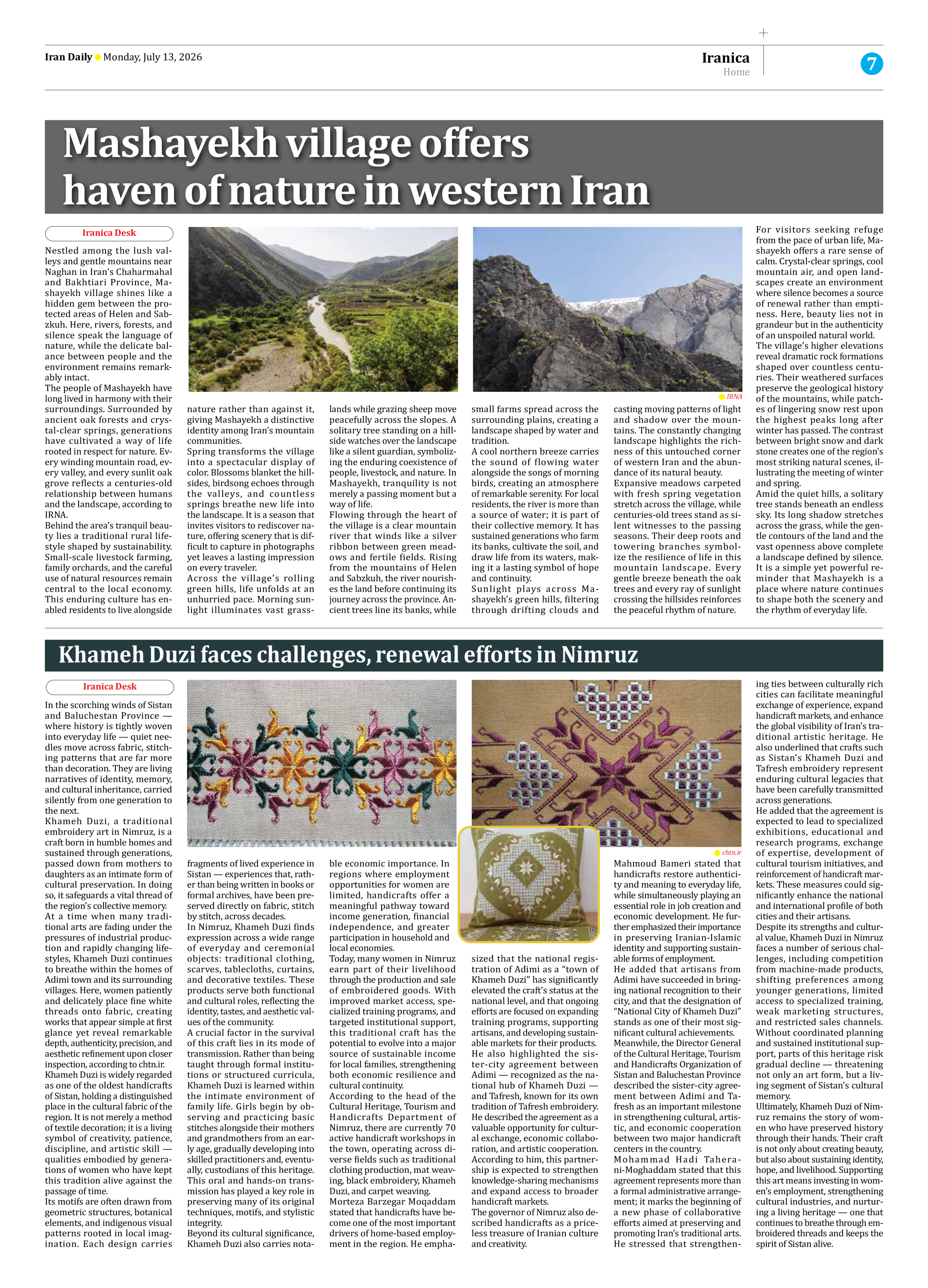
At a time when many traditional arts are fading under the pressures of industrial production and rapidly changing lifestyles, Khameh Duzi continues to breathe within the homes of Adimi town and its surrounding villages. Here, women patiently and delicately place fine white threads onto fabric, creating works that appear simple at first glance yet reveal remarkable depth, authenticity, precision, and aesthetic refinement upon closer inspection, according to chtn.ir.
Khameh Duzi is widely regarded as one of the oldest handicrafts of Sistan, holding a distinguished place in the cultural fabric of the region. It is not merely a method of textile decoration; it is a living symbol of creativity, patience, discipline, and artistic skill — qualities embodied by generations of women who have kept this tradition alive against the passage of time.
Its motifs are often drawn from geometric structures, botanical elements, and indigenous visual patterns rooted in local imagination. Each design carries fragments of lived experience in Sistan — experiences that, rather than being written in books or formal archives, have been preserved directly on fabric, stitch by stitch, across decades.
In Nimruz, Khameh Duzi finds expression across a wide range of everyday and ceremonial objects: traditional clothing, scarves, tablecloths, curtains, and decorative textiles. These products serve both functional and cultural roles, reflecting the identity, tastes, and aesthetic values of the community.
A crucial factor in the survival of this craft lies in its mode of transmission. Rather than being taught through formal institutions or structured curricula, Khameh Duzi is learned within the intimate environment of family life. Girls begin by observing and practicing basic stitches alongside their mothers and grandmothers from an early age, gradually developing into skilled practitioners and, eventually, custodians of this heritage. This oral and hands-on transmission has played a key role in preserving many of its original techniques, motifs, and stylistic integrity.
Beyond its cultural significance, Khameh Duzi also carries notable economic importance. In regions where employment opportunities for women are limited, handicrafts offer a meaningful pathway toward income generation, financial independence, and greater participation in household and local economies.
Today, many women in Nimruz earn part of their livelihood through the production and sale of embroidered goods. With improved market access, specialized training programs, and targeted institutional support, this traditional craft has the potential to evolve into a major source of sustainable income for local families, strengthening both economic resilience and cultural continuity.
According to the head of the Cultural Heritage, Tourism and Handicrafts Department of Nimruz, there are currently 70 active handicraft workshops in the town, operating across diverse fields such as traditional clothing production, mat weaving, black embroidery, Khameh Duzi, and carpet weaving.
Morteza Barzegar Moqaddam stated that handicrafts have become one of the most important drivers of home-based employment in the region. He emphasized that the national registration of Adimi as a “town of Khameh Duzi” has significantly elevated the craft’s status at the national level, and that ongoing efforts are focused on expanding training programs, supporting artisans, and developing sustainable markets for their products.
He also highlighted the sister-city agreement between Adimi — recognized as the national hub of Khameh Duzi — and Tafresh, known for its own tradition of Tafresh embroidery. He described the agreement as a valuable opportunity for cultural exchange, economic collaboration, and artistic cooperation. According to him, this partnership is expected to strengthen knowledge-sharing mechanisms and expand access to broader handicraft markets.
The governor of Nimruz also described handicrafts as a priceless treasure of Iranian culture and creativity.
Mahmoud Bameri stated that handicrafts restore authenticity and meaning to everyday life, while simultaneously playing an essential role in job creation and economic development. He further emphasized their importance in preserving Iranian-Islamic identity and supporting sustainable forms of employment.
He added that artisans from Adimi have succeeded in bringing national recognition to their city, and that the designation of “National City of Khameh Duzi” stands as one of their most significant cultural achievements.
Meanwhile, the Director General of the Cultural Heritage, Tourism and Handicrafts Organization of Sistan and Baluchestan Province described the sister-city agreement between Adimi and Tafresh as an important milestone in strengthening cultural, artistic, and economic cooperation between two major handicraft centers in the country.
Mohammad Hadi Taherani-Moghaddam stated that this agreement represents more than a formal administrative arrangement; it marks the beginning of a new phase of collaborative efforts aimed at preserving and promoting Iran’s traditional arts.
He stressed that strengthening ties between culturally rich cities can facilitate meaningful exchange of experience, expand handicraft markets, and enhance the global visibility of Iran’s traditional artistic heritage. He also underlined that crafts such as Sistan’s Khameh Duzi and Tafresh embroidery represent enduring cultural legacies that have been carefully transmitted across generations.
He added that the agreement is expected to lead to specialized exhibitions, educational and research programs, exchange of expertise, development of cultural tourism initiatives, and reinforcement of handicraft markets. These measures could significantly enhance the national and international profile of both cities and their artisans.
Despite its strengths and cultural value, Khameh Duzi in Nimruz faces a number of serious challenges, including competition from machine-made products, shifting preferences among younger generations, limited access to specialized training, weak marketing structures, and restricted sales channels. Without coordinated planning and sustained institutional support, parts of this heritage risk gradual decline — threatening not only an art form, but a living segment of Sistan’s cultural memory.
Ultimately, Khameh Duzi of Nimruz remains the story of women who have preserved history through their hands. Their craft is not only about creating beauty, but also about sustaining identity, hope, and livelihood. Supporting this art means investing in women’s employment, strengthening cultural industries, and nurturing a living heritage — one that continues to breathe through embroidered threads and keeps the spirit of Sistan alive.