







A litterateur, patron of culture
Martyred Leader’s relationship with poetry, novels
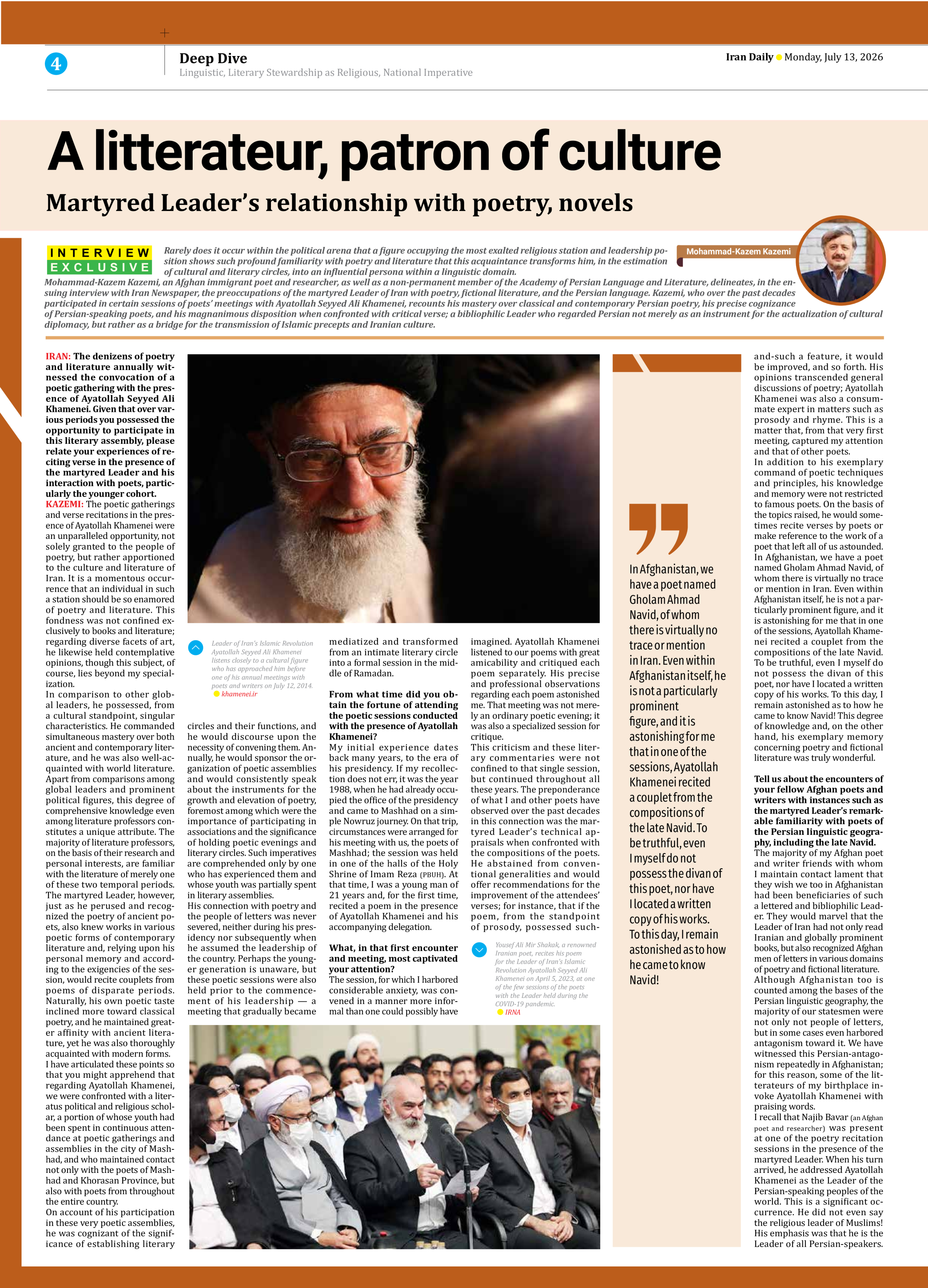
Rarely does it occur within the political arena that a figure occupying the most exalted religious station and leadership position shows such profound familiarity with poetry and literature that this acquaintance transforms him, in the estimation of cultural and literary circles, into an influential persona within a linguistic domain. Mohammad-Kazem Kazemi, an Afghan immigrant poet and researcher, as well as a non-permanent member of the Academy of Persian Language and Literature, delineates, in the ensuing interview with Iran Newspaper, the preoccupations of the martyred Leader of Iran with poetry, fictional literature, and the Persian language. Kazemi, who over the past decades participated in certain sessions of poets’ meetings with Ayatollah Seyyed Ali Khamenei, recounts his mastery over classical and contemporary Persian poetry, his precise cognizance of Persian-speaking poets, and his magnanimous disposition when confronted with critical verse; a bibliophilic Leader who regarded Persian not merely as an instrument for the actualization of cultural diplomacy, but rather as a bridge for the transmission of Islamic precepts and Iranian culture.
IRAN: The denizens of poetry and literature annually witnessed the convocation of a poetic gathering with the presence of Ayatollah Seyyed Ali Khamenei. Given that over various periods you possessed the opportunity to participate in this literary assembly, please relate your experiences of reciting verse in the presence of the martyred Leader and his interaction with poets, particularly the younger cohort.
KAZEMI: The poetic gatherings and verse recitations in the presence of Ayatollah Khamenei were an unparalleled opportunity, not solely granted to the people of poetry, but rather apportioned to the culture and literature of Iran. It is a momentous occurrence that an individual in such a station should be so enamored of poetry and literature. This fondness was not confined exclusively to books and literature; regarding diverse facets of art, he likewise held contemplative opinions, though this subject, of course, lies beyond my specialization.
In comparison to other global leaders, he possessed, from a cultural standpoint, singular characteristics. He commanded simultaneous mastery over both ancient and contemporary literature, and he was also well-acquainted with world literature. Apart from comparisons among global leaders and prominent political figures, this degree of comprehensive knowledge even among literature professors constitutes a unique attribute. The majority of literature professors, on the basis of their research and personal interests, are familiar with the literature of merely one of these two temporal periods. The martyred Leader, however, just as he perused and recognized the poetry of ancient poets, also knew works in various poetic forms of contemporary literature and, relying upon his personal memory and according to the exigencies of the session, would recite couplets from poems of disparate periods. Naturally, his own poetic taste inclined more toward classical poetry, and he maintained greater affinity with ancient literature, yet he was also thoroughly acquainted with modern forms.
I have articulated these points so that you might apprehend that regarding Ayatollah Khamenei, we were confronted with a literatus political and religious scholar, a portion of whose youth had been spent in continuous attendance at poetic gatherings and assemblies in the city of Mashhad, and who maintained contact not only with the poets of Mashhad and Khorasan Province, but also with poets from throughout the entire country.
On account of his participation in these very poetic assemblies, he was cognizant of the significance of establishing literary circles and their functions, and he would discourse upon the necessity of convening them. Annually, he would sponsor the organization of poetic assemblies and would consistently speak about the instruments for the growth and elevation of poetry, foremost among which were the importance of participating in associations and the significance of holding poetic evenings and literary circles. Such imperatives are comprehended only by one who has experienced them and whose youth was partially spent in literary assemblies.
His connection with poetry and the people of letters was never severed, neither during his presidency nor subsequently when he assumed the leadership of the country. Perhaps the younger generation is unaware, but these poetic sessions were also held prior to the commencement of his leadership — a meeting that gradually became mediatized and transformed from an intimate literary circle into a formal session in the middle of Ramadan.
From what time did you obtain the fortune of attending the poetic sessions conducted with the presence of Ayatollah Khamenei?
My initial experience dates back many years, to the era of his presidency. If my recollection does not err, it was the year 1988, when he had already occupied the office of the presidency and came to Mashhad on a simple Nowruz journey. On that trip, circumstances were arranged for his meeting with us, the poets of Mashhad; the session was held in one of the halls of the Holy Shrine of Imam Reza (PBUH). At that time, I was a young man of 21 years and, for the first time, recited a poem in the presence of Ayatollah Khamenei and his accompanying delegation.
What, in that first encounter and meeting, most captivated your attention?
The session, for which I harbored considerable anxiety, was convened in a manner more informal than one could possibly have imagined. Ayatollah Khamenei listened to our poems with great amicability and critiqued each poem separately. His precise and professional observations regarding each poem astonished me. That meeting was not merely an ordinary poetic evening; it was also a specialized session for critique.
This criticism and these literary commentaries were not confined to that single session, but continued throughout all these years. The preponderance of what I and other poets have observed over the past decades in this connection was the martyred Leader’s technical appraisals when confronted with the compositions of the poets. He abstained from conventional generalities and would offer recommendations for the improvement of the attendees’ verses; for instance, that if the poem, from the standpoint of prosody, possessed such-and-such a feature, it would be improved, and so forth. His opinions transcended general discussions of poetry; Ayatollah Khamenei was also a consummate expert in matters such as prosody and rhyme. This is a matter that, from that very first meeting, captured my attention and that of other poets.
In addition to his exemplary command of poetic techniques and principles, his knowledge and memory were not restricted to famous poets. On the basis of the topics raised, he would sometimes recite verses by poets or make reference to the work of a poet that left all of us astounded. In Afghanistan, we have a poet named Gholam Ahmad Navid, of whom there is virtually no trace or mention in Iran. Even within Afghanistan itself, he is not a particularly prominent figure, and it is astonishing for me that in one of the sessions, Ayatollah Khamenei recited a couplet from the compositions of the late Navid. To be truthful, even I myself do not possess the divan of this poet, nor have I located a written copy of his works. To this day, I remain astonished as to how he came to know Navid! This degree of knowledge and, on the other hand, his exemplary memory concerning poetry and fictional literature was truly wonderful.
Tell us about the encounters of your fellow Afghan poets and writers with instances such as the martyred Leader’s remarkable familiarity with poets of the Persian linguistic geography, including the late Navid.
The majority of my Afghan poet and writer friends with whom I maintain contact lament that they wish we too in Afghanistan had been beneficiaries of such a lettered and bibliophilic Leader. They would marvel that the Leader of Iran had not only read Iranian and globally prominent books, but also recognized Afghan men of letters in various domains of poetry and fictional literature.
Although Afghanistan too is counted among the bases of the Persian linguistic geography, the majority of our statesmen were not only not people of letters, but in some cases even harbored antagonism toward it. We have witnessed this Persian-antagonism repeatedly in Afghanistan; for this reason, some of the litterateurs of my birthplace invoke Ayatollah Khamenei with praising words.
I recall that Najib Bavar (an Afghan poet and researcher) was present at one of the poetry recitation sessions in the presence of the martyred Leader. When his turn arrived, he addressed Ayatollah Khamenei as the Leader of the Persian-speaking peoples of the world. This is a significant occurrence. He did not even say the religious leader of Muslims! His emphasis was that he is the Leader of all Persian-speakers. Well, a portion of this perspective derives from the relationship that Ayatollah Khamenei maintained with books, literature, and their adherents. There is no doubt that Afghanistan and other countries within the Persian linguistic geography are, politically, independent territories; however, just as that Afghan poet stated, Ayatollah Khamenei’s literary standing had placed him, within the linguistic domain, at the apex of the realm of these countries — a matter that reverted to his professional bibliophilia, his excellent knowledge, and his concerned disposition.
In the sessions conducted with his presence, was there any particular thematic constraint imposed upon the poets?
Never! In none of the poetic sessions held with the presence of the martyred Leader was the recitation of any specific content imposed upon the poets. Even his own disposition was not such that he would favor particular themes — for instance, religious poetry. It had occurred numerous times that some poets would emphasize in the session that they had both religious and romantic verse prepared for recitation, yet Ayatollah Khamenei would select the romantic or the socially-oriented poem.
His encounter with critical poetry was likewise accompanied by receptivity and an open perspective. I myself, on several occasions, recited critical poems concerning the situation of immigrant poets, and he listened to my verses with patience. If his reception had not been favorable, we would not have recited critical poetry!
The majority of the satirical poems recited in the sessions were also critical in nature. Mr. Naser Feiz, on account of the familiarity he had acquired with the martyred Leader, several years ago recited a critical satirical poem in his presence — a poem that, had a young and unfamiliar poet been in his place, ignorant of Ayatollah Khamenei’s magnanimity, would never have been recited. I recall well that our martyred Leader, after Mr. Feiz recited this poem, smiled and, with cheerful countenance, announced his opinion.
I have recounted this so that the younger generation might know that if the poets present at these annual poetic gatherings selected particular themes, it was their own personal choice. If they perceived self-censorship on the part of poets in altering certain couplets, they would admonish that there is no need for such an action. The sole occasion upon which Ayatollah Khamenei requested that the poets no longer recite a particular theme was when one of the young poets recited a poem filled with praise and adulation of him. When the poem concluded, he addressed those present and beseeched them not to recite this type of poem in these sessions henceforth. This very recommendation was also offered most amicably, with the rationale and argument that if I commend such poems, others will suppose it is on account of their laudatory theme, and if I criticize them, the composer will take offense. His humility was such that he would caution poets against reciting such poems.
The sessions were extremely heartening, and over these years I have seen many poets who yearned to recite verse in the presence of the martyred Leader and to benefit from those assemblies. Regrettably, his martyrdom has left the grief of attending poetic sessions upon the hearts of many poets — a presence in which, contrary to certain rumors and in contrast to some literary congresses and festivals, there was no monetary reward, yet in spiritual and professional terms, it possessed abundant yields.
Many new and talented figures were introduced to the country’s literary community through these very sessions, and this under circumstances where some of those poets resided in small towns and remote regions — poets whose talents would not, under normal conditions, have attracted anyone’s attention. This matter occurred also with respect to veteran figures, but in a different manner: when certain professors recited poetry in his presence, cultural officials would become cognizant of the necessity of honoring them through the organization of commemorative ceremonies.
What preoccupations did he harbor concerning Persian as the official language of the country and as a point of commonality among the countries of the cultural Greater Iran geography?
He maintained particular attention and a special regard for the subject of the Persian language and matters pertaining to it. But why is this regard so important and noteworthy? As was mentioned, regarding Ayatollah Seyyed Ali Khamenei, we were confronted with a Leader and religious scholar of the highest level of seminary education; the majority of Muslim scholars, on account of their religious training and the exigencies of their studies, exhibit greater inclination toward the Arabic language. Concerning the martyred Leader, however, the situation was different; despite his mastery of Arabic and his numerous authored works composed in Arabic, he harbored a perpetual concern for Persian literature and its standing.
This concerned and multifaceted perspective have also been among my perpetual astonishments, and I suspect that its root must be sought in his profound knowledge and extensive studies in the domain of Persian poetry and literature. He believed that a serious endeavor must be exerted for the elevation of Persian’s global standing, and he emphasized that Persian should become the language of science.
The implementation of the martyred Leader’s directives, some of which were mentioned, what yields would it bring forth?
The efforts of the country’s cultural and educational officials to apply Ayatollah Khamenei’s statements in the sphere of the Persian language and literature will have many yields, one of the most significant of which is the realization of cultural diplomacy as a groundwork for the achievement of other types of diplomacy, including public and political diplomacy. The presentation of various strategies for the official language and, on the other hand, the admonitions addressed to the responsible authorities, if emanating from a nationalist figure, would not be particularly extraordinary; but emanating from a religious scholar, perhaps it is not without precedent.
Permit me to recount an anecdote narrated by Mohammad-Hossein Jafarian, a journalist, war documentarian, and poet — an anecdote that Mr. Jafarian used to relate to me and other friends concerning the rationale behind Ayatollah Khamenei’s statements for the expansion of the Persian language. In that meeting, the martyred Leader had emphasized that one of the necessities for the development of Persian reverts to its capacity for influencing the transmission of Islamic religious knowledge, and he considered its exemplification in the fact that whenever we have witnessed the expansion of our religious knowledge within the Persian cultural domain, this occurrence has taken place through the medium of the Persian language and with the aid of literary texts.
The majority of foreign enthusiasts have become acquainted with our religious knowledge through the poems of Rumi, Sa’di, and other great figures of Persian poetry. Had the literary masterpieces of the Persian language not functioned as a powerful bridge between Islam and other countries, the Islamic religion would not have spread to this extent in China and parts of Central Asia. The number of Muslims in China is perhaps slightly less than the Muslim population of Iran, which constitutes a considerable number. The number of Muslims in India and Pakistan is also very large. The Muslims of the aforementioned regions have predominantly not converted to Islam through religious books, but rather the literary texts produced in Persian have rendered them desirous.
Ayatollah Khamenei emphasized that if we seek religious propagation and the promulgation of revolutionary values, one of the optimal strategies is the strengthening of the Persian language. This perspective of the martyred Leader emanated from the mastery he possessed over the Persian language and literature. Interestingly, both Leaders of the Revolution regarded poetry with special attention; both Imam Khomeini and Ayatollah Khamenei were poets and men of philosophy. That both Leaders of the Islamic Revolution of Iran were litterateurs is a great fortune and felicity that has been granted to this country and its literature.
Over the past decades, Ayatollah Khamenei has repeatedly visited the Tehran International Book Fair and engaged in discourse with publishers concerning publishing matters and new book releases. Did his preoccupation with direct meetings with publishers and with learning of their concerns emanate from his mastery of world literature and his bibliophilia?
Undoubtedly, his pursuit and concern with matters pertaining to the publishing domain emanated from a particular affinity he maintained with books and reading. Ayatollah Khamenei did not have mastery only over poetry; he was a professional bibliophile.
You have likely heard that in his reading, he perused both authored works and translations. In his youth, during the 1960s, he had read the majority of the world’s seminal works of fiction, countless exemplifications of which can be observed in the content of his various statements concerning subjects related to books and in his meetings with the people of publishing.
Among the most manifest fruits of Ayatollah Khamenei’s professional bibliophilia is the preoccupation he maintained for direct interaction with publishers and those involved in publishing. In every period of the Tehran International Book Fair that conditions permitted, he would visit it. A point that I mention on the basis of personal experience and follow-up is the martyred Leader’s abstention from discrimination among publishers during these visits. In each visit, he would approach various publishers; some might suppose that his selection was exclusively of publishers of religious books, but if you review the content of the reports of these visits briefly, you will observe that in his numerous visits to different periods of the Tehran International Book Fair, he made no distinction among publishers and repeatedly visited the booths of publishers that carried books with intellectual themes, and discoursed about their problems and works. When you read these reports, you encounter Ayatollah Khamenei’s opinions concerning various books — a matter that shows his bibliophilia and his awareness of the intellectual and literary currents of contemporary Iran and the world.
On the basis of this very characteristic, after each visit he would deliver addresses to cultural and national officials for the resolution of publishing domain issues. Ayatollah Khamenei was concerned with pursuing publishing and literary matters and frequently offered recommendations to officials for the amelioration of their condition, including the necessity of supporting a literary current or cultural institution.
What feedback did such an encounter of the martyred Leader with fictional literature and publishing matters have among the people of books?
To be truthful, for me personally, particularly in my younger years, this degree of knowledge and bibliophilia on his part was astonishing. Probably other poet and writer friends also harbored such a perception. Under normal circumstances, perhaps few would expect that a cleric and religious scholar, occupying such a station, would know poetry so well and also Iranian and foreign fictional literature!
This matter was far more astonishing in relation to certain books. Ayatollah Khamenei had read all the works of Tolstoy and Dostoevsky! Books such as Victor Hugo’s Les Misérables and even authors from various intellectual and political spectra of different decades in Iran he recognized and had read their works. He was well acquainted with poetic schools and various literary tendencies. This type of encounter and comprehensiveness in his studies — concerning ancient and contemporary poetry, as well as Iranian and foreign fictional literature — is not a matter that can be easily dismissed, and it exerted a positive influence upon the condition and perspective of the people of books.
The full interview first appeared in the Persian-language newspaper Iran.