





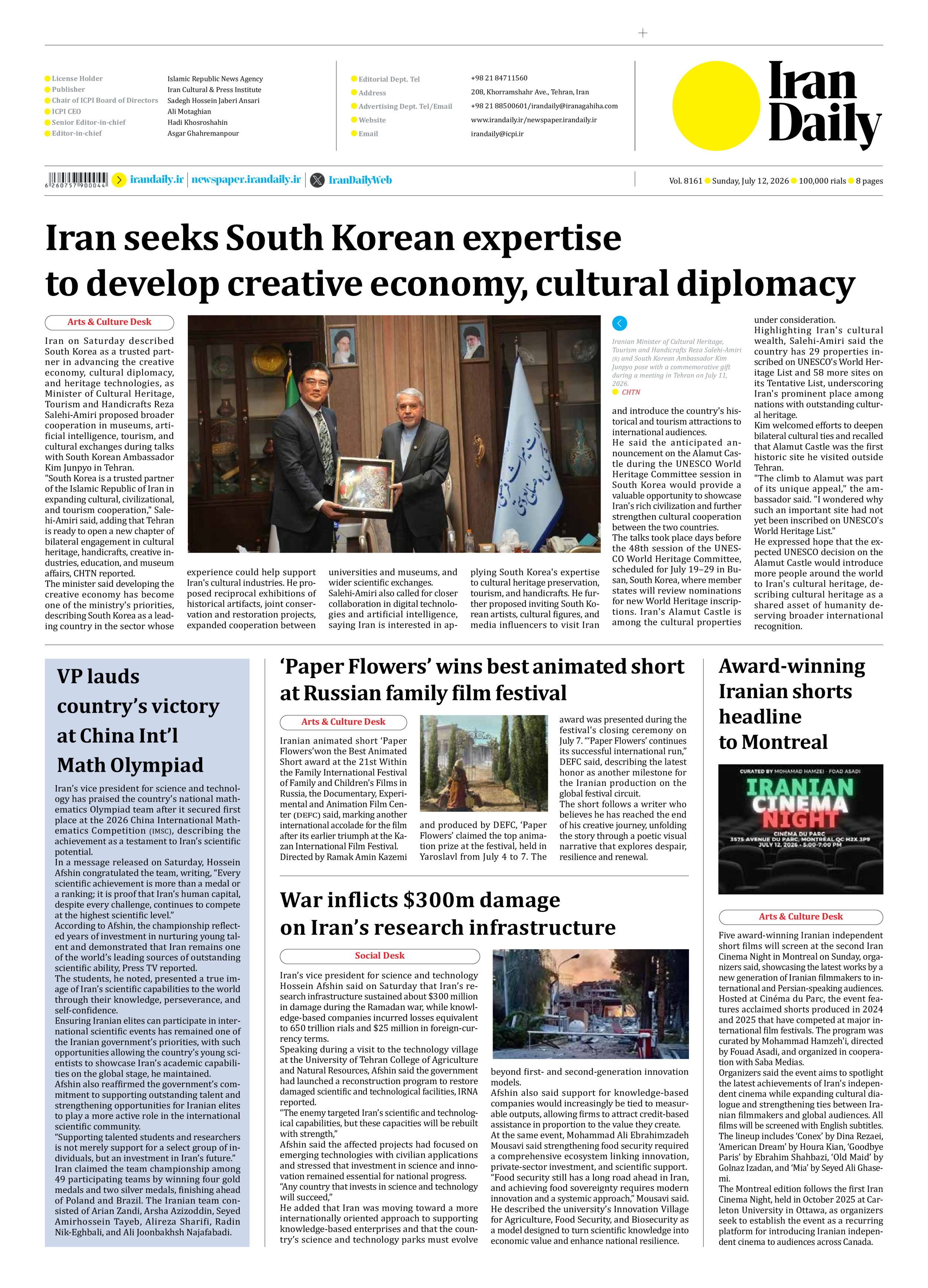


Iran seeks South Korean expertise to develop creative economy, cultural diplomacy
Iran on Saturday described South Korea as a trusted partner in advancing the creative economy, cultural diplomacy, and heritage technologies, as Minister of Cultural Heritage, Tourism and Handicrafts Reza Salehi-Amiri proposed broader cooperation in museums, artificial intelligence, tourism, and cultural exchanges during talks with South Korean Ambassador Kim Junpyo in Tehran.
"South Korea is a trusted partner of the Islamic Republic of Iran in expanding cultural, civilizational, and tourism cooperation," Salehi-Amiri said, adding that Tehran is ready to open a new chapter of bilateral engagement in cultural heritage, handicrafts, creative industries, education, and museum affairs, CHTN reported.
The minister said developing the creative economy has become one of the ministry's priorities, describing South Korea as a leading country in the sector whose experience could help support Iran's cultural industries. He proposed reciprocal exhibitions of historical artifacts, joint conservation and restoration projects, expanded cooperation between universities and museums, and wider scientific exchanges.
Salehi-Amiri also called for closer collaboration in digital technologies and artificial intelligence, saying Iran is interested in applying South Korea's expertise to cultural heritage preservation, tourism, and handicrafts. He further proposed inviting South Korean artists, cultural figures, and media influencers to visit Iran and introduce the country's historical and tourism attractions to international audiences.
He said the anticipated announcement on the Alamut Castle during the UNESCO World Heritage Committee session in South Korea would provide a valuable opportunity to showcase Iran's rich civilization and further strengthen cultural cooperation between the two countries.
The talks took place days before the 48th session of the UNESCO World Heritage Committee, scheduled for July 19–29 in Busan, South Korea, where member states will review nominations for new World Heritage inscriptions. Iran's Alamut Castle is among the cultural properties under consideration.
Highlighting Iran's cultural wealth, Salehi-Amiri said the country has 29 properties inscribed on UNESCO's World Heritage List and 58 more sites on its Tentative List, underscoring Iran's prominent place among nations with outstanding cultural heritage.
Kim welcomed efforts to deepen bilateral cultural ties and recalled that Alamut Castle was the first historic site he visited outside Tehran.
"The climb to Alamut was part of its unique appeal," the ambassador said. "I wondered why such an important site had not yet been inscribed on UNESCO's World Heritage List."
He expressed hope that the expected UNESCO decision on the Alamut Castle would introduce more people around the world to Iran's cultural heritage, describing cultural heritage as a shared asset of humanity deserving broader international recognition.