







Copy in clipboard...
Isfahan moves ahead with restoration of historic Abbasi Square
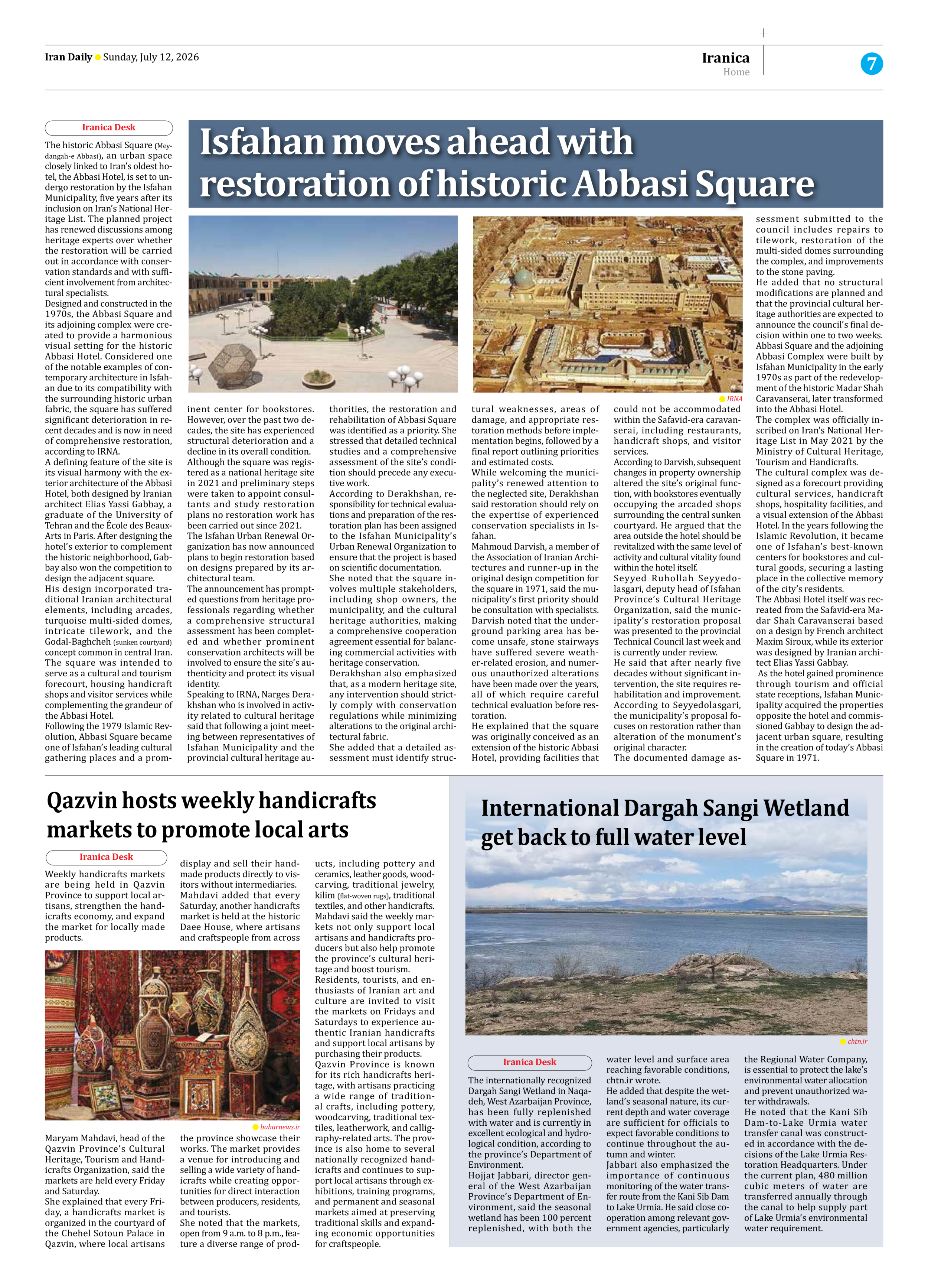
Designed and constructed in the 1970s, the Abbasi Square and its adjoining complex were created to provide a harmonious visual setting for the historic Abbasi Hotel. Considered one of the notable examples of contemporary architecture in Isfahan due to its compatibility with the surrounding historic urban fabric, the square has suffered significant deterioration in recent decades and is now in need of comprehensive restoration, according to IRNA.
A defining feature of the site is its visual harmony with the exterior architecture of the Abbasi Hotel, both designed by Iranian architect Elias Yassi Gabbay, a graduate of the University of Tehran and the École des Beaux-Arts in Paris. After designing the hotel’s exterior to complement the historic neighborhood, Gabbay also won the competition to design the adjacent square.
His design incorporated traditional Iranian architectural elements, including arcades, turquoise multi-sided domes, intricate tilework, and the Godal-Baghcheh (sunken courtyard) concept common in central Iran. The square was intended to serve as a cultural and tourism forecourt, housing handicraft shops and visitor services while complementing the grandeur of the Abbasi Hotel.
Following the 1979 Islamic Revolution, Abbasi Square became one of Isfahan’s leading cultural gathering places and a prominent center for bookstores. However, over the past two decades, the site has experienced structural deterioration and a decline in its overall condition.
Although the square was registered as a national heritage site in 2021 and preliminary steps were taken to appoint consultants and study restoration plans no restoration work has been carried out since 2021.
The Isfahan Urban Renewal Organization has now announced plans to begin restoration based on designs prepared by its architectural team.
The announcement has prompted questions from heritage professionals regarding whether a comprehensive structural assessment has been completed and whether prominent conservation architects will be involved to ensure the site’s authenticity and protect its visual identity.
Speaking to IRNA, Narges Derakhshan who is involved in activity related to cultural heritage said that following a joint meeting between representatives of Isfahan Municipality and the provincial cultural heritage authorities, the restoration and rehabilitation of Abbasi Square was identified as a priority. She stressed that detailed technical studies and a comprehensive assessment of the site’s condition should precede any executive work.
According to Derakhshan, responsibility for technical evaluations and preparation of the restoration plan has been assigned to the Isfahan Municipality’s Urban Renewal Organization to ensure that the project is based on scientific documentation.
She noted that the square involves multiple stakeholders, including shop owners, the municipality, and the cultural heritage authorities, making a comprehensive cooperation agreement essential for balancing commercial activities with heritage conservation.
Derakhshan also emphasized that, as a modern heritage site, any intervention should strictly comply with conservation regulations while minimizing alterations to the original architectural fabric.
She added that a detailed assessment must identify structural weaknesses, areas of damage, and appropriate restoration methods before implementation begins, followed by a final report outlining priorities and estimated costs.
While welcoming the municipality’s renewed attention to the neglected site, Derakhshan said restoration should rely on the expertise of experienced conservation specialists in Isfahan.
Mahmoud Darvish, a member of the Association of Iranian Architectures and runner-up in the original design competition for the square in 1971, said the municipality’s first priority should be consultation with specialists.
Darvish noted that the underground parking area has become unsafe, stone stairways have suffered severe weather-related erosion, and numerous unauthorized alterations have been made over the years, all of which require careful technical evaluation before restoration.
He explained that the square was originally conceived as an extension of the historic Abbasi Hotel, providing facilities that could not be accommodated within the Safavid-era caravanserai, including restaurants, handicraft shops, and visitor services.
According to Darvish, subsequent changes in property ownership altered the site’s original function, with bookstores eventually occupying the arcaded shops surrounding the central sunken courtyard. He argued that the area outside the hotel should be revitalized with the same level of activity and cultural vitality found within the hotel itself.
Seyyed Ruhollah Seyyedolasgari, deputy head of Isfahan Province’s Cultural Heritage Organization, said the municipality’s restoration proposal was presented to the provincial Technical Council last week and is currently under review.
He said that after nearly five decades without significant intervention, the site requires rehabilitation and improvement. According to Seyyedolasgari, the municipality’s proposal focuses on restoration rather than alteration of the monument’s original character.
The documented damage assessment submitted to the council includes repairs to tilework, restoration of the multi-sided domes surrounding the complex, and improvements to the stone paving.
He added that no structural modifications are planned and that the provincial cultural heritage authorities are expected to announce the council’s final decision within one to two weeks.
Abbasi Square and the adjoining Abbasi Complex were built by Isfahan Municipality in the early 1970s as part of the redevelopment of the historic Madar Shah Caravanserai, later transformed into the Abbasi Hotel.
The complex was officially inscribed on Iran’s National Heritage List in May 2021 by the Ministry of Cultural Heritage, Tourism and Handicrafts.
The cultural complex was designed as a forecourt providing cultural services, handicraft shops, hospitality facilities, and a visual extension of the Abbasi Hotel. In the years following the Islamic Revolution, it became one of Isfahan’s best-known centers for bookstores and cultural goods, securing a lasting place in the collective memory of the city’s residents.
The Abbasi Hotel itself was recreated from the Safavid-era Madar Shah Caravanserai based on a design by French architect Maxim Siroux, while its exterior was designed by Iranian architect Elias Yassi Gabbay.
As the hotel gained prominence through tourism and official state receptions, Isfahan Municipality acquired the properties opposite the hotel and commissioned Gabbay to design the adjacent urban square, resulting in the creation of today’s Abbasi Square in 1971.