





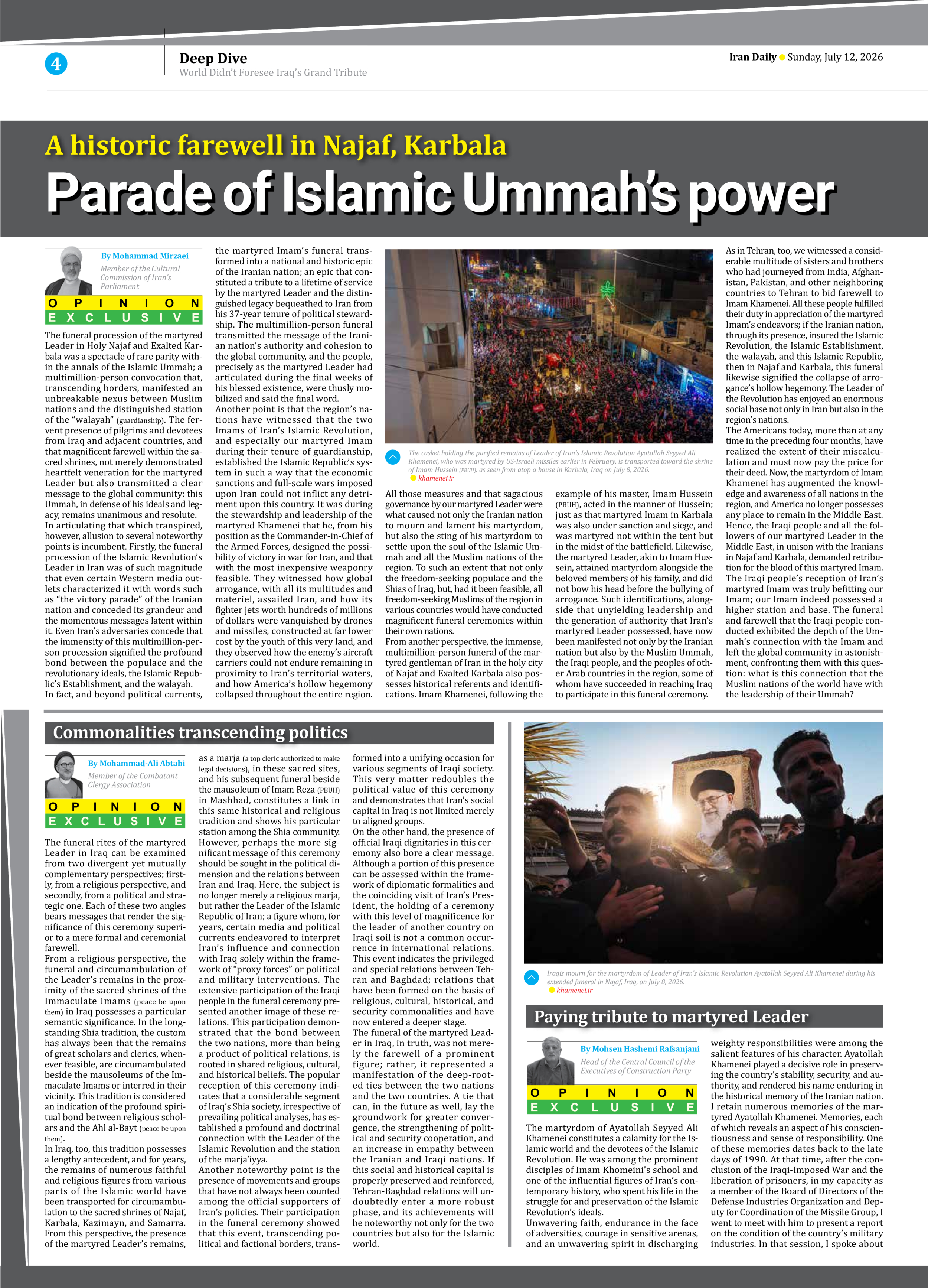


A historic farewell in Najaf, Karbala
Parade of Islamic Ummah’s power
By Mohammad Mirzaei
Member of the Cultural Commission of Iran’s Parliament
The funeral procession of the martyred Leader in Holy Najaf and Exalted Karbala was a spectacle of rare parity within the annals of the Islamic Ummah; a multimillion-person convocation that, transcending borders, manifested an unbreakable nexus between Muslim nations and the distinguished station of the “walayah” (guardianship). The fervent presence of pilgrims and devotees from Iraq and adjacent countries, and that magnificent farewell within the sacred shrines, not merely demonstrated heartfelt veneration for the martyred Leader but also transmitted a clear message to the global community: this Ummah, in defense of his ideals and legacy, remains unanimous and resolute.
In articulating that which transpired, however, allusion to several noteworthy points is incumbent. Firstly, the funeral procession of the Islamic Revolution’s Leader in Iran was of such magnitude that even certain Western media outlets characterized it with words such as “the victory parade” of the Iranian nation and conceded its grandeur and the momentous messages latent within it. Even Iran’s adversaries concede that the immensity of this multimillion-person procession signified the profound bond between the populace and the revolutionary ideals, the Islamic Republic’s Establishment, and the walayah.
In fact, and beyond political currents, the martyred Imam’s funeral transformed into a national and historic epic of the Iranian nation; an epic that constituted a tribute to a lifetime of service by the martyred Leader and the distinguished legacy bequeathed to Iran from his 37-year tenure of political stewardship. The multimillion-person funeral transmitted the message of the Iranian nation’s authority and cohesion to the global community, and the people, precisely as the martyred Leader had articulated during the final weeks of his blessed existence, were thusly mobilized and said the final word.
Another point is that the region’s nations have witnessed that the two Imams of Iran’s Islamic Revolution, and especially our martyred Imam during their tenure of guardianship, established the Islamic Republic’s system in such a way that the economic sanctions and full-scale wars imposed upon Iran could not inflict any detriment upon this country. It was during the stewardship and leadership of the martyred Khamenei that he, from his position as the Commander-in-Chief of the Armed Forces, designed the possibility of victory in war for Iran, and that with the most inexpensive weaponry feasible. They witnessed how global arrogance, with all its multitudes and materiel, assailed Iran, and how its fighter jets worth hundreds of millions of dollars were vanquished by drones and missiles, constructed at far lower cost by the youth of this very land, and they observed how the enemy’s aircraft carriers could not endure remaining in proximity to Iran’s territorial waters, and how America’s hollow hegemony collapsed throughout the entire region.
All those measures and that sagacious governance by our martyred Leader were what caused not only the Iranian nation to mourn and lament his martyrdom, but also the sting of his martyrdom to settle upon the soul of the Islamic Ummah and all the Muslim nations of the region. To such an extent that not only the freedom-seeking populace and the Shias of Iraq, but, had it been feasible, all freedom-seeking Muslims of the region in various countries would have conducted magnificent funeral ceremonies within their own nations.
From another perspective, the immense, multimillion-person funeral of the martyred gentleman of Iran in the holy city of Najaf and Exalted Karbala also possesses historical referents and identifications. Imam Khamenei, following the example of his master, Imam Hussein (PBUH), acted in the manner of Hussein; just as that martyred Imam in Karbala was also under sanction and siege, and was martyred not within the tent but in the midst of the battlefield. Likewise, the martyred Leader, akin to Imam Hussein, attained martyrdom alongside the beloved members of his family, and did not bow his head before the bullying of arrogance. Such identifications, alongside that unyielding leadership and the generation of authority that Iran’s martyred Leader possessed, have now been manifested not only by the Iranian nation but also by the Muslim Ummah, the Iraqi people, and the peoples of other Arab countries in the region, some of whom have succeeded in reaching Iraq to participate in this funeral ceremony.
As in Tehran, too, we witnessed a considerable multitude of sisters and brothers who had journeyed from India, Afghanistan, Pakistan, and other neighboring countries to Tehran to bid farewell to Imam Khamenei. All these people fulfilled their duty in appreciation of the martyred Imam’s endeavors; if the Iranian nation, through its presence, insured the Islamic Revolution, the Islamic Establishment, the walayah, and this Islamic Republic, then in Najaf and Karbala, this funeral likewise signified the collapse of arrogance’s hollow hegemony. The Leader of the Revolution has enjoyed an enormous social base not only in Iran but also in the region’s nations.
The Americans today, more than at any time in the preceding four months, have realized the extent of their miscalculation and must now pay the price for their deed. Now, the martyrdom of Imam Khamenei has augmented the knowledge and awareness of all nations in the region, and America no longer possesses any place to remain in the Middle East. Hence, the Iraqi people and all the followers of our martyred Leader in the Middle East, in unison with the Iranians in Najaf and Karbala, demanded retribution for the blood of this martyred Imam.
The Iraqi people’s reception of Iran’s martyred Imam was truly befitting our Imam; our Imam indeed possessed a higher station and base. The funeral and farewell that the Iraqi people conducted exhibited the depth of the Ummah’s connection with the Imam and left the global community in astonishment, confronting them with this question: what is this connection that the Muslim nations of the world have with the leadership of their Ummah?
Commonalities transcending politics
By Mohammad-Ali Abtahi
Member of the Combatant Clergy Association
The funeral rites of the martyred Leader in Iraq can be examined from two divergent yet mutually complementary perspectives; firstly, from a religious perspective, and secondly, from a political and strategic one. Each of these two angles bears messages that render the significance of this ceremony superior to a mere formal and ceremonial farewell.
From a religious perspective, the funeral and circumambulation of the Leader’s remains in the proximity of the sacred shrines of the Immaculate Imams (peace be upon them) in Iraq possesses a particular semantic significance. In the longstanding Shia tradition, the custom has always been that the remains of great scholars and clerics, whenever feasible, are circumambulated beside the mausoleums of the Immaculate Imams or interred in their vicinity. This tradition is considered an indication of the profound spiritual bond between religious scholars and the Ahl al-Bayt (peace be upon them).
In Iraq, too, this tradition possesses a lengthy antecedent, and for years, the remains of numerous faithful and religious figures from various parts of the Islamic world have been transported for circumambulation to the sacred shrines of Najaf, Karbala, Kazimayn, and Samarra. From this perspective, the presence of the martyred Leader’s remains, as a marja (a top cleric authorized to make legal decisions), in these sacred sites, and his subsequent funeral beside the mausoleum of Imam Reza (PBUH) in Mashhad, constitutes a link in this same historical and religious tradition and shows his particular station among the Shia community. However, perhaps the more significant message of this ceremony should be sought in the political dimension and the relations between Iran and Iraq. Here, the subject is no longer merely a religious marja, but rather the Leader of the Islamic Republic of Iran; a figure whom, for years, certain media and political currents endeavored to interpret Iran’s influence and connection with Iraq solely within the framework of “proxy forces” or political and military interventions. The extensive participation of the Iraqi people in the funeral ceremony presented another image of these relations. This participation demonstrated that the bond between the two nations, more than being a product of political relations, is rooted in shared religious, cultural, and historical beliefs. The popular reception of this ceremony indicates that a considerable segment of Iraq’s Shia society, irrespective of prevailing political analyses, has established a profound and doctrinal connection with the Leader of the Islamic Revolution and the station of the marja’iyya.
Another noteworthy point is the presence of movements and groups that have not always been counted among the official supporters of Iran’s policies. Their participation in the funeral ceremony showed that this event, transcending political and factional borders, transformed into a unifying occasion for various segments of Iraqi society. This very matter redoubles the political value of this ceremony and demonstrates that Iran’s social capital in Iraq is not limited merely to aligned groups.
On the other hand, the presence of official Iraqi dignitaries in this ceremony also bore a clear message. Although a portion of this presence can be assessed within the framework of diplomatic formalities and the coinciding visit of Iran’s President, the holding of a ceremony with this level of magnificence for the leader of another country on Iraqi soil is not a common occurrence in international relations. This event indicates the privileged and special relations between Tehran and Baghdad; relations that have been formed on the basis of religious, cultural, historical, and security commonalities and have now entered a deeper stage.
The funeral of the martyred Leader in Iraq, in truth, was not merely the farewell of a prominent figure; rather, it represented a manifestation of the deep-rooted ties between the two nations and the two countries. A tie that can, in the future as well, lay the groundwork for greater convergence, the strengthening of political and security cooperation, and an increase in empathy between the Iranian and Iraqi nations. If this social and historical capital is properly preserved and reinforced, Tehran-Baghdad relations will undoubtedly enter a more robust phase, and its achievements will be noteworthy not only for the two countries but also for the Islamic world.
Paying tribute to martyred Leader
By Mohsen Hashemi Rafsanjani
Head of the Central Council of the Executives of Construction Party
The martyrdom of Ayatollah Seyyed Ali Khamenei constitutes a calamity for the Islamic world and the devotees of the Islamic Revolution. He was among the prominent disciples of Imam Khomeini’s school and one of the influential figures of Iran’s contemporary history, who spent his life in the struggle for and preservation of the Islamic Revolution’s ideals.
Unwavering faith, endurance in the face of adversities, courage in sensitive arenas, and an unwavering spirit in discharging weighty responsibilities were among the salient features of his character. Ayatollah Khamenei played a decisive role in preserving the country’s stability, security, and authority, and rendered his name enduring in the historical memory of the Iranian nation.
I retain numerous memories of the martyred Ayatollah Khamenei. Memories, each of which reveals an aspect of his conscientiousness and sense of responsibility. One of these memories dates back to the late days of 1990. At that time, after the conclusion of the Iraqi-Imposed War and the liberation of prisoners, in my capacity as a member of the Board of Directors of the Defense Industries Organization and Deputy for Coordination of the Missile Group, I went to meet with him to present a report on the condition of the country’s military industries. In that session, I spoke about the necessity of developing Iran’s defensive capabilities, particularly in the missile domain, and the importance of supporting this strategic sector to ensure the nation’s national security.
What remains in my mind above all else was his precise perspective on the country’s strategic issues. Ayatollah Khamenei listened attentively to the explanations and posed questions that demonstrated his particular mastery and sensitivity regarding the various dimensions of the subject. At that juncture, perhaps few could grasp the significance of the missile capability’s role in Iran’s future defensive architecture as clearly as is understood today, but he, with a vision transcending day-to-day matters, attended to the necessity of reinforcing the country’s deterrence infrastructure.
The history of the Islamic Revolution is a history of connections, trusts, and collaborations among figures who, at fateful junctures, bore the burden of the country’s responsibility. Among these influential connections, the relationship between the martyred Ayatollah Seyyed Ali Khamenei and Ayatollah Akbar Hashemi Rafsanjani holds a particular place; two longtime companions who, from the years of struggle against despotism and arrogance through the era of the Islamic Establishment’s consolidation, the Sacred Defense, and the country’s reconstruction, played their roles alongside one another.
In this relationship, subsequent to the Revolution, I also have several particular memories of him. First, the time of his assassination attempt in July 1981, which occurred before the event of the Seventh of Tir [June 28, 1981]. Ayatollah Hashemi Rafsanjani was then occupied with inspecting the coal mines of Kerman; immediately upon being informed, he returned to Tehran, and we went to the hospital, and like a brother, and perhaps closer than a brother, he cherished Ayatollah Khamenei and was concerned for his condition. After the event of the Seventh of Tir, one of my father’s spiritual challenges was how to convey the news of the martyrdom of Ayatollah Beheshti and 72 others to Ayatollah Khamenei.
For our family, the recollection of Ayatollah Khamenei’s name has always been intertwined with the memory of an ancient friendship. My father recounted that his first acquaintance with Ayatollah Khamenei was formed in the advanced jurisprudence (kharij) class of the late Ayatollah Damad. A friendship that, during the years of struggle against the Pahlavi regime and especially in Iraq, deepened and transformed into brotherhood, and continued after the victory of the Islamic Revolution in the great arenas of responsibility and the country’s governance.
This friendship was not merely a political relationship. It was rooted in trust, mutual understanding, and years of shared struggle. Both were among the closest companions of Imam Khomeini and, at the most critical junctures of Iran’s contemporary history, stood beside one another, and many of the country’s great crises were overcome through their consultation and cooperation and under the guidance of the departed Imam.
The martyred Ayatollah Khamenei is no longer among us, but his intellectual, political, and managerial legacy continues to flow through the life of the Islamic Republic and the historical memory of the Iranian nation; a legacy manifested in resistance against threats, a sense of responsibility toward the nation’s destiny, continuous effort to preserve stability and national security, and faith in Iran’s future. Figures of this caliber cannot be measured merely within the framework of political disputes and daily judgments. Just as my father frequently emphasized, the record of great historical figures is properly understood only when evaluated on the broad horizon of national transformations and in relation to the conditions and exigencies of their own era. The final judgment concerning them is rendered not by the clamor of daily politics but by the passage of time and the historical memory of nations.
Iran transcends factions, tastes, and political rivalries, and the survival of the Islamic Revolution depends on preserving national unity, rationality in decision-making, and harnessing the capacities of all forces loyal to the country. Today, the most important tribute to his memory and legacy is the endeavor to build a future in which national unity prevails over division, rationality over extremism, hope over despair, and national interest over transient political conflicts. This is the very ideal that he and his longtime companion, Ayatollah Hashemi Rafsanjani, with all the ups and downs of history, strived for years to realize; the ideal of a powerful, secure, and stable Iran, developed and pure, possessing national solidarity, capable — by relying on its human and historical capital — of continuing the path of progress and glory.
Indissoluble bond of two nations
By Reza Mirabian
Expert on West Asian affairs
The funeral of the martyred Leader in Iraq, unquestionably, is an exceptional, unprecedented, and noteworthy phenomenon in the history of relations between the two countries. If we return only a few decades, we will observe that Iran and Iraq endured eight years of heavy warfare. A war that left thousands of dead, martyrs, and devastation for both nations. At that time, no one could have imagined that a day would arrive when this same Iraqi nation, with insistent and extensive reception, would demand the presence of the Islamic Republic of Iran’s Leader’s remains on their own soil, to perform the funeral prayer for him beside the sacred shrines and to bid him farewell with a magnificence of rare occurrence.
This event can scarcely be compared with any parallel in contemporary history. In fact, we are confronted with an entirely exceptional phenomenon that surprised many observers, especially Western and American analysts. It should not be forgotten that Iraq has been under occupation and subsequently under American pressure and influence for more than two decades, and it was natural that Washington would have no desire for the holding of such a ceremony. Hence, this magnificent reception can be interpreted as a resounding “no” from the Iraqi nation toward American policies vis-à-vis the Islamic Republic of Iran. A clear message that they consider Iran a neighborly, brotherly, co-religious, and co-sectarian country and are unwilling to act against the Islamic Republic under American political pressure.
This solidarity is not limited merely to the funeral ceremony. In recent years, especially in the battles of the Resistance Axis, Iraq has played one of the most brilliant and influential roles. Iraq’s resistance forces, alongside the Islamic Republic of Iran, whether in confronting counter-revolutionary groups based in the Iraqi Kurdistan Region or against the threats and hostile actions of certain regional countries, have had an active and decisive presence. They have demonstrated in practice that, at critical junctures, they stand fully beside the Islamic Republic of Iran.
If we analyze these developments within the framework of prevailing international equations, perhaps no analogous example can be found. What has occurred transcends conventional political calculations, and for this reason, this valuable capital must be appreciated. The historical, cultural, religious, and doctrinal bonds between the two nations have today manifested themselves more than ever before, and it is hoped that these relations will become increasingly robust. The extensive participation of the Iraqi people in this ceremony demonstrated that they perceive their future and destiny as intertwined with the Islamic Republic of Iran and interpret this convergence in the confrontation with American policies in the region.
If we cast a glance at the history of Iran-Iraq relations, we realize that, at various junctures, many of the governments ruling Iraq endeavored to place this country in opposition to Iran. This policy is not confined solely to the era of Saddam. Even during the Ottoman period and thereafter, numerous wars and provocations were undertaken with the aim of creating a schism between the two nations. During the Imposed War, too, despite the fact that the majority of Iraq’s population consisted of Shias, the country’s rulers attempted to employ these same Iraqi youth in the army ranks against the Islamic Republic of Iran. This approach demonstrates that foreign powers and dependent governments have always sought to generate confrontation between the two nations.
Nevertheless, by virtue of the awareness of the region’s nations, the blood of the martyrs, and the martyred Leader’s leadership, many of these mental and political boundaries crumbled. Had the leaders of the Baathist regime been told years ago that the Iraqi people would one day, with fervor and enthusiasm, hold a funeral for the Leader of the Islamic Republic of Iran, they would undoubtedly have deemed such a statement unbelievable. Today, however, this historical reality has occurred and has become a symbol of the profound transformation in the relations between the two nations.
It is natural that such an event would be displeasing to America. Even before the ceremony’s holding, reports were published indicating that the US State Department, by dispatching directives to certain of its embassies in the region, had pressured governments regarding participation in this ceremony and had warned them against involvement at a high level. Despite these pressures, many countries participated in the ceremony, and more importantly, the Iraqi people, through extensive and rare participation, demonstrated that the will of nations transcends pressures and the political considerations of foreign powers. This very extensive participation constituted the most important message of this ceremony. A message that indicates the solidity of the historical, religious, and strategic bonds between Iran and Iraq and shows that these relations have today entered a new and decisive phase.
Farewell to the sun
By Eskandar Momeni
Iran’s Minister of the Interior
The farewell to the martyred Leader of Iran’s Islamic Revolution Ayatollah Imam Khamenei transcends a national mourning, constituting an event of immense international dimensions. His comprehensive personality and sagacious leadership traversed geographical boundaries and captivated innumerable hearts across the globe, the Islamic world, and especially within the strategic depth of the Resistance Front.
Hence, a portion of the unparalleled magnificence and grandeur of this venerable rite is indebted to the presence and solidarity of the devotees who, from various countries of the world, renewed their allegiance to the ideals of that exalted martyr, and this epic presence conveyed the message of the fortitude and vitality of the movement of the two Imams of the Revolution to the world’s ears.
This magnificent and historic ceremony, simultaneously, depicts a unique and enduring manifestation of unity, concord, and cohesion. The unified presence of various groups, ethnicities, and tastes from across Islamic Iran, alongside brothers and sisters from other Islamic countries, displays an indissoluble nexus among the individual members of the nation and the great Islamic Ummah. This profound empathy and solidarity will constitute a line drawn through all the divisive conspiracies of the enemies and demonstrates that the martyrdom of the Ummah’s Leader itself constitutes a new axis for the cohesion and integration of society and the consolidation of the Islamic Ummah’s ranks against the arrogant powers.
By divine favor, the holding of numerous sessions for coordination, synergy, and support of the popular farewell and funeral rites among various institutions, and the preparation of necessary arrangements, have provided a secure and orderly environment so that this historic farewell can be conducted at the highest possible level and befitting the exalted station of the revolutionary Leader’s martyr. The extensive presence of the people in this ceremony was, in practice, a renewal of allegiance to the Leader of the Revolution Ayatollah Seyyed Mojtaba Hosseini Khamenei.
The articles first appeared in the
Persian-language newspaper Iran.