







Iran pitches transit initiatives to strengthen BRICS connectivity
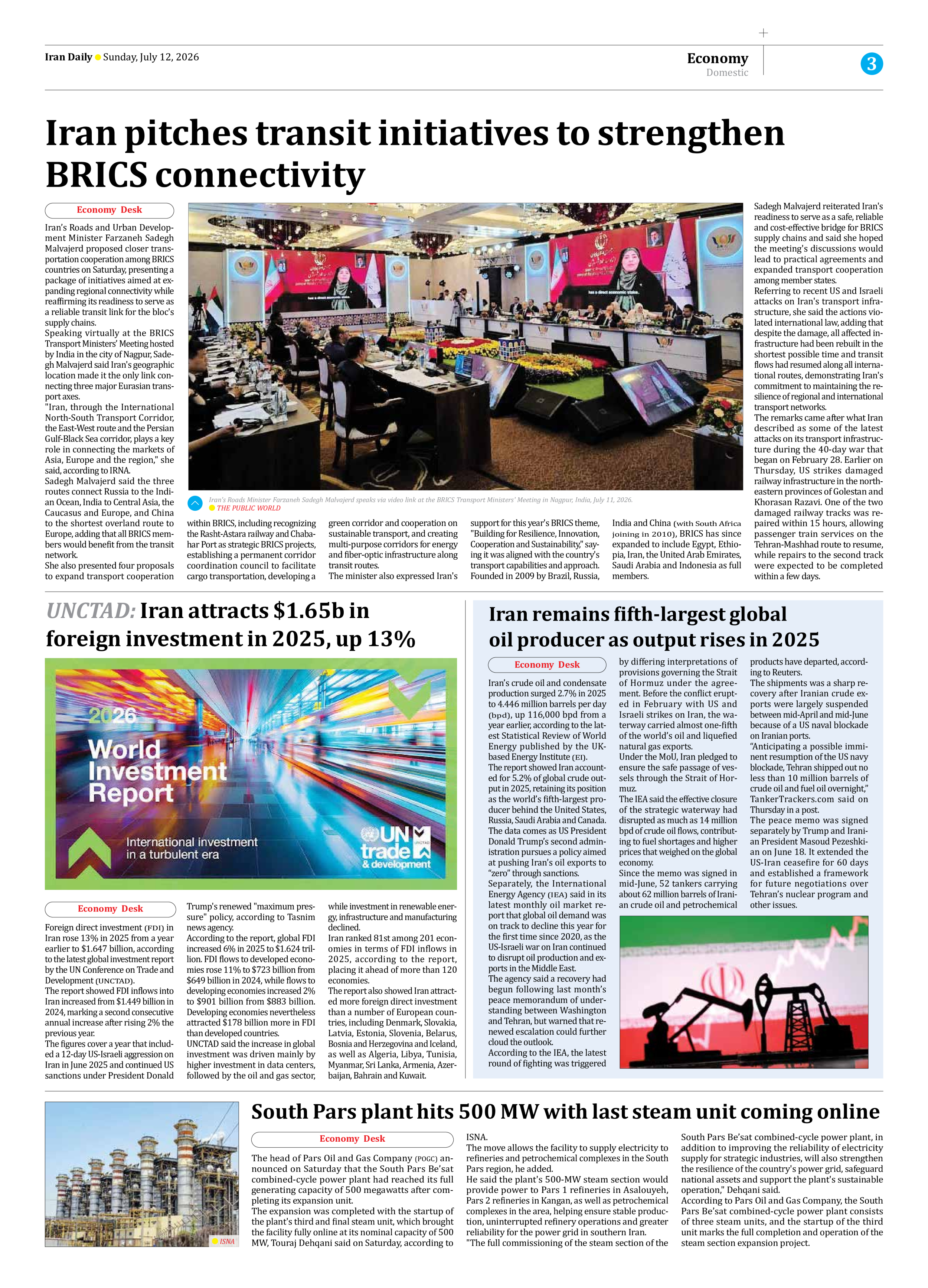
Iran’s Roads and Urban Development Minister Farzaneh Sadegh Malvajerd proposed closer transportation cooperation among BRICS countries on Saturday, presenting a package of initiatives aimed at expanding regional connectivity while reaffirming its readiness to serve as a reliable transit link for the bloc's supply chains.
Speaking virtually at the BRICS Transport Ministers’ Meeting hosted by India in the city of Nagpur, Sadegh Malvajerd said Iran's geographic location made it the only link connecting three major Eurasian transport axes.
"Iran, through the International North-South Transport Corridor, the East-West route and the Persian Gulf-Black Sea corridor, plays a key role in connecting the markets of Asia, Europe and the region," she said, according to IRNA.
Sadegh Malvajerd said the three routes connect Russia to the Indian Ocean, India to Central Asia, the Caucasus and Europe, and China to the shortest overland route to Europe, adding that all BRICS members would benefit from the transit network.
She also presented four proposals to expand transport cooperation within BRICS, including recognizing the Rasht-Astara railway and Chabahar Port as strategic BRICS projects, establishing a permanent corridor coordination council to facilitate cargo transportation, developing a green corridor and cooperation on sustainable transport, and creating multi-purpose corridors for energy and fiber-optic infrastructure along transit routes.
The minister also expressed Iran's support for this year's BRICS theme, "Building for Resilience, Innovation, Cooperation and Sustainability," saying it was aligned with the country's transport capabilities and approach.
Founded in 2009 by Brazil, Russia, India and China (with South Africa joining in 2010), BRICS has since expanded to include Egypt, Ethiopia, Iran, the United Arab Emirates, Saudi Arabia and Indonesia as full members.
Sadegh Malvajerd reiterated Iran's readiness to serve as a safe, reliable and cost-effective bridge for BRICS supply chains and said she hoped the meeting's discussions would lead to practical agreements and expanded transport cooperation among member states.
Referring to recent US and Israeli attacks on Iran's transport infrastructure, she said the actions violated international law, adding that despite the damage, all affected infrastructure had been rebuilt in the shortest possible time and transit flows had resumed along all international routes, demonstrating Iran's commitment to maintaining the resilience of regional and international transport networks.
The remarks came after what Iran described as some of the latest attacks on its transport infrastructure during the 40-day war that began on February 28. Earlier on Thursday, US strikes damaged railway infrastructure in the northeastern provinces of Golestan and Khorasan Razavi. One of the two damaged railway tracks was repaired within 15 hours, allowing passenger train services on the Tehran-Mashhad route to resume, while repairs to the second track were expected to be completed within a few days.