





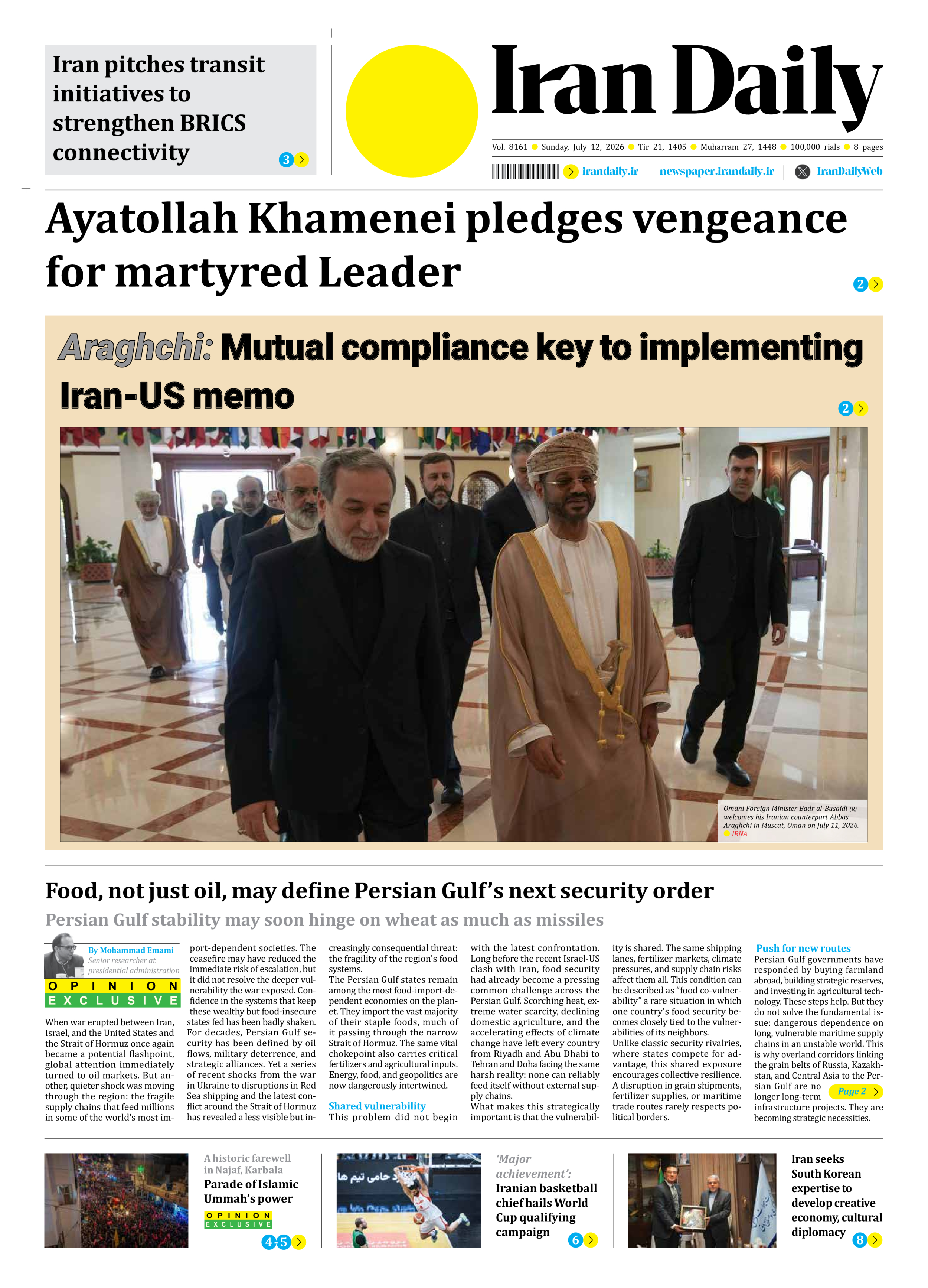


Food, not just oil, may define Persian Gulf’s next security order
Persian Gulf stability may soon hinge on wheat as much as missiles
By Mohammad Emami
Senior researcher at
presidential administration
When war erupted between Iran, Israel, and the United States and the Strait of Hormuz once again became a potential flashpoint, global attention immediately turned to oil markets. But another, quieter shock was moving through the region: the fragile supply chains that feed millions in some of the world's most import-dependent societies. The ceasefire may have reduced the immediate risk of escalation, but it did not resolve the deeper vulnerability the war exposed. Confidence in the systems that keep these wealthy but food-insecure states fed has been badly shaken.
For decades, Persian Gulf security has been defined by oil flows, military deterrence, and strategic alliances. Yet a series of recent shocks from the war in Ukraine to disruptions in Red Sea shipping and the latest conflict around the Strait of Hormuz has revealed a less visible but increasingly consequential threat: the fragility of the region's food systems.
The Persian Gulf states remain among the most food-import-dependent economies on the planet. They import the vast majority of their staple foods, much of it passing through the narrow Strait of Hormuz. The same vital chokepoint also carries critical fertilizers and agricultural inputs. Energy, food, and geopolitics are now dangerously intertwined.
Shared vulnerability
This problem did not begin with the latest confrontation. Long before the recent Israel-US clash with Iran, food security had already become a pressing common challenge across the Persian Gulf. Scorching heat, extreme water scarcity, declining domestic agriculture, and the accelerating effects of climate change have left every country from Riyadh and Abu Dhabi to Tehran and Doha facing the same harsh reality: none can reliably feed itself without external supply chains.
What makes this strategically important is that the vulnerability is shared. The same shipping lanes, fertilizer markets, climate pressures, and supply chain risks affect them all. This condition can be described as “food co-vulnerability” a rare situation in which one country's food security becomes closely tied to the vulnerabilities of its neighbors.
Unlike classic security rivalries, where states compete for advantage, this shared exposure encourages collective resilience. A disruption in grain shipments, fertilizer supplies, or maritime trade routes rarely respects political borders.
Push for new routes
Persian Gulf governments have responded by buying farmland abroad, building strategic reserves, and investing in agricultural technology. These steps help. But they do not solve the fundamental issue: dangerous dependence on long, vulnerable maritime supply chains in an unstable world. This is why overland corridors linking the grain belts of Russia, Kazakhstan, and Central Asia to the Persian Gulf are no longer long-term infrastructure projects. They are becoming strategic necessities.
Page 2