





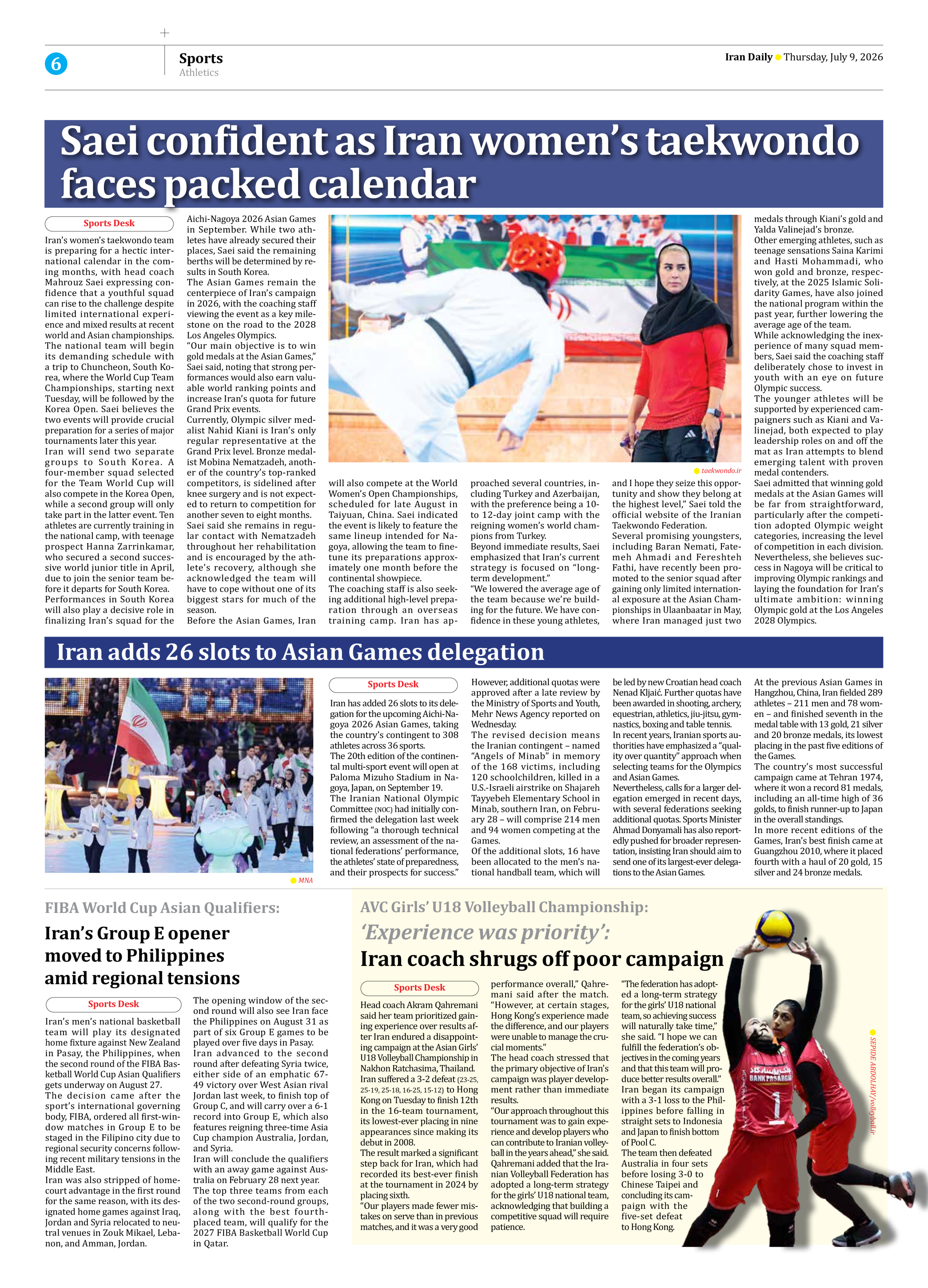


Saei confident as Iran women’s taekwondo faces packed calendar
Iran’s women’s taekwondo team is preparing for a hectic international calendar in the coming months, with head coach Mahrouz Saei expressing confidence that a youthful squad can rise to the challenge despite limited international experience and mixed results at recent world and Asian championships.
The national team will begin its demanding schedule with a trip to Chuncheon, South Korea, where the World Cup Team Championships, starting next Tuesday, will be followed by the Korea Open. Saei believes the two events will provide crucial preparation for a series of major tournaments later this year.
Iran will send two separate groups to South Korea. A four-member squad selected for the Team World Cup will also compete in the Korea Open, while a second group will only take part in the latter event. Ten athletes are currently training in the national camp, with teenage prospect Hanna Zarrinkamar, who secured a second successive world junior title in April, due to join the senior team before it departs for South Korea.
Performances in South Korea will also play a decisive role in finalizing Iran’s squad for the Aichi-Nagoya 2026 Asian Games in September. While two athletes have already secured their places, Saei said the remaining berths will be determined by results in South Korea.
The Asian Games remain the centerpiece of Iran’s campaign in 2026, with the coaching staff viewing the event as a key milestone on the road to the 2028 Los Angeles Olympics.
“Our main objective is to win gold medals at the Asian Games,” Saei said, noting that strong performances would also earn valuable world ranking points and increase Iran’s quota for future Grand Prix events.
Currently, Olympic silver medalist Nahid Kiani is Iran’s only regular representative at the Grand Prix level. Bronze medalist Mobina Nematzadeh, another of the country’s top-ranked competitors, is sidelined after knee surgery and is not expected to return to competition for another seven to eight months.
Saei said she remains in regular contact with Nematzadeh throughout her rehabilitation and is encouraged by the athlete’s recovery, although she acknowledged the team will have to cope without one of its biggest stars for much of the season.
Before the Asian Games, Iran will also compete at the World Women’s Open Championships, scheduled for late August in Taiyuan, China. Saei indicated the event is likely to feature the same lineup intended for Nagoya, allowing the team to fine-tune its preparations approximately one month before the continental showpiece.
The coaching staff is also seeking additional high-level preparation through an overseas training camp. Iran has approached several countries, including Turkey and Azerbaijan, with the preference being a 10- to 12-day joint camp with the reigning women’s world champions from Turkey.
Beyond immediate results, Saei emphasized that Iran’s current strategy is focused on “long-term development.”
“We lowered the average age of the team because we’re building for the future. We have confidence in these young athletes, and I hope they seize this opportunity and show they belong at the highest level,” Saei told the official website of the Iranian Taekwondo Federation.
Several promising youngsters, including Baran Nemati, Fatemeh Ahmadi and Fereshteh Fathi, have recently been promoted to the senior squad after gaining only limited international exposure at the Asian Championships in Ulaanbaatar in May, where Iran managed just two medals through Kiani’s gold and Yalda Valinejad’s bronze.
Other emerging athletes, such as teenage sensations Saina Karimi and Hasti Mohammadi, who won gold and bronze, respectively, at the 2025 Islamic Solidarity Games, have also joined the national program within the past year, further lowering the average age of the team.
While acknowledging the inexperience of many squad members, Saei said the coaching staff deliberately chose to invest in youth with an eye on future Olympic success.
The younger athletes will be supported by experienced campaigners such as Kiani and Valinejad, both expected to play leadership roles on and off the mat as Iran attempts to blend emerging talent with proven medal contenders.
Saei admitted that winning gold medals at the Asian Games will be far from straightforward, particularly after the competition adopted Olympic weight categories, increasing the level of competition in each division. Nevertheless, she believes success in Nagoya will be critical to improving Olympic rankings and laying the foundation for Iran’s ultimate ambition: winning Olympic gold at the Los Angeles 2028 Olympics.