







Global messages of a national ceremony
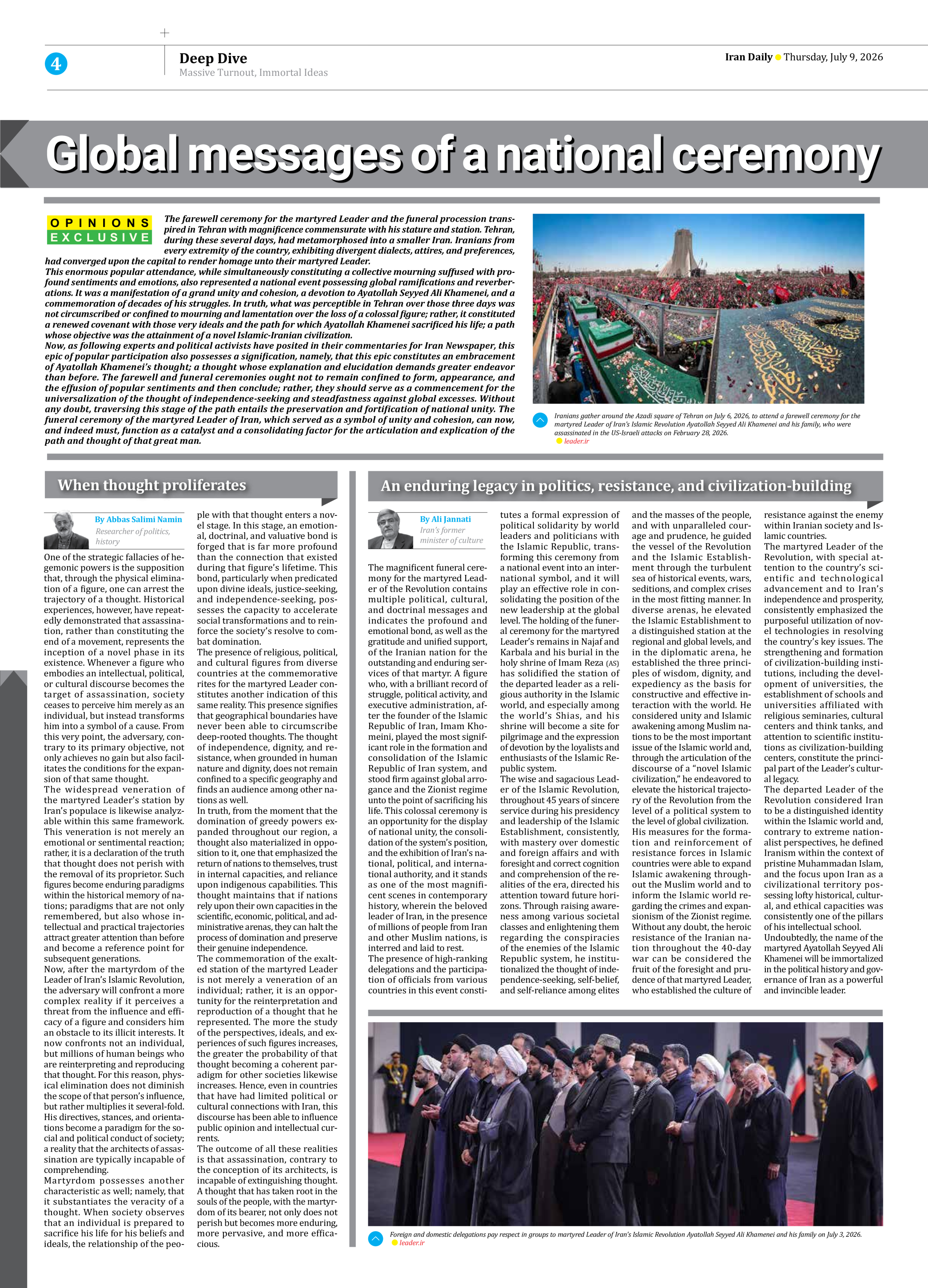
The farewell ceremony for the martyred Leader and the funeral procession transpired in Tehran with magnificence commensurate with his stature and station. Tehran, during these several days, had metamorphosed into a smaller Iran. Iranians from every extremity of the country, exhibiting divergent dialects, attires, and preferences, had converged upon the capital to render homage unto their martyred Leader. This enormous popular attendance, while simultaneously constituting a collective mourning suffused with profound sentiments and emotions, also represented a national event possessing global ramifications and reverberations. It was a manifestation of a grand unity and cohesion, a devotion to Ayatollah Seyyed Ali Khamenei, and a commemoration of decades of his struggles. In truth, what was perceptible in Tehran over those three days was not circumscribed or confined to mourning and lamentation over the loss of a colossal figure; rather, it constituted a renewed covenant with those very ideals and the path for which Ayatollah Khamenei sacrificed his life; a path whose objective was the attainment of a novel Islamic-Iranian civilization. Now, as following experts and political activists have posited in their commentaries for Iran Newspaper, this epic of popular participation also possesses a signification, namely, that this epic constitutes an embracement of Ayatollah Khamenei’s thought; a thought whose explanation and elucidation demands greater endeavor than before. The farewell and funeral ceremonies ought not to remain confined to form, appearance, and the effusion of popular sentiments and then conclude; rather, they should serve as a commencement for the universalization of the thought of independence-seeking and steadfastness against global excesses. Without any doubt, traversing this stage of the path entails the preservation and fortification of national unity. The funeral ceremony of the martyred Leader of Iran, which served as a symbol of unity and cohesion, can now, and indeed must, function as a catalyst and a consolidating factor for the articulation and explication of the path and thought of that great man.
When thought proliferates
By Abbas Salimi Namin
Researcher of politics,
history
One of the strategic fallacies of hegemonic powers is the supposition that, through the physical elimination of a figure, one can arrest the trajectory of a thought. Historical experiences, however, have repeatedly demonstrated that assassination, rather than constituting the end of a movement, represents the inception of a novel phase in its existence. Whenever a figure who embodies an intellectual, political, or cultural discourse becomes the target of assassination, society ceases to perceive him merely as an individual, but instead transforms him into a symbol of a cause. From this very point, the adversary, contrary to its primary objective, not only achieves no gain but also facilitates the conditions for the expansion of that same thought.
The widespread veneration of the martyred Leader’s station by Iran’s populace is likewise analyzable within this same framework. This veneration is not merely an emotional or sentimental reaction; rather, it is a declaration of the truth that thought does not perish with the removal of its proprietor. Such figures become enduring paradigms within the historical memory of nations; paradigms that are not only remembered, but also whose intellectual and practical trajectories attract greater attention than before and become a reference point for subsequent generations.
Now, after the martyrdom of the Leader of Iran’s Islamic Revolution, the adversary will confront a more complex reality if it perceives a threat from the influence and efficacy of a figure and considers him an obstacle to its illicit interests. It now confronts not an individual, but millions of human beings who are reinterpreting and reproducing that thought. For this reason, physical elimination does not diminish the scope of that person’s influence, but rather multiplies it several-fold. His directives, stances, and orientations become a paradigm for the social and political conduct of society; a reality that the architects of assassination are typically incapable of comprehending.
Martyrdom possesses another characteristic as well; namely, that it substantiates the veracity of a thought. When society observes that an individual is prepared to sacrifice his life for his beliefs and ideals, the relationship of the people with that thought enters a novel stage. In this stage, an emotional, doctrinal, and valuative bond is forged that is far more profound than the connection that existed during that figure’s lifetime. This bond, particularly when predicated upon divine ideals, justice-seeking, and independence-seeking, possesses the capacity to accelerate social transformations and to reinforce the society’s resolve to combat domination.
The presence of religious, political, and cultural figures from diverse countries at the commemorative rites for the martyred Leader constitutes another indication of this same reality. This presence signifies that geographical boundaries have never been able to circumscribe deep-rooted thoughts. The thought of independence, dignity, and resistance, when grounded in human nature and dignity, does not remain confined to a specific geography and finds an audience among other nations as well.
In truth, from the moment that the domination of greedy powers expanded throughout our region, a thought also materialized in opposition to it, one that emphasized the return of nations to themselves, trust in internal capacities, and reliance upon indigenous capabilities. This thought maintains that if nations rely upon their own capacities in the scientific, economic, political, and administrative arenas, they can halt the process of domination and preserve their genuine independence.
The commemoration of the exalted station of the martyred Leader is not merely a veneration of an individual; rather, it is an opportunity for the reinterpretation and reproduction of a thought that he represented. The more the study of the perspectives, ideals, and experiences of such figures increases, the greater the probability of that thought becoming a coherent paradigm for other societies likewise increases. Hence, even in countries that have had limited political or cultural connections with Iran, this discourse has been able to influence public opinion and intellectual currents.
The outcome of all these realities is that assassination, contrary to the conception of its architects, is incapable of extinguishing thought. A thought that has taken root in the souls of the people, with the martyrdom of its bearer, not only does not perish but becomes more enduring, more pervasive, and more efficacious.
An enduring legacy in politics, resistance, and civilization-building
By Ali Jannati
Iran’s former
minister of culture
The magnificent funeral ceremony for the martyred Leader of the Revolution contains multiple political, cultural, and doctrinal messages and indicates the profound and emotional bond, as well as the gratitude and unified support, of the Iranian nation for the outstanding and enduring services of that martyr. A figure who, with a brilliant record of struggle, political activity, and executive administration, after the founder of the Islamic Republic of Iran, Imam Khomeini, played the most significant role in the formation and consolidation of the Islamic Republic of Iran system, and stood firm against global arrogance and the Zionist regime unto the point of sacrificing his life. This colossal ceremony is an opportunity for the display of national unity, the consolidation of the system’s position, and the exhibition of Iran’s national, political, and international authority, and it stands as one of the most magnificent scenes in contemporary history, wherein the beloved leader of Iran, in the presence of millions of people from Iran and other Muslim nations, is interred and laid to rest.
The presence of high-ranking delegations and the participation of officials from various countries in this event constitutes a formal expression of political solidarity by world leaders and politicians with the Islamic Republic, transforming this ceremony from a national event into an international symbol, and it will play an effective role in consolidating the position of the new leadership at the global level. The holding of the funeral ceremony for the martyred Leader’s remains in Najaf and Karbala and his burial in the holy shrine of Imam Reza (AS) has solidified the station of the departed leader as a religious authority in the Islamic world, and especially among the world’s Shias, and his shrine will become a site for pilgrimage and the expression of devotion by the loyalists and enthusiasts of the Islamic Republic system.
The wise and sagacious Leader of the Islamic Revolution, throughout 45 years of sincere service during his presidency and leadership of the Islamic Establishment, consistently, with mastery over domestic and foreign affairs and with foresight and correct cognition and comprehension of the realities of the era, directed his attention toward future horizons. Through raising awareness among various societal classes and enlightening them regarding the conspiracies of the enemies of the Islamic Republic system, he institutionalized the thought of independence-seeking, self-belief, and self-reliance among elites and the masses of the people, and with unparalleled courage and prudence, he guided the vessel of the Revolution and the Islamic Establishment through the turbulent sea of historical events, wars, seditions, and complex crises in the most fitting manner. In diverse arenas, he elevated the Islamic Establishment to a distinguished station at the regional and global levels, and in the diplomatic arena, he established the three principles of wisdom, dignity, and expediency as the basis for constructive and effective interaction with the world. He considered unity and Islamic awakening among Muslim nations to be the most important issue of the Islamic world and, through the articulation of the discourse of a “novel Islamic civilization,” he endeavored to elevate the historical trajectory of the Revolution from the level of a political system to the level of global civilization.
His measures for the formation and reinforcement of resistance forces in Islamic countries were able to expand Islamic awakening throughout the Muslim world and to inform the Islamic world regarding the crimes and expansionism of the Zionist regime. Without any doubt, the heroic resistance of the Iranian nation throughout the 40-day war can be considered the fruit of the foresight and prudence of that martyred Leader, who established the culture of resistance against the enemy within Iranian society and Islamic countries.
The martyred Leader of the Revolution, with special attention to the country’s scientific and technological advancement and to Iran’s independence and prosperity, consistently emphasized the purposeful utilization of novel technologies in resolving the country’s key issues. The strengthening and formation of civilization-building institutions, including the development of universities, the establishment of schools and universities affiliated with religious seminaries, cultural centers and think tanks, and attention to scientific institutions as civilization-building centers, constitute the principal part of the Leader’s cultural legacy.
The departed Leader of the Revolution considered Iran to be a distinguished identity within the Islamic world and, contrary to extreme nationalist perspectives, he defined Iranism within the context of pristine Muhammadan Islam, and the focus upon Iran as a civilizational territory possessing lofty historical, cultural, and ethical capacities was consistently one of the pillars of his intellectual school.
Undoubtedly, the name of the martyred Ayatollah Seyyed Ali Khamenei will be immortalized in the political history and governance of Iran as a powerful and invincible leader.
Display of social capital, int’l credibility
By Mohsen Pakaein
Former Iranian ambassador
The magnificent ceremonies of mourning and the funeral procession for the remains of Ayatollah Khamenei, with the million-strong presence of the people, were not merely a ritual of lamentation, but rather transformed into an arena for the display of his station and influence in the domestic and international arenas. The extensive participation of various societal classes, accompanied by the attendance of delegations and high-ranking officials from diverse countries at the rites of homage, demonstrated that, contrary to the decades-long endeavors of the adversaries of the Islamic Republic of Iran, particularly the United States of America and the Zionist regime, to implant an image of Iranian isolation, the realities on the ground narrate an alternative trajectory. This presence, in fact, signifies that the Islamic Republic of Iran still possesses considerable political and diplomatic capacity for influence, and that the personality of the martyred Leader of the Revolution, even beyond Iran’s borders, has attracted the attention and respect of numerous nations and governments.
Indubitably, the rendering of homage by political and religious figures from various countries to the martyred Leader of the Revolution can be interpreted as an indication of opposition to unilateralism and the hegemonic policies of powers that have consistently endeavored to impose their desired order upon the world. This event, in addition to reinforcing the station of the Islamic Republic of Iran in the international arena, provides a context through which global public opinion may regard the Iranian people, the country’s governance structure, and the political and religious thoughts of the martyred Leader with greater precision. It is natural that, subsequent to this, the attention of researchers, academics, political science scholars, and religious clerics to the governance experience of the Islamic Republic and its theoretical foundations will increase more than before; an experience that, over nearly five decades, despite pressures, sanctions, threats, and numerous crises, has been able to preserve the country’s independence and authority.
In confirmation of this reality, a memory from the period of my diplomatic mission in Thailand is worthy of contemplation. At that time, an Asian Buddhist association that constituted an organization with political and research-oriented approaches invited me to deliver a lecture on the Islamic Revolution of Iran and its political structure. After the conclusion of the session, I discovered that the members of this association had conducted extensive studies on the Constitution of the Islamic Republic of Iran and its mode of governance. The association’s spokesperson explained that they had comparatively examined the four great revolutions of the world, namely, the French Revolution, the Cuban Revolution, the Soviet Revolution, and the Islamic Revolution of Iran. The result of their studies was that, irrespective of doctrinal and cultural differences, the governance model of the Islamic Republic of Iran could be inspirational for many countries; because at its apex stands a leader who, despite possessing extensive political prerogatives, does not incline toward despotism, and, despite having access to abundant resources, does not become ensnared by corruption; a matter that, in their belief, in many other revolutions, ultimately led their leaders toward dictatorship or corruption.
The reality is that, although certain regional governments have at times adopted policies aligned with America, the majority of Iran’s neighbors did not enter a path of comprehensive confrontation with the Islamic Republic, and the endeavor to create a regional consensus against Iran did not achieve results. This matter signifies that Iran, in addition to possessing defensive capabilities, also holds an effective and determinative station in regional diplomacy. The profound relations between the nations of Iran and Iraq, which in recent years have been further reinforced by events such as the massive Arbaeen pilgrimage, constitute a clear example of this social and cultural capital. Hence, the holding of commemorative ceremonies for the martyred Leader in Iraq should be considered a symbol of the continuity of these strategic bonds and an indication of the failure of efforts that sought to create a rift between the two nations; a bond that today, more than ever, manifests itself across various political, cultural, and social arenas.
From individual mourning to global bond of truth-seekers
By Mohammad Sadegh Javadi-Hesar
Member of the Central Council of the Mardom Salari Party
The farewell and funeral ceremonies for a human being, at first glance, represent an effusion of emotions and profound grief that settles upon hearts following the loss of a beloved one. This grief can belong to an individual, a family, a people, a nation, or even a part of the world. In such moments, human beings, by accompanying the remains of their departed beloved, display the pain of separation and the agony of parting, and through their presence, they reveal their emotional bond with him. This emotional dimension, although valuable and natural, constitutes but a small part of the truth latent within a grand funeral.
The more important and enduring part of this event becomes manifest when the bond among human beings transcends the boundaries of personal and emotional relationships and enters the arena of belief, thought, ideal, and truth. When individuals assemble not merely due to kinship or friendship, but by virtue of empathy in the path of a school of thought, a doctrine, and a shared objective, then their mourning acquires a deeper meaning. In such circumstances, the loss of a figure is not merely the loss of an individual; rather, it is the grief of separation from an intellectual current and a spiritual paradigm that has united many hearts.
In the history of Islam, a clear example of this truth is observable. It has been narrated that, after the passing of the Holy Prophet (PBUH), the pillar upon which he leaned before the construction of the pulpit, lamented from separation from him. Rumi has poetically described this narrative thus: “The groaning pillar from separation from the Messenger, lamented like the possessors of intellects.” This story is a symbol of the fact that whenever a bond is formed upon the foundation of truth, faith, and love, even inanimate objects lament the separation from that truth. It is self-evident that, at such a station, conscious and truth-seeking human beings, more than any other creature, will feel the loss of that figure with their entire being.
From this perspective, the significance of a magnificent funeral is not confined to the vastness of the multitude or its outward splendor; rather, it resides in its capacity to engender empathy, alignment, and harmony among truth-seeking hearts across the globe. If this convergence can connect souls desirous of truth with the ideals and thoughts of the martyr, then this ceremony will become the point of inception for a cultural and civilizational movement; a movement that transcends geographical boundaries and will constitute a spiritual asset for the future.
Within the intellectual system of the Islamic Revolution, raising awareness, seeking truth, and opposing arrogance have always been enumerated among the most important principles. The funeral of the martyred Leader was not merely a memorial for a figure; rather, it was a catalyst for the rebirth of a thought founded upon justice-seeking, dignity, independence, and the defense of the oppressed.
The Iranian nation has repeatedly demonstrated its capacity to create grand scenes of unity and solidarity at historical junctures. Hence, this social capital was also displayed in the most optimal manner in such an event. Truth belongs to all, and the spiritual assets of a nation must also be preserved in a comprehensive and national manner. Any exclusivist perspective can diminish the efficacy of such movements and circumscribe their sphere of influence.
A martyr who has spent his life in the path of Islamic and revolutionary ideals is not recognized solely by his name and image; rather, what must be introduced to society and the world is his intellectual system, his ethical character, his manner of living, his type of social engagement, his political insight, his faith, his sincerity, and his spirit of self-sacrifice. If these dimensions are properly reinterpreted and elucidated, his personality will become an inspirational paradigm for future generations, and his message, transcending a specific temporal period, will remain in the historical memory of the nation.
Ultimately, if the martyr’s ideals and directives, accompanied by the responsible and conscientious conduct of the adherents of this school, are correctly presented to the world, a robust ring of solidarity among the nations of the region, and even certain governments, will be forged in the path of justice-seeking and opposition to arrogance. This is the very meaning that the Holy Quran refers to as “Hablullah”; a divine rope that invites human beings to unity, empathy, and solidarity, and adherence to it will be a source of authority, cohesion, and dignity for the Islamic ummah.
Environmental policies of martyred Leader
By Shina Ansari
Head of Department of Environment
The communicated environmental policies of the martyred Leader in the Persian calendar year 1394 (2015) constituted a watershed moment in the country’s environmental policy-making. The establishment of an integrated national environmental system, coordinated and systematic management of vital resources, the criminalization of environmental degradation, the preparation of the country’s ecosystem atlas, the reinforcement of environmental diplomacy, the expansion of the green economy, and the institutionalization of environmental culture and ethics are among the 15 topics of the communicated policies of the martyred Leader.
The general environmental policies are, in truth, among the highest levels of policy-making and macro-strategic determination for the country. The Leader’s special attention to the “environment” as a cross-sectoral issue rendered these policies a comprehensive roadmap for the country’s environment; policies that included not only the executive branch but also other branches of government and even the armed forces. Hence, the communication of these policies by the Leader was a highly significant and valuable event for the country’s environment.
Although more than a decade has passed since the communication of the general environmental policies, and many of their components have not been implemented, this does not negate their comprehensiveness, inclusiveness, or efficacy, and these policies still constitute a robust strategy for resolving the country’s environmental issues. Because, in the system of environmental problems, alignment among the executive, legislative, and judicial branches, as well as other sectors such as the armed forces, the media, and the general populace, is an unavoidable necessity.
Among the noteworthy aspects of the Leader’s communicated policies is the attention to the prominent and efficacious role of the people in environmental preservation. The expansion of the society’s environmental awareness, knowledge, and insight, the reinforcement of social responsibility at all levels and among all segments of society, and, in other words, the creation of a social movement for the improvement of the country’s environmental condition are among the intelligent and precise aspects of the martyred Leader’s communicated environmental policies, which merit examination with a more expansive perspective on his teachings and statements concerning the protection of nature.
The martyred Leader’s emphases that “the environment does not belong to this or that administration, and we must all strive for its preservation,” “environmental degradation is a great calamity that destroys humanity’s future; therefore, officials and the people must stand against it,” “officials should endeavor to elevate the level of public awareness and sensitivity regarding the environment,” “the responsible apparatuses should diligently monitor the implementation of laws, and the judiciary should address environmental violations through appropriate mechanisms,” and many of his explicit and emphatic viewpoints in the environmental domain, indicate the necessity of eschewing a sectoral perspective on the environment, the need for a national consensus and resolve for the protection of natural assets, and the imperative for decisive action against environmental violations.
Today, in honor of the blood of the martyrs of the two unjust imposed wars, especially the martyred Leader, and relying upon and supported by the general environmental policies, which must continue to serve as a comprehensive and all-inclusive document constituting the basis of activity and the axis of cooperation among governmental, executive, and popular institutions, we must, with greater belief and conviction, endeavor for the protection of this land’s precious nature.
The article first appeared in the Persian-language
newspaper Iran.