





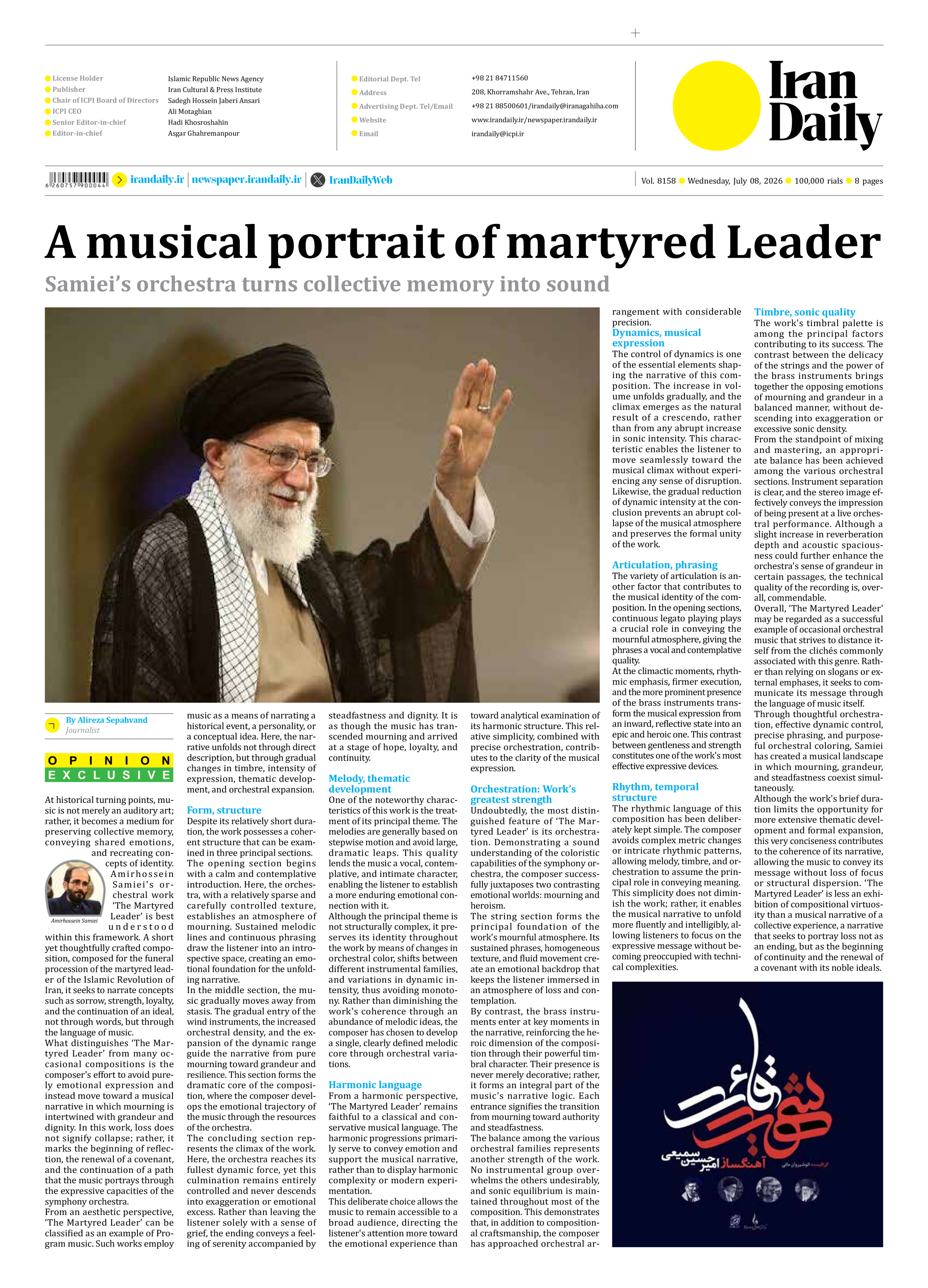


A musical portrait of martyred Leader
Samiei’s orchestra turns collective memory into sound
By Alireza Sepahvand
Journalist
At historical turning points, music is not merely an auditory art; rather, it becomes a medium for preserving collective memory, conveying shared emotions, and recreating concepts of identity. Amirhossein Samiei's orchestral work ‘The Martyred Leader’ is best understood within this framework. A short yet thoughtfully crafted composition, composed for the funeral procession of the martyred leader of the Islamic Revolution of Iran, it seeks to narrate concepts such as sorrow, strength, loyalty, and the continuation of an ideal, not through words, but through the language of music.
What distinguishes ‘The Martyred Leader’ from many occasional compositions is the composer's effort to avoid purely emotional expression and instead move toward a musical narrative in which mourning is intertwined with grandeur and dignity. In this work, loss does not signify collapse; rather, it marks the beginning of reflection, the renewal of a covenant, and the continuation of a path that the music portrays through the expressive capacities of the symphony orchestra.
From an aesthetic perspective, ‘The Martyred Leader’ can be classified as an example of Program music. Such works employ music as a means of narrating a historical event, a personality, or a conceptual idea. Here, the narrative unfolds not through direct description, but through gradual changes in timbre, intensity of expression, thematic development, and orchestral expansion.
Form, structure
Despite its relatively short duration, the work possesses a coherent structure that can be examined in three principal sections.
The opening section begins with a calm and contemplative introduction. Here, the orchestra, with a relatively sparse and carefully controlled texture, establishes an atmosphere of mourning. Sustained melodic lines and continuous phrasing draw the listener into an introspective space, creating an emotional foundation for the unfolding narrative.
In the middle section, the music gradually moves away from stasis. The gradual entry of the wind instruments, the increased orchestral density, and the expansion of the dynamic range guide the narrative from pure mourning toward grandeur and resilience. This section forms the dramatic core of the composition, where the composer develops the emotional trajectory of the music through the resources of the orchestra.
The concluding section represents the climax of the work. Here, the orchestra reaches its fullest dynamic force, yet this culmination remains entirely controlled and never descends into exaggeration or emotional excess. Rather than leaving the listener solely with a sense of grief, the ending conveys a feeling of serenity accompanied by steadfastness and dignity. It is as though the music has transcended mourning and arrived at a stage of hope, loyalty, and continuity.
Melody, thematic development
One of the noteworthy characteristics of this work is the treatment of its principal theme. The melodies are generally based on stepwise motion and avoid large, dramatic leaps. This quality lends the music a vocal, contemplative, and intimate character, enabling the listener to establish a more enduring emotional connection with it.
Although the principal theme is not structurally complex, it preserves its identity throughout the work by means of changes in orchestral color, shifts between different instrumental families, and variations in dynamic intensity, thus avoiding monotony. Rather than diminishing the work's coherence through an abundance of melodic ideas, the composer has chosen to develop a single, clearly defined melodic core through orchestral variations.
Harmonic language
From a harmonic perspective, ‘The Martyred Leader’ remains faithful to a classical and conservative musical language. The harmonic progressions primarily serve to convey emotion and support the musical narrative, rather than to display harmonic complexity or modern experimentation.
This deliberate choice allows the music to remain accessible to a broad audience, directing the listener's attention more toward the emotional experience than toward analytical examination of its harmonic structure. This relative simplicity, combined with precise orchestration, contributes to the clarity of the musical expression.
Orchestration: Work’s greatest strength
Undoubtedly, the most distinguished feature of ‘The Martyred Leader’ is its orchestration. Demonstrating a sound understanding of the coloristic capabilities of the symphony orchestra, the composer successfully juxtaposes two contrasting emotional worlds: mourning and heroism.
The string section forms the principal foundation of the work's mournful atmosphere. Its sustained phrases, homogeneous texture, and fluid movement create an emotional backdrop that keeps the listener immersed in an atmosphere of loss and contemplation.
By contrast, the brass instruments enter at key moments in the narrative, reinforcing the heroic dimension of the composition through their powerful timbral character. Their presence is never merely decorative; rather, it forms an integral part of the music's narrative logic. Each entrance signifies the transition from mourning toward authority and steadfastness.
The balance among the various orchestral families represents another strength of the work. No instrumental group overwhelms the others undesirably, and sonic equilibrium is maintained throughout most of the composition. This demonstrates that, in addition to compositional craftsmanship, the composer has approached orchestral arrangement with considerable precision.
Dynamics, musical expression
The control of dynamics is one of the essential elements shaping the narrative of this composition. The increase in volume unfolds gradually, and the climax emerges as the natural result of a crescendo, rather than from any abrupt increase in sonic intensity. This characteristic enables the listener to move seamlessly toward the musical climax without experiencing any sense of disruption. Likewise, the gradual reduction of dynamic intensity at the conclusion prevents an abrupt collapse of the musical atmosphere and preserves the formal unity of the work.
Articulation, phrasing
The variety of articulation is another factor that contributes to the musical identity of the composition. In the opening sections, continuous legato playing plays a crucial role in conveying the mournful atmosphere, giving the phrases a vocal and contemplative quality.
At the climactic moments, rhythmic emphasis, firmer execution, and the more prominent presence of the brass instruments transform the musical expression from an inward, reflective state into an epic and heroic one. This contrast between gentleness and strength constitutes one of the work's most effective expressive devices.
Rhythm, temporal structure
The rhythmic language of this composition has been deliberately kept simple. The composer avoids complex metric changes or intricate rhythmic patterns, allowing melody, timbre, and orchestration to assume the principal role in conveying meaning.
This simplicity does not diminish the work; rather, it enables the musical narrative to unfold more fluently and intelligibly, allowing listeners to focus on the expressive message without becoming preoccupied with technical complexities.
Timbre, sonic quality
The work's timbral palette is among the principal factors contributing to its success. The contrast between the delicacy of the strings and the power of the brass instruments brings together the opposing emotions of mourning and grandeur in a balanced manner, without descending into exaggeration or excessive sonic density.
From the standpoint of mixing and mastering, an appropriate balance has been achieved among the various orchestral sections. Instrument separation is clear, and the stereo image effectively conveys the impression of being present at a live orchestral performance. Although a slight increase in reverberation depth and acoustic spaciousness could further enhance the orchestra's sense of grandeur in certain passages, the technical quality of the recording is, overall, commendable.
Overall, ‘The Martyred Leader’ may be regarded as a successful example of occasional orchestral music that strives to distance itself from the clichés commonly associated with this genre. Rather than relying on slogans or external emphases, it seeks to communicate its message through the language of music itself.
Through thoughtful orchestration, effective dynamic control, precise phrasing, and purposeful orchestral coloring, Samiei has created a musical landscape in which mourning, grandeur, and steadfastness coexist simultaneously.
Although the work's brief duration limits the opportunity for more extensive thematic development and formal expansion, this very conciseness contributes to the coherence of its narrative, allowing the music to convey its message without loss of focus or structural dispersion. ‘The Martyred Leader’ is less an exhibition of compositional virtuosity than a musical narrative of a collective experience, a narrative that seeks to portray loss not as an ending, but as the beginning of continuity and the renewal of a covenant with its noble ideals.