







Against the Odds: Young Iran turns hardship into momentum in World Cup qualifiers
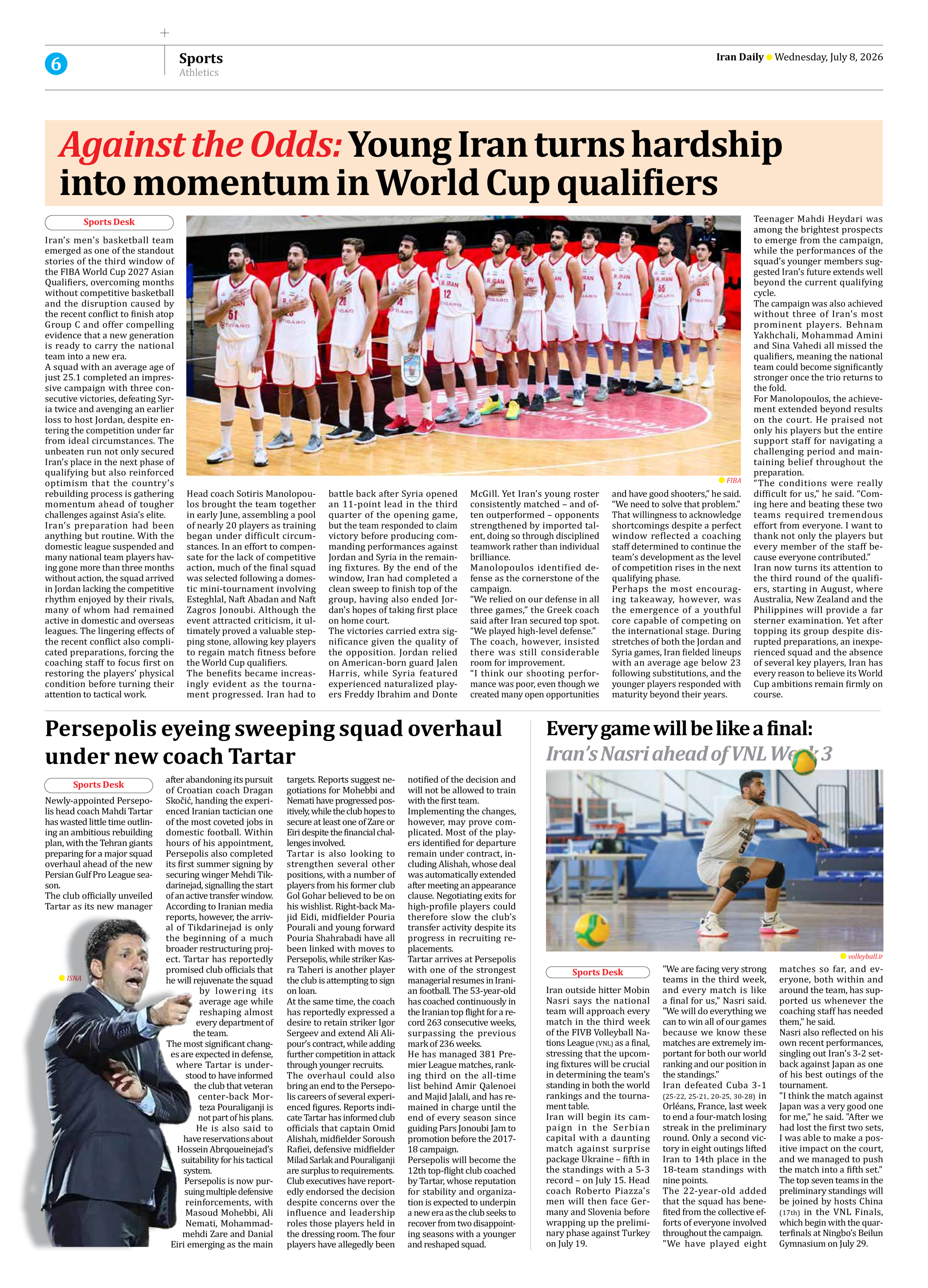
Iran’s men’s basketball team emerged as one of the standout stories of the third window of the FIBA World Cup 2027 Asian Qualifiers, overcoming months without competitive basketball and the disruption caused by the recent conflict to finish atop Group C and offer compelling evidence that a new generation is ready to carry the national team into a new era.
A squad with an average age of just 25.1 completed an impressive campaign with three consecutive victories, defeating Syria twice and avenging an earlier loss to host Jordan, despite entering the competition under far from ideal circumstances. The unbeaten run not only secured Iran’s place in the next phase of qualifying but also reinforced optimism that the country’s rebuilding process is gathering momentum ahead of tougher challenges against Asia’s elite.
Iran’s preparation had been anything but routine. With the domestic league suspended and many national team players having gone more than three months without action, the squad arrived in Jordan lacking the competitive rhythm enjoyed by their rivals, many of whom had remained active in domestic and overseas leagues. The lingering effects of the recent conflict also complicated preparations, forcing the coaching staff to focus first on restoring the players’ physical condition before turning their attention to tactical work.
Head coach Sotiris Manolopoulos brought the team together in early June, assembling a pool of nearly 20 players as training began under difficult circumstances. In an effort to compensate for the lack of competitive action, much of the final squad was selected following a domestic mini-tournament involving Esteghlal, Naft Abadan and Naft Zagros Jonoubi. Although the event attracted criticism, it ultimately proved a valuable stepping stone, allowing key players to regain match fitness before the World Cup qualifiers.
The benefits became increasingly evident as the tournament progressed. Iran had to battle back after Syria opened an 11-point lead in the third quarter of the opening game, but the team responded to claim victory before producing commanding performances against Jordan and Syria in the remaining fixtures. By the end of the window, Iran had completed a clean sweep to finish top of the group, having also ended Jordan’s hopes of taking first place on home court.
The victories carried extra significance given the quality of the opposition. Jordan relied on American-born guard Jalen Harris, while Syria featured experienced naturalized players Freddy Ibrahim and Donte McGill. Yet Iran’s young roster consistently matched – and often outperformed – opponents strengthened by imported talent, doing so through disciplined teamwork rather than individual brilliance.
Manolopoulos identified defense as the cornerstone of the campaign.
“We relied on our defense in all three games,” the Greek coach said after Iran secured top spot. “We played high-level defense.”
The coach, however, insisted there was still considerable room for improvement.
“I think our shooting performance was poor, even though we created many open opportunities and have good shooters,” he said. “We need to solve that problem.”
That willingness to acknowledge shortcomings despite a perfect window reflected a coaching staff determined to continue the team’s development as the level of competition rises in the next qualifying phase.
Perhaps the most encouraging takeaway, however, was the emergence of a youthful core capable of competing on the international stage. During stretches of both the Jordan and Syria games, Iran fielded lineups with an average age below 23 following substitutions, and the younger players responded with maturity beyond their years.
Teenager Mahdi Heydari was among the brightest prospects to emerge from the campaign, while the performances of the squad’s younger members suggested Iran’s future extends well beyond the current qualifying cycle.
The campaign was also achieved without three of Iran's most prominent players. Behnam Yakhchali, Mohammad Amini and Sina Vahedi all missed the qualifiers, meaning the national team could become significantly stronger once the trio returns to the fold.
For Manolopoulos, the achievement extended beyond results on the court. He praised not only his players but the entire support staff for navigating a challenging period and maintaining belief throughout the preparation.
“The conditions were really difficult for us,” he said. “Coming here and beating these two teams required tremendous effort from everyone. I want to thank not only the players but every member of the staff because everyone contributed.”
Iran now turns its attention to the third round of the qualifiers, starting in August, where Australia, New Zealand and the Philippines will provide a far sterner examination. Yet after topping its group despite disrupted preparations, an inexperienced squad and the absence of several key players, Iran has every reason to believe its World Cup ambitions remain firmly on course.