





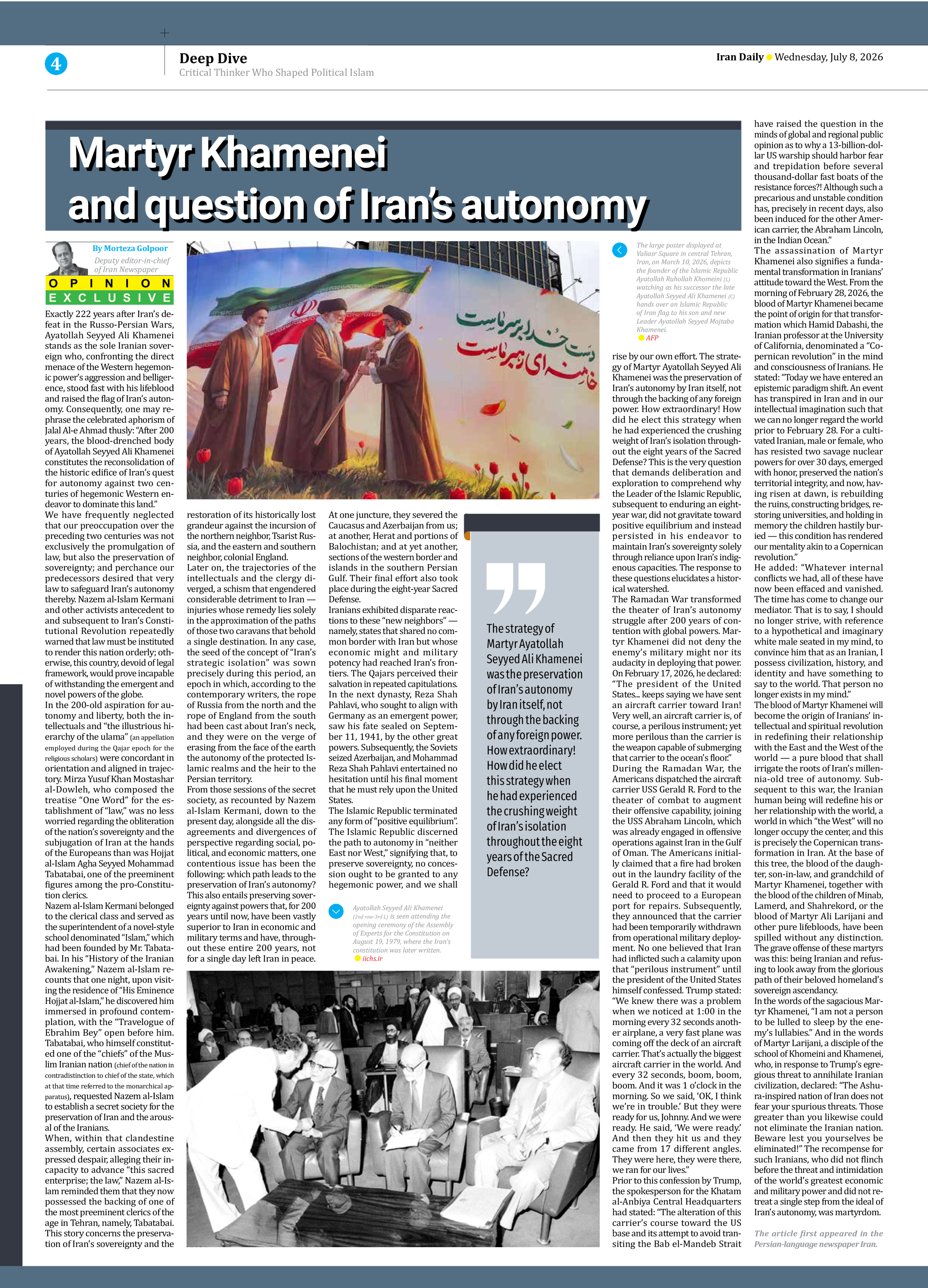


Martyr Khamenei and question of Iran’s autonomy
Deputy editor-in-chief of Iran Newspaper
Exactly 222 years after Iran’s defeat in the Russo-Persian Wars, Ayatollah Seyyed Ali Khamenei stands as the sole Iranian sovereign who, confronting the direct menace of the Western hegemonic power’s aggression and belligerence, stood fast with his lifeblood and raised the flag of Iran’s autonomy. Consequently, one may rephrase the celebrated aphorism of Jalal Al-e Ahmad thusly: “After 200 years, the blood-drenched body of Ayatollah Seyyed Ali Khamenei constitutes the reconsolidation of the historic edifice of Iran’s quest for autonomy against two centuries of hegemonic Western endeavor to dominate this land.”
We have frequently neglected that our preoccupation over the preceding two centuries was not exclusively the promulgation of law, but also the preservation of sovereignty; and perchance our predecessors desired that very law to safeguard Iran’s autonomy thereby. Nazem al-Islam Kermani and other activists antecedent to and subsequent to Iran’s Constitutional Revolution repeatedly warned that law must be instituted to render this nation orderly; otherwise, this country, devoid of legal framework, would prove incapable of withstanding the emergent and novel powers of the globe.
In the 200-old aspiration for autonomy and liberty, both the intellectuals and “the illustrious hierarchy of the ulama” (an appellation employed during the Qajar epoch for the religious scholars) were concordant in orientation and aligned in trajectory. Mirza Yusuf Khan Mostashar al-Dowleh, who composed the treatise “One Word” for the establishment of “law,” was no less worried regarding the obliteration of the nation’s sovereignty and the subjugation of Iran at the hands of the Europeans than was Hojjat al-Islam Agha Seyyed Mohammad Tabatabai, one of the preeminent figures among the pro-Constitution clerics.
Nazem al-Islam Kermani belonged to the clerical class and served as the superintendent of a novel-style school denominated “Islam,” which had been founded by Mr. Tabatabai. In his “History of the Iranian Awakening,” Nazem al-Islam recounts that one night, upon visiting the residence of “His Eminence Hojjat al-Islam,” he discovered him immersed in profound contemplation, with the “Travelogue of Ebrahim Bey” open before him. Tabatabai, who himself constituted one of the “chiefs” of the Muslim Iranian nation (chief of the nation in contradistinction to chief of the state, which at that time referred to the monarchical apparatus), requested Nazem al-Islam to establish a secret society for the preservation of Iran and the arousal of the Iranians.
When, within that clandestine assembly, certain associates expressed despair, alleging their incapacity to advance “this sacred enterprise; the law,” Nazem al-Islam reminded them that they now possessed the backing of one of the most preeminent clerics of the age in Tehran, namely, Tabatabai. This story concerns the preservation of Iran’s sovereignty and the restoration of its historically lost grandeur against the incursion of the northern neighbor, Tsarist Russia, and the eastern and southern neighbor, colonial England.
Later on, the trajectories of the intellectuals and the clergy diverged, a schism that engendered considerable detriment to Iran — injuries whose remedy lies solely in the approximation of the paths of those two caravans that behold a single destination. In any case, the seed of the concept of “Iran’s strategic isolation” was sown precisely during this period, an epoch in which, according to the contemporary writers, the rope of Russia from the north and the rope of England from the south had been cast about Iran’s neck, and they were on the verge of erasing from the face of the earth the autonomy of the protected Islamic realms and the heir to the Persian territory.
From those sessions of the secret society, as recounted by Nazem al-Islam Kermani, down to the present day, alongside all the disagreements and divergences of perspective regarding social, political, and economic matters, one contentious issue has been the following: which path leads to the preservation of Iran’s autonomy? This also entails preserving sovereignty against powers that, for 200 years until now, have been vastly superior to Iran in economic and military terms and have, throughout these entire 200 years, not for a single day left Iran in peace. At one juncture, they severed the Caucasus and Azerbaijan from us; at another, Herat and portions of Balochistan; and at yet another, sections of the western border and islands in the southern Persian Gulf. Their final effort also took place during the eight-year Sacred Defense.
Iranians exhibited disparate reactions to these “new neighbors” — namely, states that shared no common border with Iran but whose economic might and military potency had reached Iran’s frontiers. The Qajars perceived their salvation in repeated capitulations. In the next dynasty, Reza Shah Pahlavi, who sought to align with Germany as an emergent power, saw his fate sealed on September 11, 1941, by the other great powers. Subsequently, the Soviets seized Azerbaijan, and Mohammad Reza Shah Pahlavi entertained no hesitation until his final moment that he must rely upon the United States.
The Islamic Republic terminated any form of “positive equilibrium”. The Islamic Republic discerned the path to autonomy in “neither East nor West,” signifying that, to preserve sovereignty, no concession ought to be granted to any hegemonic power, and we shall rise by our own effort. The strategy of Martyr Ayatollah Seyyed Ali Khamenei was the preservation of Iran’s autonomy by Iran itself, not through the backing of any foreign power. How extraordinary! How did he elect this strategy when he had experienced the crushing weight of Iran’s isolation throughout the eight years of the Sacred Defense? This is the very question that demands deliberation and exploration to comprehend why the Leader of the Islamic Republic, subsequent to enduring an eight-year war, did not gravitate toward positive equilibrium and instead persisted in his endeavor to maintain Iran’s sovereignty solely through reliance upon Iran’s indigenous capacities. The response to these questions elucidates a historical watershed.
The Ramadan War transformed the theater of Iran’s autonomy struggle after 200 years of contention with global powers. Martyr Khamenei did not deny the enemy’s military might nor its audacity in deploying that power. On February 17, 2026, he declared: “The president of the United States... keeps saying we have sent an aircraft carrier toward Iran! Very well, an aircraft carrier is, of course, a perilous instrument; yet more perilous than the carrier is the weapon capable of submerging that carrier to the ocean’s floor.”
During the Ramadan War, the Americans dispatched the aircraft carrier USS Gerald R. Ford to the theater of combat to augment their offensive capability, joining the USS Abraham Lincoln, which was already engaged in offensive operations against Iran in the Gulf of Oman. The Americans initially claimed that a fire had broken out in the laundry facility of the Gerald R. Ford and that it would need to proceed to a European port for repairs. Subsequently, they announced that the carrier had been temporarily withdrawn from operational military deployment. No one believed that Iran had inflicted such a calamity upon that “perilous instrument” until the president of the United States himself confessed. Trump stated: “We knew there was a problem when we noticed at 1:00 in the morning every 32 seconds another airplane, a very fast plane was coming off the deck of an aircraft carrier. That’s actually the biggest aircraft carrier in the world. And every 32 seconds, boom, boom, boom. And it was 1 o’clock in the morning. So we said, ‘OK, I think we’re in trouble.’ But they were ready for us, Johnny. And we were ready. He said, ‘We were ready.’ And then they hit us and they came from 17 different angles. They were here, they were there, we ran for our lives.”
Prior to this confession by Trump, the spokesperson for the Khatam al-Anbiya Central Headquarters had stated: “The alteration of this carrier’s course toward the US base and its attempt to avoid transiting the Bab el-Mandeb Strait have raised the question in the minds of global and regional public opinion as to why a 13-billion-dollar US warship should harbor fear and trepidation before several thousand-dollar fast boats of the resistance forces?! Although such a precarious and unstable condition has, precisely in recent days, also been induced for the other American carrier, the Abraham Lincoln, in the Indian Ocean.”
The assassination of Martyr Khamenei also signifies a fundamental transformation in Iranians’ attitude toward the West. From the morning of February 28, 2026, the blood of Martyr Khamenei became the point of origin for that transformation which Hamid Dabashi, the Iranian professor at the University of California, denominated a “Copernican revolution” in the mind and consciousness of Iranians. He stated: “Today we have entered an epistemic paradigm shift. An event has transpired in Iran and in our intellectual imagination such that we can no longer regard the world prior to February 28. For a cultivated Iranian, male or female, who has resisted two savage nuclear powers for over 30 days, emerged with honor, preserved the nation’s territorial integrity, and now, having risen at dawn, is rebuilding the ruins, constructing bridges, restoring universities, and holding in memory the children hastily buried — this condition has rendered our mentality akin to a Copernican revolution.”
He added: “Whatever internal conflicts we had, all of these have now been effaced and vanished. The time has come to change our mediator. That is to say, I should no longer strive, with reference to a hypothetical and imaginary white male seated in my mind, to convince him that as an Iranian, I possess civilization, history, and identity and have something to say to the world. That person no longer exists in my mind.”
The blood of Martyr Khamenei will become the origin of Iranians’ intellectual and spiritual revolution in redefining their relationship with the East and the West of the world — a pure blood that shall irrigate the roots of Iran’s millennia-old tree of autonomy. Subsequent to this war, the Iranian human being will redefine his or her relationship with the world, a world in which “the West” will no longer occupy the center, and this is precisely the Copernican transformation in Iran. At the base of this tree, the blood of the daughter, son-in-law, and grandchild of Martyr Khamenei, together with the blood of the children of Minab, Lamerd, and Shahrekord, or the blood of Martyr Ali Larijani and other pure lifebloods, have been spilled without any distinction. The grave offense of these martyrs was this: being Iranian and refusing to look away from the glorious path of their beloved homeland’s sovereign ascendancy.
In the words of the sagacious Martyr Khamenei, “I am not a person to be lulled to sleep by the enemy’s lullabies.” And in the words of Martyr Larijani, a disciple of the school of Khomeini and Khamenei, who, in response to Trump’s egregious threat to annihilate Iranian civilization, declared: “The Ashura-inspired nation of Iran does not fear your spurious threats. Those greater than you likewise could not eliminate the Iranian nation. Beware lest you yourselves be eliminated!” The recompense for such Iranians, who did not flinch before the threat and intimidation of the world’s greatest economic and military power and did not retreat a single step from the ideal of Iran’s autonomy, was martyrdom.
The article first appeared in the
Persian-language newspaper Iran.