





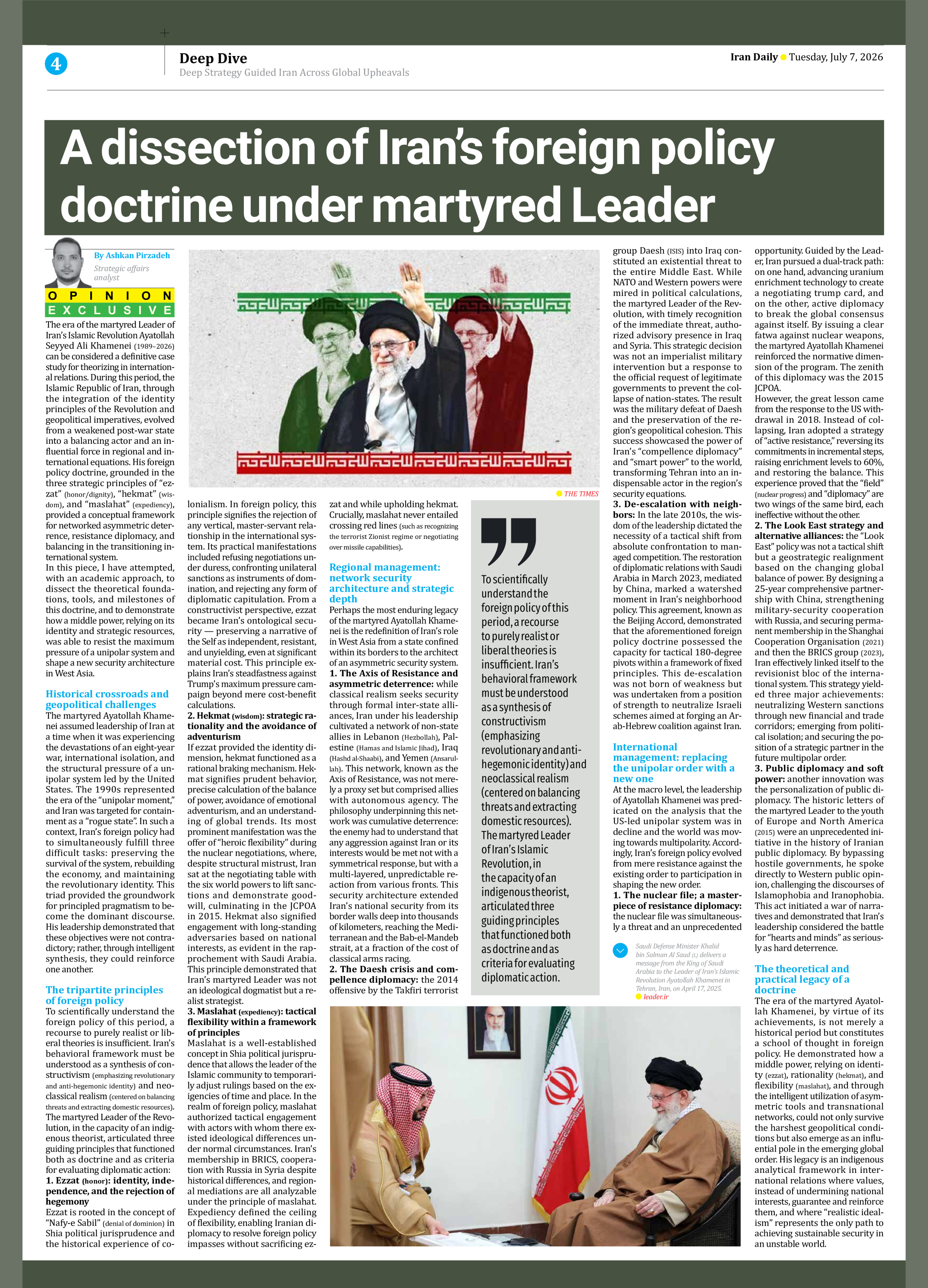


A dissection of Iran’s foreign policy doctrine under martyred Leader
Strategic affairs analyst
The era of the martyred Leader of Iran’s Islamic Revolution Ayatollah Seyyed Ali Khamenei (1989–2026) can be considered a definitive case study for theorizing in international relations. During this period, the Islamic Republic of Iran, through the integration of the identity principles of the Revolution and geopolitical imperatives, evolved from a weakened post-war state into a balancing actor and an influential force in regional and international equations. His foreign policy doctrine, grounded in the three strategic principles of “ezzat” (honor/dignity), “hekmat” (wisdom), and “maslahat” (expediency), provided a conceptual framework for networked asymmetric deterrence, resistance diplomacy, and balancing in the transitioning international system.
In this piece, I have attempted, with an academic approach, to dissect the theoretical foundations, tools, and milestones of this doctrine, and to demonstrate how a middle power, relying on its identity and strategic resources, was able to resist the maximum pressure of a unipolar system and shape a new security architecture in West Asia.
Historical crossroads and geopolitical challenges
The martyred Ayatollah Khamenei assumed leadership of Iran at a time when it was experiencing the devastations of an eight-year war, international isolation, and the structural pressure of a unipolar system led by the United States. The 1990s represented the era of the “unipolar moment,” and Iran was targeted for containment as a “rogue state”. In such a context, Iran’s foreign policy had to simultaneously fulfill three difficult tasks: preserving the survival of the system, rebuilding the economy, and maintaining the revolutionary identity. This triad provided the groundwork for principled pragmatism to become the dominant discourse. His leadership demonstrated that these objectives were not contradictory; rather, through intelligent synthesis, they could reinforce one another.
The tripartite principles of foreign policy
To scientifically understand the foreign policy of this period, a recourse to purely realist or liberal theories is insufficient. Iran’s behavioral framework must be understood as a synthesis of constructivism (emphasizing revolutionary and anti-hegemonic identity) and neoclassical realism (centered on balancing threats and extracting domestic resources). The martyred Leader of the Revolution, in the capacity of an indigenous theorist, articulated three guiding principles that functioned both as doctrine and as criteria for evaluating diplomatic action:
1. Ezzat (honor): identity, independence, and the rejection of hegemony
Ezzat is rooted in the concept of “Nafy-e Sabil” (denial of dominion) in Shia political jurisprudence and the historical experience of colonialism. In foreign policy, this principle signifies the rejection of any vertical, master-servant relationship in the international system. Its practical manifestations included refusing negotiations under duress, confronting unilateral sanctions as instruments of domination, and rejecting any form of diplomatic capitulation. From a constructivist perspective, ezzat became Iran’s ontological security — preserving a narrative of the Self as independent, resistant, and unyielding, even at significant material cost. This principle explains Iran’s steadfastness against Trump’s maximum pressure campaign beyond mere cost-benefit calculations.
2. Hekmat (wisdom): strategic rationality and the avoidance of adventurism
If ezzat provided the identity dimension, hekmat functioned as a rational braking mechanism. Hekmat signifies prudent behavior, precise calculation of the balance of power, avoidance of emotional adventurism, and an understanding of global trends. Its most prominent manifestation was the offer of “heroic flexibility” during the nuclear negotiations, where, despite structural mistrust, Iran sat at the negotiating table with the six world powers to lift sanctions and demonstrate goodwill, culminating in the JCPOA in 2015. Hekmat also signified engagement with long-standing adversaries based on national interests, as evident in the rapprochement with Saudi Arabia. This principle demonstrated that Iran’s martyred Leader was not an ideological dogmatist but a realist strategist.
3. Maslahat (expediency): tactical flexibility within a framework of principles
Maslahat is a well-established concept in Shia political jurisprudence that allows the leader of the Islamic community to temporarily adjust rulings based on the exigencies of time and place. In the realm of foreign policy, maslahat authorized tactical engagement with actors with whom there existed ideological differences under normal circumstances. Iran’s membership in BRICS, cooperation with Russia in Syria despite historical differences, and regional mediations are all analyzable under the principle of maslahat. Expediency defined the ceiling of flexibility, enabling Iranian diplomacy to resolve foreign policy impasses without sacrificing ezzat and while upholding hekmat. Crucially, maslahat never entailed crossing red lines (such as recognizing the terrorist Zionist regime or negotiating over missile capabilities).
Regional management: network security architecture and strategic depth
Perhaps the most enduring legacy of the martyred Ayatollah Khamenei is the redefinition of Iran’s role in West Asia from a state confined within its borders to the architect of an asymmetric security system.
1. The Axis of Resistance and asymmetric deterrence: while classical realism seeks security through formal inter-state alliances, Iran under his leadership cultivated a network of non-state allies in Lebanon (Hezbollah), Palestine (Hamas and Islamic Jihad), Iraq (Hashd al-Shaabi), and Yemen (Ansarullah). This network, known as the Axis of Resistance, was not merely a proxy set but comprised allies with autonomous agency. The philosophy underpinning this network was cumulative deterrence: the enemy had to understand that any aggression against Iran or its interests would be met not with a symmetrical response, but with a multi-layered, unpredictable reaction from various fronts. This security architecture extended Iran’s national security from its border walls deep into thousands of kilometers, reaching the Mediterranean and the Bab-el-Mandeb strait, at a fraction of the cost of classical arms racing.
2. The Daesh crisis and compellence diplomacy: the 2014 offensive by the Takfiri terrorist group Daesh (ISIS) into Iraq constituted an existential threat to the entire Middle East. While NATO and Western powers were mired in political calculations, the martyred Leader of the Revolution, with timely recognition of the immediate threat, authorized advisory presence in Iraq and Syria. This strategic decision was not an imperialist military intervention but a response to the official request of legitimate governments to prevent the collapse of nation-states. The result was the military defeat of Daesh and the preservation of the region’s geopolitical cohesion. This success showcased the power of Iran’s “compellence diplomacy” and “smart power” to the world, transforming Tehran into an indispensable actor in the region’s security equations.
3. De-escalation with neighbors: In the late 2010s, the wisdom of the leadership dictated the necessity of a tactical shift from absolute confrontation to managed competition. The restoration of diplomatic relations with Saudi Arabia in March 2023, mediated by China, marked a watershed moment in Iran’s neighborhood policy. This agreement, known as the Beijing Accord, demonstrated that the aforementioned foreign policy doctrine possessed the capacity for tactical 180-degree pivots within a framework of fixed principles. This de-escalation was not born of weakness but was undertaken from a position of strength to neutralize Israeli schemes aimed at forging an Arab-Hebrew coalition against Iran.
International management: replacing the unipolar order with a new one
At the macro level, the leadership of Ayatollah Khamenei was predicated on the analysis that the US-led unipolar system was in decline and the world was moving towards multipolarity. Accordingly, Iran’s foreign policy evolved from mere resistance against the existing order to participation in shaping the new order.
1. The nuclear file; a masterpiece of resistance diplomacy: the nuclear file was simultaneously a threat and an unprecedented opportunity. Guided by the Leader, Iran pursued a dual-track path: on one hand, advancing uranium enrichment technology to create a negotiating trump card, and on the other, active diplomacy to break the global consensus against itself. By issuing a clear fatwa against nuclear weapons, the martyred Ayatollah Khamenei reinforced the normative dimension of the program. The zenith of this diplomacy was the 2015 JCPOA.
However, the great lesson came from the response to the US withdrawal in 2018. Instead of collapsing, Iran adopted a strategy of “active resistance,” reversing its commitments in incremental steps, raising enrichment levels to 60%, and restoring the balance. This experience proved that the “field” (nuclear progress) and “diplomacy” are two wings of the same bird, each ineffective without the other.
2. The Look East strategy and alternative alliances: the “Look East” policy was not a tactical shift but a geostrategic realignment based on the changing global balance of power. By designing a 25-year comprehensive partnership with China, strengthening military-security cooperation with Russia, and securing permanent membership in the Shanghai Cooperation Organisation (2021) and then the BRICS group (2023), Iran effectively linked itself to the revisionist bloc of the international system. This strategy yielded three major achievements: neutralizing Western sanctions through new financial and trade corridors; emerging from political isolation; and securing the position of a strategic partner in the future multipolar order.
3. Public diplomacy and soft power: another innovation was the personalization of public diplomacy. The historic letters of the martyred Leader to the youth of Europe and North America (2015) were an unprecedented initiative in the history of Iranian public diplomacy. By bypassing hostile governments, he spoke directly to Western public opinion, challenging the discourses of Islamophobia and Iranophobia. This act initiated a war of narratives and demonstrated that Iran’s leadership considered the battle for “hearts and minds” as seriously as hard deterrence.
The theoretical and practical legacy of a doctrine
The era of the martyred Ayatollah Khamenei, by virtue of its achievements, is not merely a historical period but constitutes a school of thought in foreign policy. He demonstrated how a middle power, relying on identity (ezzat), rationality (hekmat), and flexibility (maslahat), and through the intelligent utilization of asymmetric tools and transnational networks, could not only survive the harshest geopolitical conditions but also emerge as an influential pole in the emerging global order. His legacy is an indigenous analytical framework in international relations where values, instead of undermining national interests, guarantee and reinforce them, and where “realistic idealism” represents the only path to achieving sustainable security in an unstable world.