







Qalibaf: Peace in Lebanon impossible without Iran
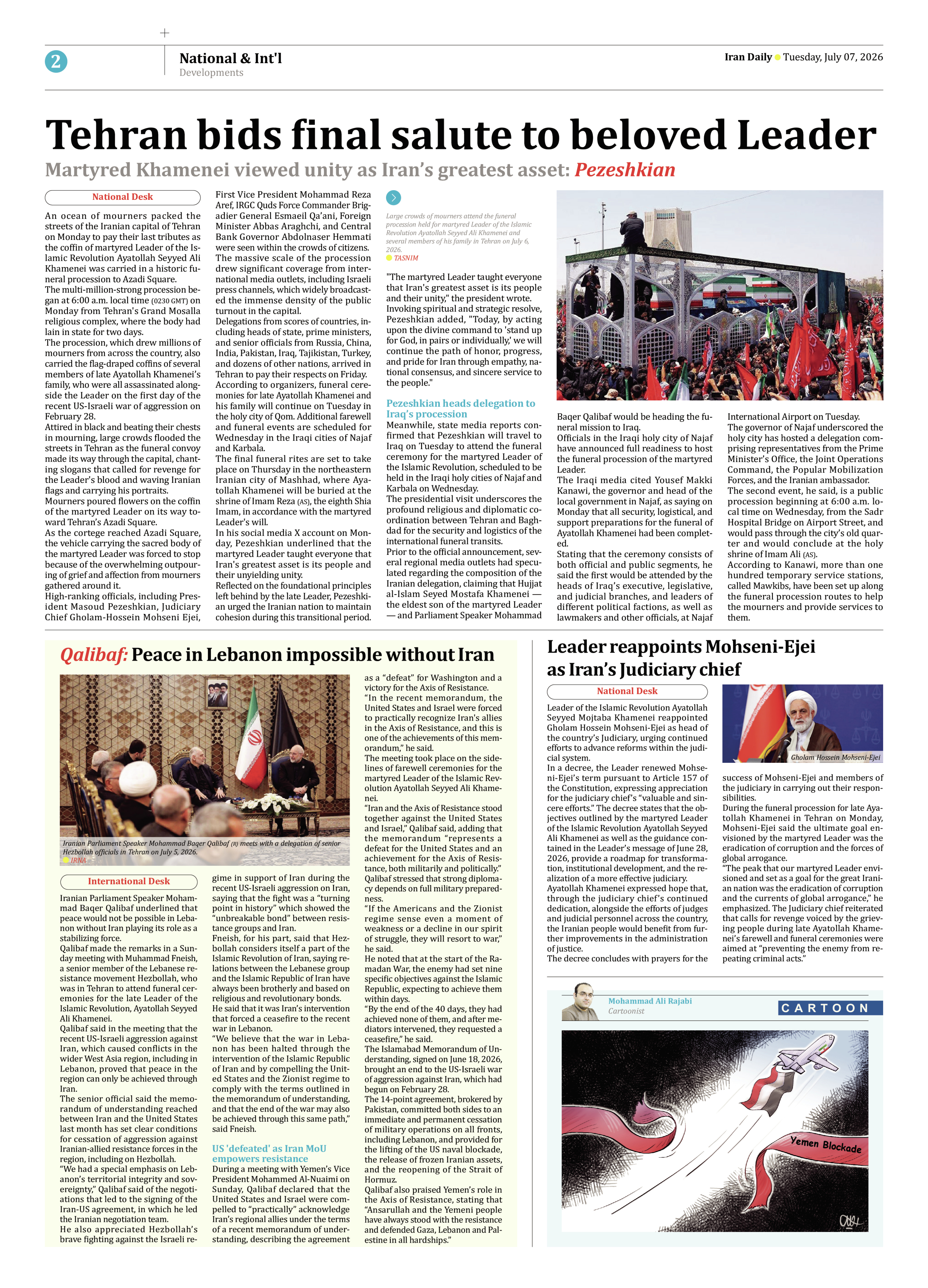
ranian Parliament Speaker Moham mad Baqer Qalibaf underlined that peace would not be possible in Leba non without Iran playing its role as a stabilizing force. Qalibaf made the remarks in a Sun day meeting with Muhammad Fneish, a senior member of the Lebanese re sistance movement Hezbollah, who was in Tehran to attend funeral cer emonies for the late Leader of the Islamic Revolution, Ayatollah Seyyed Ali Khamenei. Qalibaf said in the meeting that the recent US-Israeli aggression against Iran, which caused conflicts in the wider West Asia region, including in Lebanon, proved that peace in the region can only be achieved through Iran. The senior official said the memo randum of understanding reached between Iran and the United States last month has set clear conditions for cessation of aggression against Iranian-allied resistance forces in the region, including on Hezbollah. “We had a special emphasis on Leb anon’s territorial integrity and sov ereignty,” Qalibaf said of the negoti ations that led to the signing of the Iran-US agreement, in which he led the Iranian negotiation team. He also appreciated Hezbollah’s brave fighting against the Israeli re gime in support of Iran during the recent US-Israeli aggression on Iran, saying that the fight was a “turning point in history” which showed the “unbreakable bond” between resis tance groups and Iran. Fneish, for his part, said that Hez bollah considers itself a part of the Islamic Revolution of Iran, saying re lations between the Lebanese group and the Islamic Republic of Iran have always been brotherly and based on religious and revolutionary bonds. He said that it was Iran’s intervention that forced a ceasefire to the recent war in Lebanon. “We believe that the war in Leba non has been halted through the intervention of the Islamic Republic of Iran and by compelling the Unit ed States and the Zionist regime to comply with the terms outlined in the memorandum of understanding, and that the end of the war may also be achieved through this same path,” said Fneish. US 'defeated' as Iran MoU empowers resistance During a meeting with Yemen’s Vice President Mohammed Al-Nuaimi on Sunday, Qalibaf declared that the United States and Israel were com pelled to “practically” acknowledge Iran’s regional allies under the terms of a recent memorandum of under standing, describing the agreement as a “defeat” for Washington and a
as a “defeat” for Washington and a victory for the Axis of Resistance. “In the recent memorandum, the United States and Israel were forced to practically recognize Iran's allies in the Axis of Resistance, and this is one of the achievements of this mem orandum,” he said. The meeting took place on the side lines of farewell ceremonies for the martyred Leader of the Islamic Rev olution Ayatollah Seyyed Ali Khame nei. “Iran and the Axis of Resistance stood together against the United States and Israel,” Qalibaf said, adding that the memorandum “represents a defeat for the United States and an achievement for the Axis of Resis tance, both militarily and politically.” Qalibaf stressed that strong diploma cy depends on full military prepared ness. “If the Americans and the Zionist regime sense even a moment of weakness or a decline in our spirit of struggle, they will resort to war,” he said. He noted that at the start of the Ra madan War, the enemy had set nine specific objectives against the Islamic Republic, expecting to achieve them within days. “By the end of the 40 days, they had achieved none of them, and after me diators intervened, they requested a ceasefire,” he said. The Islamabad Memorandum of Un derstanding, signed on June 18, 2026, brought an end to the US-Israeli war of aggression against Iran, which had begun on February 28. The 14-point agreement, brokered by Pakistan, committed both sides to an immediate and permanent cessation of military operations on all fronts, including Lebanon, and provided for the lifting of the US naval blockade, the release of frozen Iranian assets, and the reopening of the Strait of Hormuz. Qalibaf also praised Yemen’s role in the Axis of Resistance, stating that “Ansarullah and the Yemeni people have always stood with the resistance and defended Gaza, Lebanon and Pal estine in all hardships.