





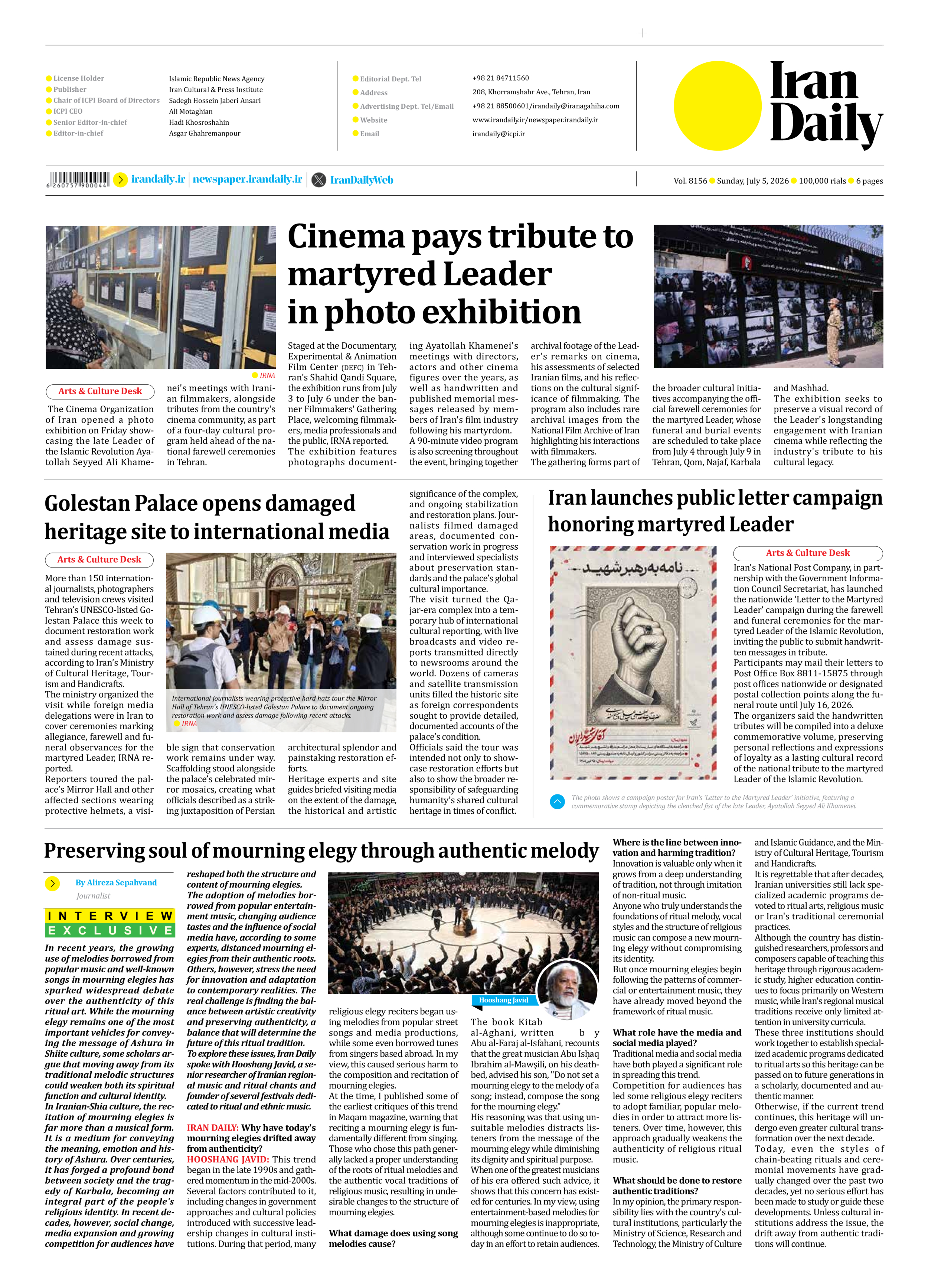


Preserving soul of mourning elegy through authentic melody
By Alireza Sepahvand
Journalist
In recent years, the growing use of melodies borrowed from popular music and well-known songs in mourning elegies has sparked widespread debate over the authenticity of this ritual art. While the mourning elegy remains one of the most important vehicles for conveying the message of Ashura in Shiite culture, some scholars argue that moving away from its traditional melodic structures could weaken both its spiritual function and cultural identity.
In Iranian-Shia culture, the recitation of mourning elegies is far more than a musical form. It is a medium for conveying the meaning, emotion and history of Ashura. Over centuries, it has forged a profound bond between society and the tragedy of Karbala, becoming an integral part of the people's religious identity. In recent decades, however, social change, media expansion and growing competition for audiences have reshaped both the structure and content of mourning elegies.
The adoption of melodies borrowed from popular entertainment music, changing audience tastes and the influence of social media have, according to some experts, distanced mourning elegies from their authentic roots. Others, however, stress the need for innovation and adaptation to contemporary realities. The real challenge is finding the balance between artistic creativity and preserving authenticity, a balance that will determine the future of this ritual tradition.
To explore these issues, Iran Daily spoke with Hooshang Javid, a senior researcher of Iranian regional music and ritual chants and founder of several festivals dedicated to ritual and ethnic music.
Iran Daily: Why have today's mourning elegies drifted away from authenticity?
HOOSHANG JAVID: This trend began in the late 1990s and gathered momentum in the mid-2000s. Several factors contributed to it, including changes in government approaches and cultural policies introduced with successive leadership changes in cultural institutions. During that period, many religious elegy reciters began using melodies from popular street songs and media productions, while some even borrowed tunes from singers based abroad. In my view, this caused serious harm to the composition and recitation of mourning elegies.
At the time, I published some of the earliest critiques of this trend in Maqam magazine, warning that reciting a mourning elegy is fundamentally different from singing. Those who chose this path generally lacked a proper understanding of the roots of ritual melodies and the authentic vocal traditions of religious music, resulting in undesirable changes to the structure of mourning elegies.
What damage does using song melodies cause?
The book Kitab al-Aghani, written by Abu al-Faraj al-Isfahani, recounts that the great musician Abu Isḥaq Ibrahim al-Mawṣili, on his deathbed, advised his son, "Do not set a mourning elegy to the melody of a song; instead, compose the song for the mourning elegy."
His reasoning was that using unsuitable melodies distracts listeners from the message of the mourning elegy while diminishing its dignity and spiritual purpose.
When one of the greatest musicians of his era offered such advice, it shows that this concern has existed for centuries. In my view, using entertainment-based melodies for mourning elegies is inappropriate, although some continue to do so today in an effort to retain audiences.
Where is the line between innovation and harming tradition?
Innovation is valuable only when it grows from a deep understanding of tradition, not through imitation of non-ritual music.
Anyone who truly understands the foundations of ritual melody, vocal styles and the structure of religious music can compose a new mourning elegy without compromising its identity.
But once mourning elegies begin following the patterns of commercial or entertainment music, they have already moved beyond the framework of ritual music.
What role have the media and social media played?
Traditional media and social media have both played a significant role in spreading this trend.
Competition for audiences has led some religious elegy reciters to adopt familiar, popular melodies in order to attract more listeners. Over time, however, this approach gradually weakens the authenticity of religious ritual music.
What should be done to restore authentic traditions?
In my opinion, the primary responsibility lies with the country's cultural institutions, particularly the Ministry of Science, Research and Technology, the Ministry of Culture and Islamic Guidance, and the Ministry of Cultural Heritage, Tourism and Handicrafts.
It is regrettable that after decades, Iranian universities still lack specialized academic programs devoted to ritual arts, religious music or Iran's traditional ceremonial practices.
Although the country has distinguished researchers, professors and composers capable of teaching this heritage through rigorous academic study, higher education continues to focus primarily on Western music, while Iran's regional musical traditions receive only limited attention in university curricula.
These three institutions should work together to establish specialized academic programs dedicated to ritual arts so this heritage can be passed on to future generations in a scholarly, documented and authentic manner.
Otherwise, if the current trend continues, this heritage will undergo even greater cultural transformation over the next decade.
Today, even the styles of chain-beating rituals and ceremonial movements have gradually changed over the past two decades, yet no serious effort has been made to study or guide these developments. Unless cultural institutions address the issue, the drift away from authentic traditions will continue.