





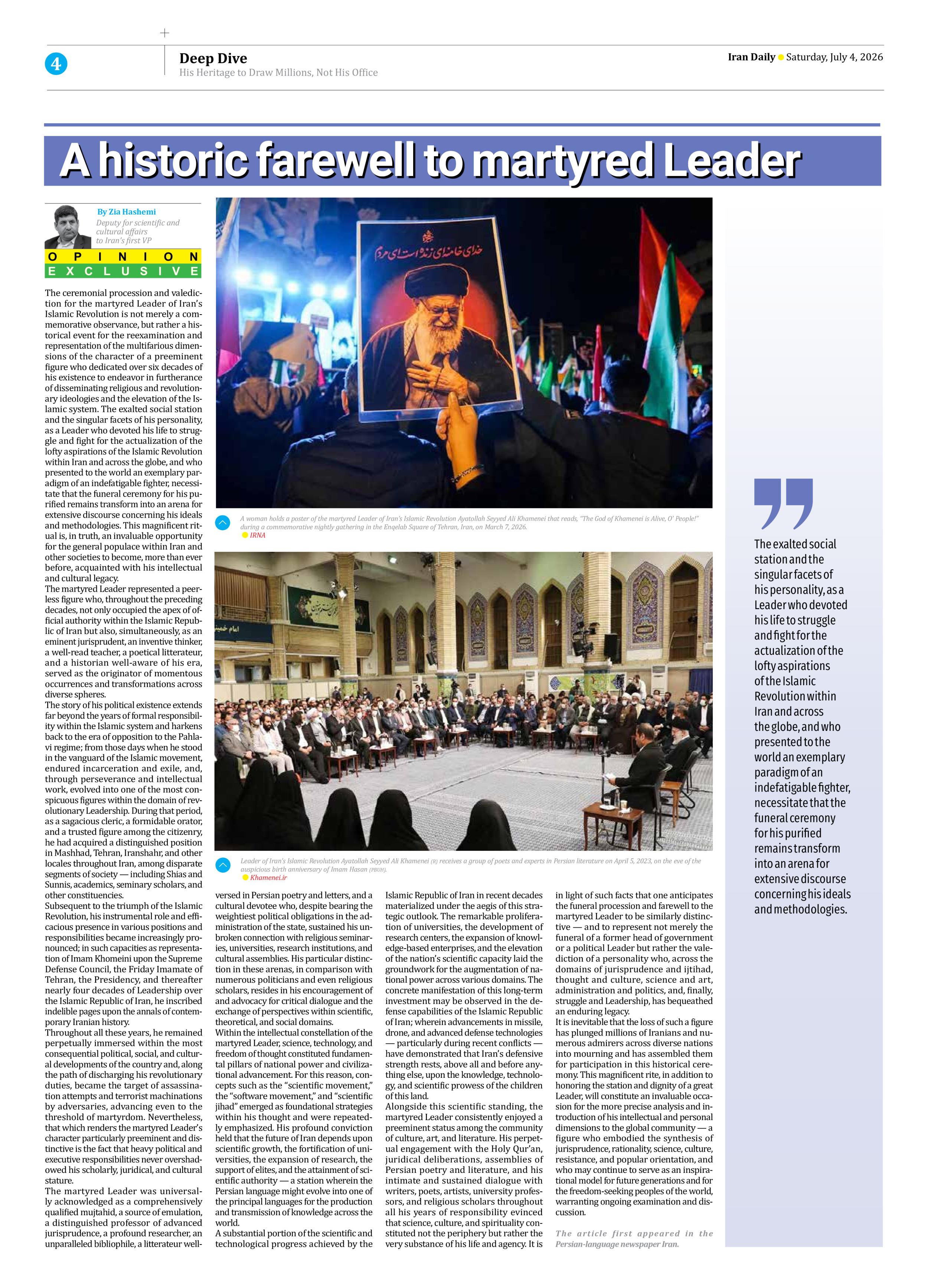


A historic farewell to martyred Leader
Deputy for scientific and cultural affairs
to Iran’s first VP
The ceremonial procession and valediction for the martyred Leader of Iran’s Islamic Revolution is not merely a commemorative observance, but rather a historical event for the reexamination and representation of the multifarious dimensions of the character of a preeminent figure who dedicated over six decades of his existence to endeavor in furtherance of disseminating religious and revolutionary ideologies and the elevation of the Islamic system. The exalted social station and the singular facets of his personality, as a Leader who devoted his life to struggle and fight for the actualization of the lofty aspirations of the Islamic Revolution within Iran and across the globe, and who presented to the world an exemplary paradigm of an indefatigable fighter, necessitate that the funeral ceremony for his purified remains transform into an arena for extensive discourse concerning his ideals and methodologies. This magnificent ritual is, in truth, an invaluable opportunity for the general populace within Iran and other societies to become, more than ever before, acquainted with his intellectual and cultural legacy.
The martyred Leader represented a peerless figure who, throughout the preceding decades, not only occupied the apex of official authority within the Islamic Republic of Iran but also, simultaneously, as an eminent jurisprudent, an inventive thinker, a well-read teacher, a poetical litterateur, and a historian well-aware of his era, served as the originator of momentous occurrences and transformations across diverse spheres.
The story of his political existence extends far beyond the years of formal responsibility within the Islamic system and harkens back to the era of opposition to the Pahlavi regime; from those days when he stood in the vanguard of the Islamic movement, endured incarceration and exile, and, through perseverance and intellectual work, evolved into one of the most conspicuous figures within the domain of revolutionary Leadership. During that period, as a sagacious cleric, a formidable orator, and a trusted figure among the citizenry, he had acquired a distinguished position in Mashhad, Tehran, Iranshahr, and other locales throughout Iran, among disparate segments of society — including Shias and Sunnis, academics, seminary scholars, and other constituencies.
Subsequent to the triumph of the Islamic Revolution, his instrumental role and efficacious presence in various positions and responsibilities became increasingly pronounced; in such capacities as representation of Imam Khomeini upon the Supreme Defense Council, the Friday Imamate of Tehran, the Presidency, and thereafter nearly four decades of Leadership over the Islamic Republic of Iran, he inscribed indelible pages upon the annals of contemporary Iranian history.
Throughout all these years, he remained perpetually immersed within the most consequential political, social, and cultural developments of the country and, along the path of discharging his revolutionary duties, became the target of assassination attempts and terrorist machinations by adversaries, advancing even to the threshold of martyrdom. Nevertheless, that which renders the martyred Leader’s character particularly preeminent and distinctive is the fact that heavy political and executive responsibilities never overshadowed his scholarly, juridical, and cultural stature.
The martyred Leader was universally acknowledged as a comprehensively qualified mujtahid, a source of emulation, a distinguished professor of advanced jurisprudence, a profound researcher, an unparalleled bibliophile, a litterateur well-versed in Persian poetry and letters, and a cultural devotee who, despite bearing the weightiest political obligations in the administration of the state, sustained his unbroken connection with religious seminaries, universities, research institutions, and cultural assemblies. His particular distinction in these arenas, in comparison with numerous politicians and even religious scholars, resides in his encouragement of and advocacy for critical dialogue and the exchange of perspectives within scientific, theoretical, and social domains.
Within the intellectual constellation of the martyred Leader, science, technology, and freedom of thought constituted fundamental pillars of national power and civilizational advancement. For this reason, concepts such as the “scientific movement,” the “software movement,” and “scientific jihad” emerged as foundational strategies within his thought and were repeatedly emphasized. His profound conviction held that the future of Iran depends upon scientific growth, the fortification of universities, the expansion of research, the support of elites, and the attainment of scientific authority — a station wherein the Persian language might evolve into one of the principal languages for the production and transmission of knowledge across the world.
A substantial portion of the scientific and technological progress achieved by the Islamic Republic of Iran in recent decades materialized under the aegis of this strategic outlook. The remarkable proliferation of universities, the development of research centers, the expansion of knowledge-based enterprises, and the elevation of the nation’s scientific capacity laid the groundwork for the augmentation of national power across various domains. The concrete manifestation of this long-term investment may be observed in the defense capabilities of the Islamic Republic of Iran; wherein advancements in missile, drone, and advanced defense technologies — particularly during recent conflicts — have demonstrated that Iran’s defensive strength rests, above all and before anything else, upon the knowledge, technology, and scientific prowess of the children of this land.
Alongside this scientific standing, the martyred Leader consistently enjoyed a preeminent status among the community of culture, art, and literature. His perpetual engagement with the Holy Qur’an, juridical deliberations, assemblies of Persian poetry and literature, and his intimate and sustained dialogue with writers, poets, artists, university professors, and religious scholars throughout all his years of responsibility evinced that science, culture, and spirituality constituted not the periphery but rather the very substance of his life and agency. It is in light of such facts that one anticipates the funeral procession and farewell to the martyred Leader to be similarly distinctive — and to represent not merely the funeral of a former head of government or a political Leader but rather the valediction of a personality who, across the domains of jurisprudence and ijtihad, thought and culture, science and art, administration and politics, and, finally, struggle and Leadership, has bequeathed an enduring legacy.
It is inevitable that the loss of such a figure has plunged millions of Iranians and numerous admirers across diverse nations into mourning and has assembled them for participation in this historical ceremony. This magnificent rite, in addition to honoring the station and dignity of a great Leader, will constitute an invaluable occasion for the more precise analysis and introduction of his intellectual and personal dimensions to the global community — a figure who embodied the synthesis of jurisprudence, rationality, science, culture, resistance, and popular orientation, and who may continue to serve as an inspirational model for future generations and for the freedom-seeking peoples of the world, warranting ongoing examination and discussion.
The article first appeared in the
Persian-language newspaper Iran.