







Long-term fundamental reform needed throughout Iranian football: Modirrousta
Iran’s national football team bowed out of the group stage of the 2026 FIFA World Cup despite producing determined performances and earning respectable results against its Group G opponents. Ultimately, however, Team Melli failed again to capitalize on the opportunity to reach the knockout rounds for the first time in the history of the showpiece. Many observers identified Iran’s match against New Zealand in their opening match as the defining moment of the campaign. Victory in that fixture would have put qualification firmly within reach, but a 2-2 draw against a team that was comfortably beaten by Egypt and Belgium later left Iran’s fate dependent on results in other groups. Beyond the team’s on-field performances, analysts also pointed to a series of off-field challenges leading up to the tournament. These included the lack of high-quality warm-up matches, logistical difficulties stemming from the team’s training base in Mexico and travel restrictions imposed by co-host United States, as well as criticism of several management decisions and the team’s overall preparation. Former Iran international Ali-Asghar Modirrousta believes the players gave everything despite the circumstances, but argues that the absence of an effective tactical plan and the coaching staff’s conservative approach ultimately prevented Iran from advancing. In an interview with Iran Daily, Modirrousta discussed Iran’s World Cup campaign, the reasons behind the team’s elimination, tactical and managerial shortcomings, the need for generational renewal, the future of head coach Amir Qalenoei, and the structural reforms Iranian football requires to succeed in future tournaments.
By Sadeq Dehqan
Staff writer
IRAN DAILY: How would you assess Iran’s overall performance at the 2026 World Cup?
MODIRROUSTA: Our national team arrived at the World Cup under very difficult circumstances. The regional situation and the war had a significant impact on our preparations. We faced a challenging training camp, lacked quality friendly matches, and based ourselves in Tijuana, which meant we had to travel back and forth between Mexico and the United States for every game.
Those conditions made things extremely difficult, especially psychologically. A team preparing for the World Cup needs strong preparation matches, but we simply didn’t have them. We also didn’t have an ideal base close to the tournament venues.
The decision to base the team in Mexico raises important questions. We need to know whether it was solely because some federation officials and staff were denied U.S. visas or whether other considerations influenced that decision.
If the choice was made primarily so federation officials and media personnel could remain with the team, then I believe we made the wrong decision and the players paid the price. Had those officials returned home and the team itself been based in the United States, the constant travel between Mexico and the U.S. would have been avoided, making life much easier for the players.
What about the team’s performances on the pitch?
Given the circumstances, I think our players fought admirably in all three matches. Every member of the team deserves credit because they entered the tournament without proper preparation but still gave everything they had.
With the World Cup expanding to 48 teams, many believed our path to qualification would be easier. Qualification ultimately depended on beating New Zealand, and unfortunately that didn’t happen.
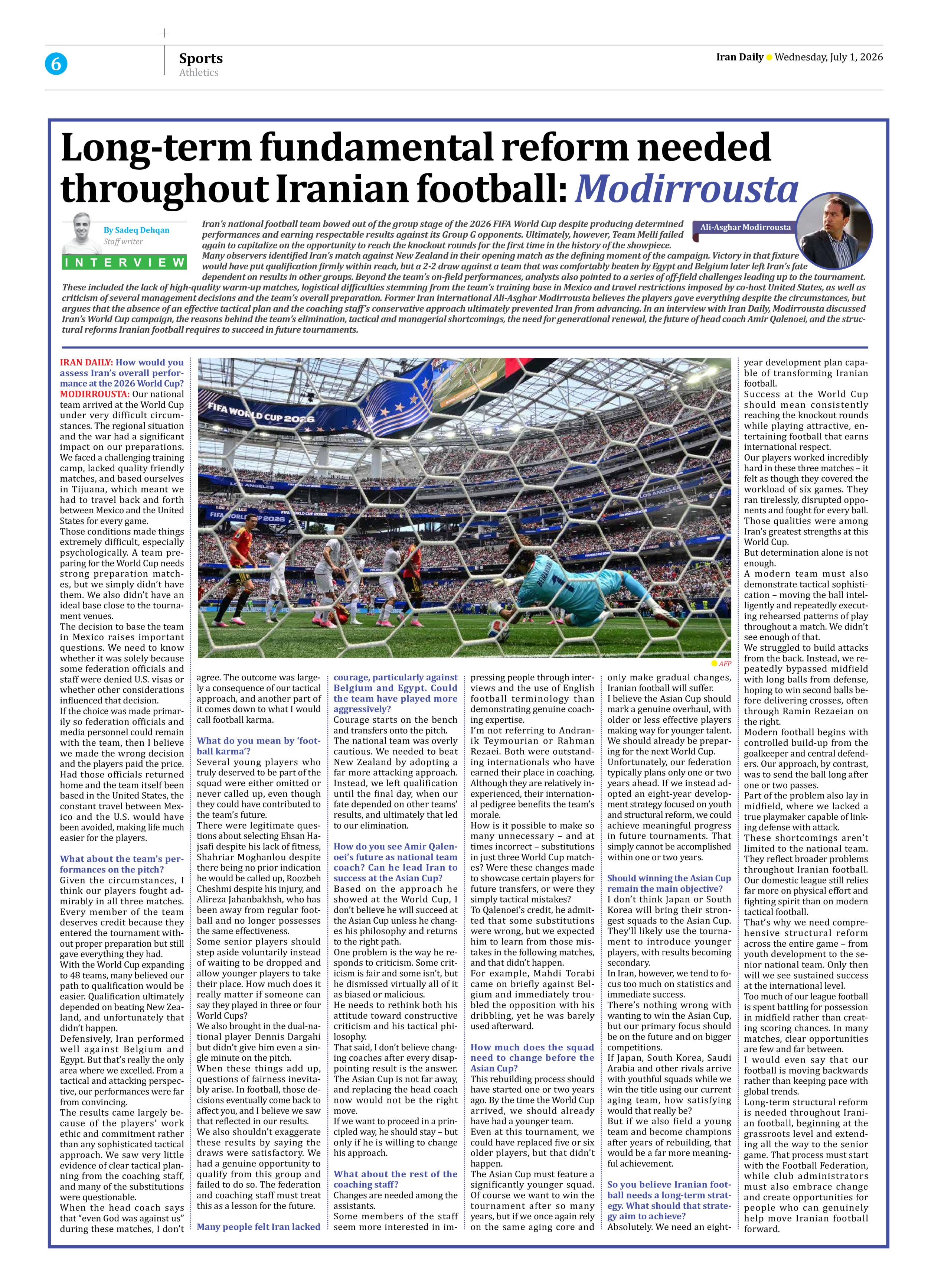
Defensively, Iran performed well against Belgium and Egypt. But that’s really the only area where we excelled. From a tactical and attacking perspective, our performances were far from convincing.
The results came largely because of the players’ work ethic and commitment rather than any sophisticated tactical approach. We saw very little evidence of clear tactical planning from the coaching staff, and many of the substitutions were questionable.
When the head coach says that “even God was against us” during these matches, I don’t agree. The outcome was largely a consequence of our tactical approach, and another part of it comes down to what I would call football karma.
What do you mean by ‘football karma’?
Several young players who truly deserved to be part of the squad were either omitted or never called up, even though they could have contributed to the team’s future.
There were legitimate questions about selecting Ehsan Hajsafi despite his lack of fitness, Shahriar Moghanlou despite there being no prior indication he would be called up, Roozbeh Cheshmi despite his injury, and Alireza Jahanbakhsh, who has been away from regular football and no longer possesses the same effectiveness.
Some senior players should step aside voluntarily instead of waiting to be dropped and allow younger players to take their place. How much does it really matter if someone can say they played in three or four World Cups?
We also brought in the dual-national player Dennis Dargahi but didn’t give him even a single minute on the pitch.
When these things add up, questions of fairness inevitably arise. In football, those decisions eventually come back to affect you, and I believe we saw that reflected in our results.
We also shouldn’t exaggerate these results by saying the draws were satisfactory. We had a genuine opportunity to qualify from this group and failed to do so. The federation and coaching staff must treat this as a lesson for the future.
Many people felt Iran lacked courage, particularly against Belgium and Egypt. Could the team have played more aggressively?
Courage starts on the bench and transfers onto the pitch.
The national team was overly cautious. We needed to beat New Zealand by adopting a far more attacking approach. Instead, we left qualification until the final day, when our fate depended on other teams’ results, and ultimately that led to our elimination.
How do you see Amir Qalenoei’s future as national team coach? Can he lead Iran to success at the Asian Cup?
Based on the approach he showed at the World Cup, I don’t believe he will succeed at the Asian Cup unless he changes his philosophy and returns to the right path.
One problem is the way he responds to criticism. Some criticism is fair and some isn’t, but he dismissed virtually all of it as biased or malicious.
He needs to rethink both his attitude toward constructive criticism and his tactical philosophy.
That said, I don’t believe changing coaches after every disappointing result is the answer. The Asian Cup is not far away, and replacing the head coach now would not be the right move.
If we want to proceed in a principled way, he should stay – but only if he is willing to change his approach.
What about the rest of the coaching staff?
Changes are needed among the assistants.
Some members of the staff seem more interested in impressing people through interviews and the use of English football terminology than demonstrating genuine coaching expertise.
I’m not referring to Andranik Teymourian or Rahman Rezaei. Both were outstanding internationals who have earned their place in coaching. Although they are relatively inexperienced, their international pedigree benefits the team’s morale.
How is it possible to make so many unnecessary – and at times incorrect – substitutions in just three World Cup matches? Were these changes made to showcase certain players for future transfers, or were they simply tactical mistakes?
To Qalenoei’s credit, he admitted that some substitutions were wrong, but we expected him to learn from those mistakes in the following matches, and that didn’t happen.
For example, Mahdi Torabi came on briefly against Belgium and immediately troubled the opposition with his dribbling, yet he was barely used afterward.
How much does the squad need to change before the Asian Cup?
This rebuilding process should have started one or two years ago. By the time the World Cup arrived, we should already have had a younger team.
Even at this tournament, we could have replaced five or six older players, but that didn’t happen.
The Asian Cup must feature a significantly younger squad. Of course we want to win the tournament after so many years, but if we once again rely on the same aging core and only make gradual changes, Iranian football will suffer.
I believe the Asian Cup should mark a genuine overhaul, with older or less effective players making way for younger talent. We should already be preparing for the next World Cup.
Unfortunately, our federation typically plans only one or two years ahead. If we instead adopted an eight-year development strategy focused on youth and structural reform, we could achieve meaningful progress in future tournaments. That simply cannot be accomplished within one or two years.
Should winning the Asian Cup remain the main objective?
I don’t think Japan or South Korea will bring their strongest squads to the Asian Cup. They’ll likely use the tournament to introduce younger players, with results becoming secondary.
In Iran, however, we tend to focus too much on statistics and immediate success.
There’s nothing wrong with wanting to win the Asian Cup, but our primary focus should be on the future and on bigger competitions.
If Japan, South Korea, Saudi Arabia and other rivals arrive with youthful squads while we win the title using our current aging team, how satisfying would that really be?
But if we also field a young team and become champions after years of rebuilding, that would be a far more meaningful achievement.
So you believe Iranian football needs a long-term strategy. What should that strategy aim to achieve?
Absolutely. We need an eight-year development plan capable of transforming Iranian football.
Success at the World Cup should mean consistently reaching the knockout rounds while playing attractive, entertaining football that earns international respect.
Our players worked incredibly hard in these three matches – it felt as though they covered the workload of six games. They ran tirelessly, disrupted opponents and fought for every ball. Those qualities were among Iran’s greatest strengths at this World Cup.
But determination alone is not enough.
A modern team must also demonstrate tactical sophistication – moving the ball intelligently and repeatedly executing rehearsed patterns of play throughout a match. We didn’t see enough of that.
We struggled to build attacks from the back. Instead, we repeatedly bypassed midfield with long balls from defense, hoping to win second balls before delivering crosses, often through Ramin Rezaeian on the right.
Modern football begins with controlled build-up from the goalkeeper and central defenders. Our approach, by contrast, was to send the ball long after one or two passes.
Part of the problem also lay in midfield, where we lacked a true playmaker capable of linking defense with attack.
These shortcomings aren’t limited to the national team. They reflect broader problems throughout Iranian football. Our domestic league still relies far more on physical effort and fighting spirit than on modern tactical football.
That’s why we need comprehensive structural reform across the entire game – from youth development to the senior national team. Only then will we see sustained success at the international level.
Too much of our league football is spent battling for possession in midfield rather than creating scoring chances. In many matches, clear opportunities are few and far between.
I would even say that our football is moving backwards rather than keeping pace with global trends.
Long-term structural reform is needed throughout Iranian football, beginning at the grassroots level and extending all the way to the senior game. That process must start with the Football Federation, while club administrators must also embrace change and create opportunities for people who can genuinely help move Iranian football forward.