





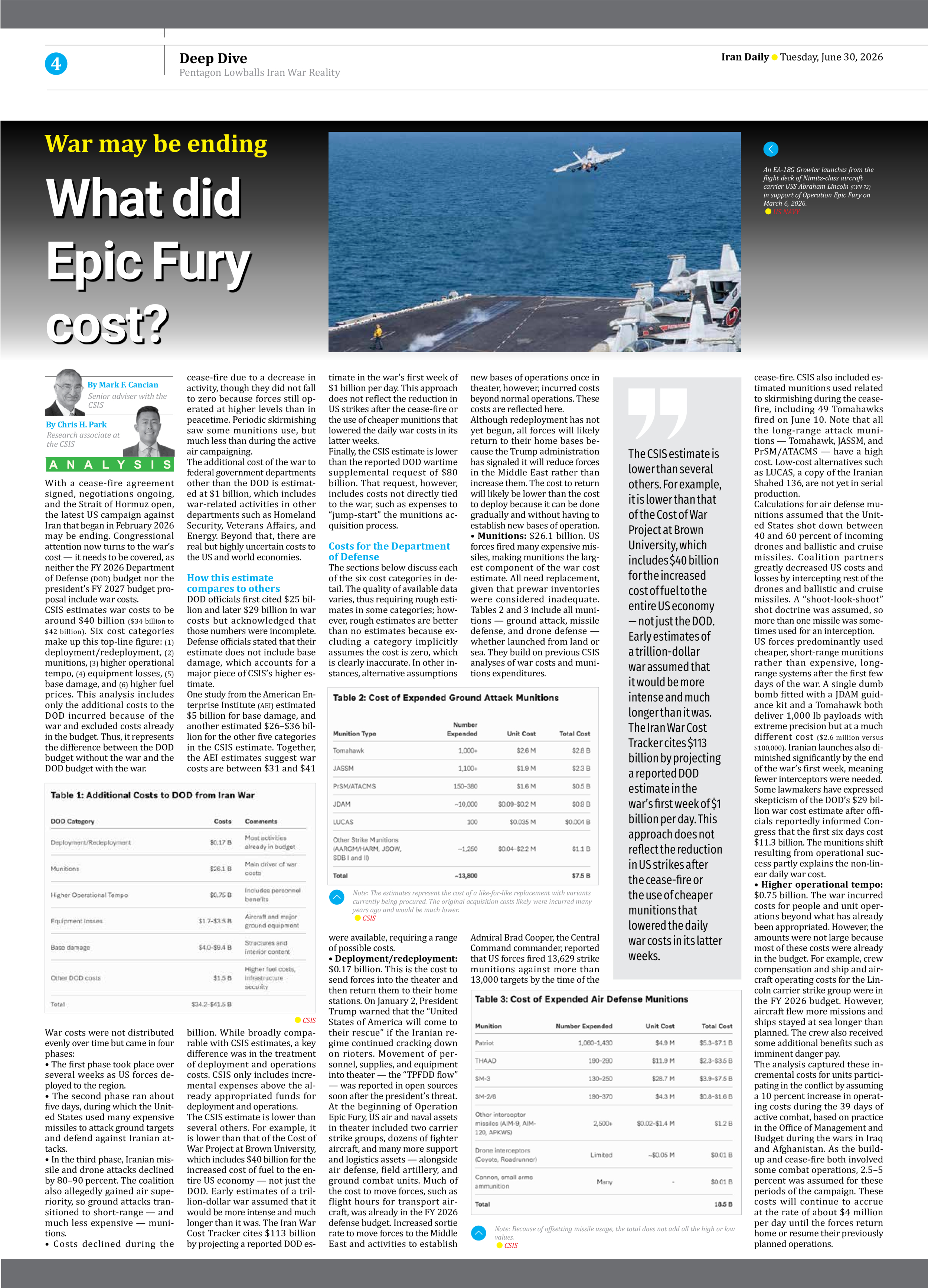


War may be ending
What did Epic Fury cost?
By Mark F. Cancian
Senior adviser with the CSIS
By Chris H. Park
Research associate at the CSIS
With a cease-fire agreement signed, negotiations ongoing, and the Strait of Hormuz open, the latest US campaign against Iran that began in February 2026 may be ending. Congressional attention now turns to the war’s cost — it needs to be covered, as neither the FY 2026 Department of Defense (DOD) budget nor the president’s FY 2027 budget proposal include war costs.
CSIS estimates war costs to be around $40 billion ($34 billion to $42 billion). Six cost categories make up this top-line figure: (1) deployment/redeployment, (2) munitions, (3) higher operational tempo, (4) equipment losses, (5) base damage, and (6) higher fuel prices. This analysis includes only the additional costs to the DOD incurred because of the war and excluded costs already in the budget. Thus, it represents the difference between the DOD budget without the war and the DOD budget with the war.
War costs were not distributed evenly over time but came in four phases:
• The first phase took place over several weeks as US forces deployed to the region.
• The second phase ran about five days, during which the United States used many expensive missiles to attack ground targets and defend against Iranian attacks.
• In the third phase, Iranian missile and drone attacks declined by 80–90 percent. The coalition also allegedly gained air superiority, so ground attacks transitioned to short-range — and much less expensive — munitions.
• Costs declined during the cease-fire due to a decrease in activity, though they did not fall to zero because forces still operated at higher levels than in peacetime. Periodic skirmishing saw some munitions use, but much less than during the active air campaigning.
The additional cost of the war to federal government departments other than the DOD is estimated at $1 billion, which includes war-related activities in other departments such as Homeland Security, Veterans Affairs, and Energy. Beyond that, there are real but highly uncertain costs to the US and world economies.
How this estimate compares to others
DOD officials first cited $25 billion and later $29 billion in war costs but acknowledged that those numbers were incomplete. Defense officials stated that their estimate does not include base damage, which accounts for a major piece of CSIS’s higher estimate.
One study from the American Enterprise Institute (AEI) estimated $5 billion for base damage, and another estimated $26–$36 billion for the other five categories in the CSIS estimate. Together, the AEI estimates suggest war costs are between $31 and $41 billion. While broadly comparable with CSIS estimates, a key difference was in the treatment of deployment and operations costs. CSIS only includes incremental expenses above the already appropriated funds for deployment and operations.
The CSIS estimate is lower than several others. For example, it is lower than that of the Cost of War Project at Brown University, which includes $40 billion for the increased cost of fuel to the entire US economy — not just the DOD. Early estimates of a trillion-dollar war assumed that it would be more intense and much longer than it was. The Iran War Cost Tracker cites $113 billion by projecting a reported DOD estimate in the war’s first week of $1 billion per day. This approach does not reflect the reduction in US strikes after the cease-fire or the use of cheaper munitions that lowered the daily war costs in its latter weeks.
Finally, the CSIS estimate is lower than the reported DOD wartime supplemental request of $80 billion. That request, however, includes costs not directly tied to the war, such as expenses to “jump-start” the munitions acquisition process.
Costs for the Department of Defense
The sections below discuss each of the six cost categories in detail. The quality of available data varies, thus requiring rough estimates in some categories; however, rough estimates are better than no estimates because excluding a category implicitly assumes the cost is zero, which is clearly inaccurate. In other instances, alternative assumptions were available, requiring a range of possible costs.
• Deployment/redeployment: $0.17 billion. This is the cost to send forces into the theater and then return them to their home stations. On January 2, President Trump warned that the “United States of America will come to their rescue” if the Iranian regime continued cracking down on rioters. Movement of personnel, supplies, and equipment into theater — the “TPFDD flow” — was reported in open sources soon after the president’s threat.
At the beginning of Operation Epic Fury, US air and naval assets in theater included two carrier strike groups, dozens of fighter aircraft, and many more support and logistics assets — alongside air defense, field artillery, and ground combat units. Much of the cost to move forces, such as flight hours for transport aircraft, was already in the FY 2026 defense budget. Increased sortie rate to move forces to the Middle East and activities to establish new bases of operations once in theater, however, incurred costs beyond normal operations. These costs are reflected here.
Although redeployment has not yet begun, all forces will likely return to their home bases because the Trump administration has signaled it will reduce forces in the Middle East rather than increase them. The cost to return will likely be lower than the cost to deploy because it can be done gradually and without having to establish new bases of operation.
• Munitions: $26.1 billion. US forces fired many expensive missiles, making munitions the largest component of the war cost estimate. All need replacement, given that prewar inventories were considered inadequate. Tables 2 and 3 include all munitions — ground attack, missile defense, and drone defense — whether launched from land or sea. They build on previous CSIS analyses of war costs and munitions expenditures.
Admiral Brad Cooper, the Central Command commander, reported that US forces fired 13,629 strike munitions against more than 13,000 targets by the time of the cease-fire. CSIS also included estimated munitions used related to skirmishing during the cease-fire, including 49 Tomahawks fired on June 10. Note that all the long-range attack munitions — Tomahawk, JASSM, and PrSM/ATACMS — have a high cost. Low-cost alternatives such as LUCAS, a copy of the Iranian Shahed 136, are not yet in serial production.
Calculations for air defense munitions assumed that the United States shot down between 40 and 60 percent of incoming drones and ballistic and cruise missiles. Coalition partners greatly decreased US costs and losses by intercepting rest of the drones and ballistic and cruise missiles. A “shoot-look-shoot” shot doctrine was assumed, so more than one missile was sometimes used for an interception.
US forces predominantly used cheaper, short-range munitions rather than expensive, long-range systems after the first few days of the war. A single dumb bomb fitted with a JDAM guidance kit and a Tomahawk both deliver 1,000 lb payloads with extreme precision but at a much different cost ($2.6 million versus $100,000). Iranian launches also diminished significantly by the end of the war’s first week, meaning fewer interceptors were needed.
Some lawmakers have expressed skepticism of the DOD’s $29 billion war cost estimate after officials reportedly informed Congress that the first six days cost $11.3 billion. The munitions shift resulting from operational success partly explains the non-linear daily war cost.
• Higher operational tempo: $0.75 billion. The war incurred costs for people and unit operations beyond what has already been appropriated. However, the amounts were not large because most of these costs were already in the budget. For example, crew compensation and ship and aircraft operating costs for the Lincoln carrier strike group were in the FY 2026 budget. However, aircraft flew more missions and ships stayed at sea longer than planned. The crew also received some additional benefits such as imminent danger pay.
The analysis captured these incremental costs for units participating in the conflict by assuming a 10 percent increase in operating costs during the 39 days of active combat, based on practice in the Office of Management and Budget during the wars in Iraq and Afghanistan. As the buildup and cease-fire both involved some combat operations, 2.5–5 percent was assumed for these periods of the campaign. These costs will continue to accrue at the rate of about $4 million per day until the forces return home or resume their previously planned operations.
• Equipment losses and damages: $1.8–$3.5 billion. The analysis used DOD press releases and public reports to estimate equipment losses — mostly aircraft — from the war. Base equipment losses are included under “base damage”.
The Congressional Research Service identified 42 lost or damaged aircraft. Table 4 includes several tilt-rotor aircraft and a mobile Terminal High-Altitude Aerial Defense (THAAD) radar in addition to the CRS list. Note that most lost aircraft are uncrewed drones. The United States is much more willing to risk uncrewed aircraft than crewed aircraft.
Table 4 shows a high and low to capture the different approaches to calculating replacement costs. The high-end cost is a one-for-one replacement with the most comparable aircraft currently in production. Thus, an F-15EX would replace a lost F-15E and an F-35A would replace a lost A-10. The low-end cost excludes aircraft such as the A-10 and E-3 that are planned for retirement. The theory here is that replacements are already in the budget. The cost to repair damaged aircraft is assumed to be 25 to 75 percent of the replacement cost, captured in the range of the estimate.
• Damage to bases and fixed infrastructure: $4.0–$9.4 billion. Throughout the conflict, Iran has attacked US bases with missiles and drones. The coalition allegedly intercepted up to 90 percent of those attackers. However, 10 percent leakage still caused much damage when attackers numbered in the thousands. Despite this, there is little evidence that Iranian attacks materially restricted US operations during this campaign.
The New York Times, Wall Street Journal, and Washington Post have all analyzed satellite imagery showing the damage. CSIS has its own set of overhead photographs and made damage estimates from those. CSIS analysis produced a range of $2.2–$5.1 billion for the 122 structures examined — and $4–$9.4 billion, accounting for the greater number of buildings damage identified by the Washington Post. The actual cost to repair all damages will be greater, as restricted access to satellite imagery limits analysis using available open-source information.
The images make clear the Iranian strikes were precise. There are no random craters indicating misses or wasted assets. Most struck facilities were unusable afterward. Iran has had decades to prepare its target lists. It likely developed most of its own targeting information, using its proximity to the targets and its many agents on the ground. However, it may have received intelligence help from Russia or China in identifying mobile or fleeting targets.
Iran attacked not just warfighting facilities but barracks, gyms, and dining facilities, indicating an intent to cause US casualties. This was largely unsuccessful because the United States had evacuated many personnel and put others under cover.
This analysis identified the damaged buildings using base maps, where available, and visual recognition. Permanent structures were differentiated from temporary structures. The estimated repair costs were derived from the DOD construction handbooks detailing the “cost to design and construct a notional facility to current standards to replace an existing facility on the same site”. The estimate accounts for differences in facility type, as well as design and planning costs, overhead, and location-specific construction cost factors.
The DOD has not included the cost of repairing bases in its calculations because it is reviewing its posture in the Middle East and may not continue to use all the bases or use them in the same way. This would reduce costs. On the other hand, moving activities to new locations entails its own costs.
The estimate captured three uncertainties with base damage:
The major uncertainty is the number of buildings struck. The most comprehensive base damage assessment so far, conducted by the Washington Post, identified 228 structures in a more comprehensive database that includes similar categories of facilities as the CSIS one. Assuming the additional 106 structures identified by the Washington Post have the same composition as those in the CSIS database, the range would then be $3.2–$9.2 billion.
Another uncertainty is determining the cost of what was inside the buildings. For some, such as barracks and gyms, the material contents were not particularly costly. For warehouses, however, the contents could be as valuable as the building itself. CSIS used standard warehouse factors to estimate lost inventories. Commercial counterparts were used for other building types, such as hangers, dining facilities, and living quarters.
Damages were assessed only if visible in images. There is likely much more damage that is not visible, and many structures may have become unusable because of nearby explosions. Reported DOD estimates suggest that the CSIS analysis — or those by media outlets — may not reflect the full extent of the regional base damage. The embargo on satellite imagery prevents efforts to get greater fidelity on US base damage.
• Other DOD costs: $1.5 billion. The previous categories picked up nearly all costs, but a few need to be treated separately:
a) Fuel: $1.4 billion. The DOD is a major consumer of fuel, so the entire department, not just deployed forces, is affected by price increases. A rough calculation compares what the DOD budgeted for jet fuel ($3.67/gallon) for FY 2026 with current prices, which rose to about $4.46/gallon — $0.79 above what the DOD budgeted. In 2026, the DOD was projected to use 3.05 billion gallons of fuel. The higher fuel cost during four months of war therefore totaled $800 million. If it takes six more months for prices to return to prewar levels, then the DOD’s additional cost during this period will be $600 million, bringing the total to $1.4 billion.
b) Security and overtime: $100 million. The DOD has enhanced physical security on its bases and may have surged some equipment maintenance and production. These costs will appear mostly as overtime for government employees and contractors.
Costs for the federal government outside the DOD
Although the DOD incurred the bulk of costs associated with the war, other government agencies had smaller roles that nevertheless required additional resources.
• Homeland and diplomatic security: $300 million. The Federal Bureau of Investigation and the National Coordinator for Critical Infrastructure Security and Resilience have issued warnings about Iranian attacks on the US homeland, and agencies have increased physical security. The amount shown here funds cyber defense, antiterrorism activities, and government-wide law enforcement. For the State Department, it funds embassy security and consular services for evacuees. The categories and amounts are based on analogs to US activities in the Ukraine-Russia war.
• Future veterans’ costs: $400 million annually. Service members who participated in the conflict will have medical and disability claims above the usual veterans’ benefits. The DOD has said that about 400 service members have been injured, though most returned to duty. These injuries will need immediate care. However, the major cost will arise over time as veterans age and conditions such as post-traumatic stress disorder, depression, hearing loss, joint pain, and tinnitus appear. The cost estimate here assumes that veterans of this conflict receive disability benefits at the same level of severity ($16,100 average per year) as veterans of the conflicts in Iraq and Afghanistan, but at a lower rate (35 percent versus about 50 percent) because the tour of duty has been shorter.
The total cost over 30 years ($12 billion) is large but much less than that for veterans of the Iraq and Afghanistan wars because fewer service members were involved (70,000, including support outside the theater, versus 2,000,000) and the duration was shorter (four months versus 20 years). Because the federal government has no accrual system for veterans’ benefits, this is not a current cost that can go into today’s budget but a future cost. Table 6 includes the first year.
• Fuel, nuclear, and other costs: $265 million. Although the DOD accounts for 90 percent of the federal government’s fuel usage, other agencies also have increased costs. This amounts to $165 million using the same methodology as for the DOD’s fuel cost. The National Nuclear Security Administration, the part of the Department of Energy that deals with nuclear weapons, likely had additional costs relating to nuclear monitoring and preparation for disposal of Iran’s nuclear materials ($50 million, based on similar activities related to the war in Ukraine). Other agencies likely had incidental additional costs, such as the Department of the Treasury regarding sanctions enforcement ($50 million, also based on experience during the Ukraine war).
Economic and human costs
These are not part of the federal budget but are nonetheless real and should be recognized. The first is the cost to the US economy. The Cost of War project estimated $40 billion in additional fuel costs for the American public: This estimate appears accurate using our fuel pricing methodology. Other costs are hard to measure. Moody’s estimated that the war will cost Americans $132 billion. Economic performance statistics for this period might show some effect when they are published. A stable and successful peace might produce some long-term economic benefits.
Like the US economy, the world economy has also sustained damage, though national energy inventories have mitigated that damage.
Finally, there is a human cost. The 13 US casualties, while individually tragic, have been few by the standards of warfare. Israel suffered around 40 fatalities, civilian and military. At least 30, mostly civilians, have been killed in the Persian Gulf States. Iran is reported to have suffered 1,700 civilian fatalities, and Lebanon has likely suffered many civilian casualties as well.
The full article was first published by the Center for Strategic and
International Studies.