







Iran, Oman hold first meeting on Hormuz governance
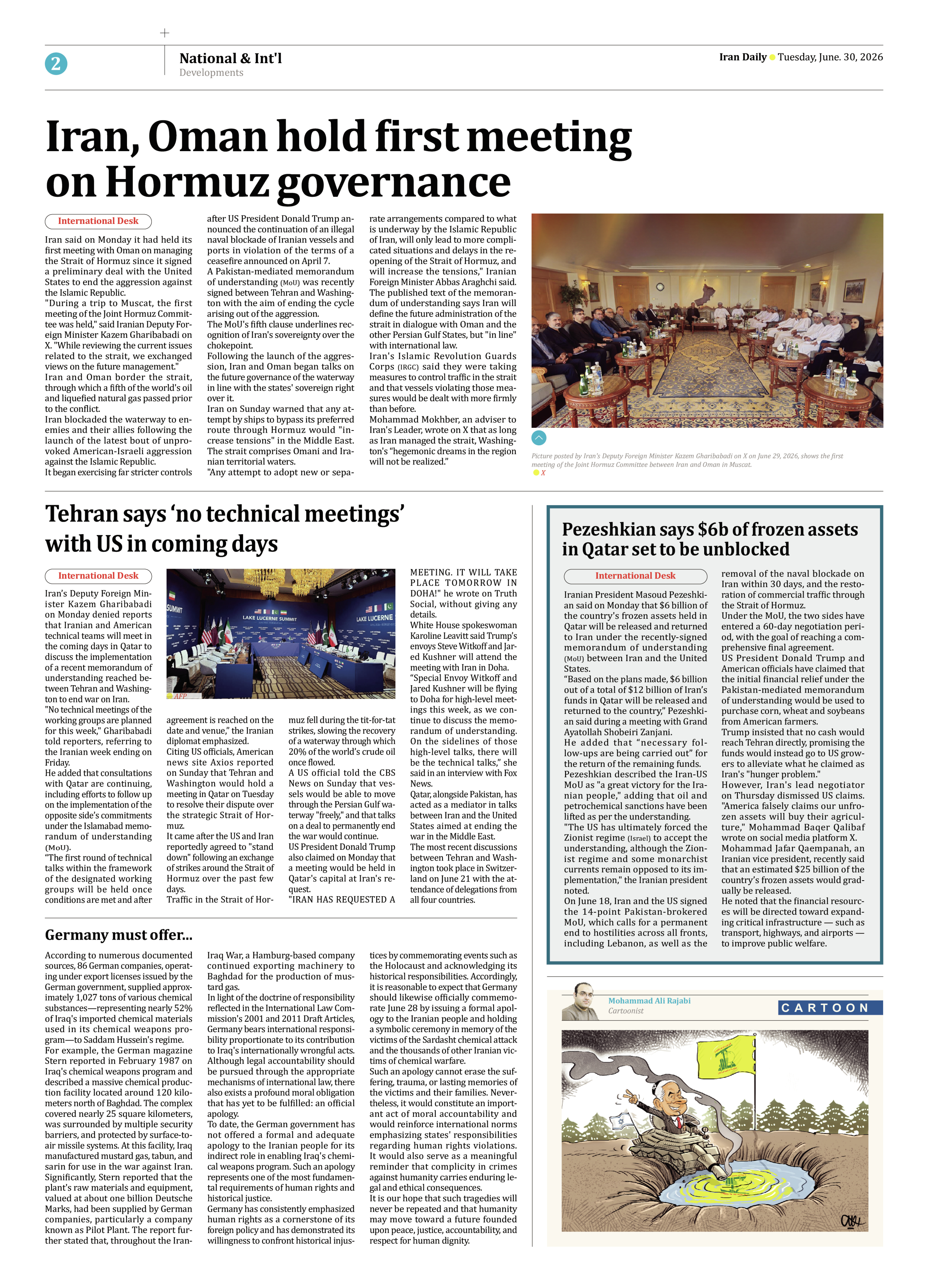
Iran said on Monday it had held its first meeting with Oman on managing the Strait of Hormuz since it signed a preliminary deal with the United States to end the aggression against the Islamic Republic.
"During a trip to Muscat, the first meeting of the Joint Hormuz Committee was held," said Iranian Deputy Foreign Minister Kazem Gharibabadi on X. "While reviewing the current issues related to the strait, we exchanged views on the future management."
Iran and Oman border the strait, through which a fifth of the world's oil and liquefied natural gas passed prior to the conflict.
Iran blockaded the waterway to enemies and their allies following the launch of the latest bout of unprovoked American-Israeli aggression against the Islamic Republic.
It began exercising far stricter controls after US President Donald Trump announced the continuation of an illegal naval blockade of Iranian vessels and ports in violation of the terms of a ceasefire announced on April 7.
A Pakistan-mediated memorandum of understanding (MoU) was recently signed between Tehran and Washington with the aim of ending the cycle arising out of the aggression.
The MoU's fifth clause underlines recognition of Iran's sovereignty over the chokepoint.
Following the launch of the aggression, Iran and Oman began talks on the future governance of the waterway in line with the states' sovereign right over it.
Iran on Sunday warned that any attempt by ships to bypass its preferred route through Hormuz would "increase tensions" in the Middle East. The strait comprises Omani and Iranian territorial waters.
"Any attempt to adopt new or separate arrangements compared to what is underway by the Islamic Republic of Iran, will only lead to more complicated situations and delays in the reopening of the Strait of Hormuz, and will increase the tensions," Iranian Foreign Minister Abbas Araghchi said.
The published text of the memorandum of understanding says Iran will define the future administration of the strait in dialogue with Oman and the other Persian Gulf States, but "in line" with international law.
Iran's Islamic Revolution Guards Corps (IRGC) said they were taking measures to control traffic in the strait and that vessels violating those measures would be dealt with more firmly than before.
Mohammad Mokhber, an adviser to Iran's Leader, wrote on X that as long as Iran managed the strait, Washington's “hegemonic dreams in the region will not be realized.”