







Britain’s next prime minister faces deep foreign policy challenges
Whether Burnham or another
By Olivia O’Sullivan
Director of the UK in the World Programme at Chatham House
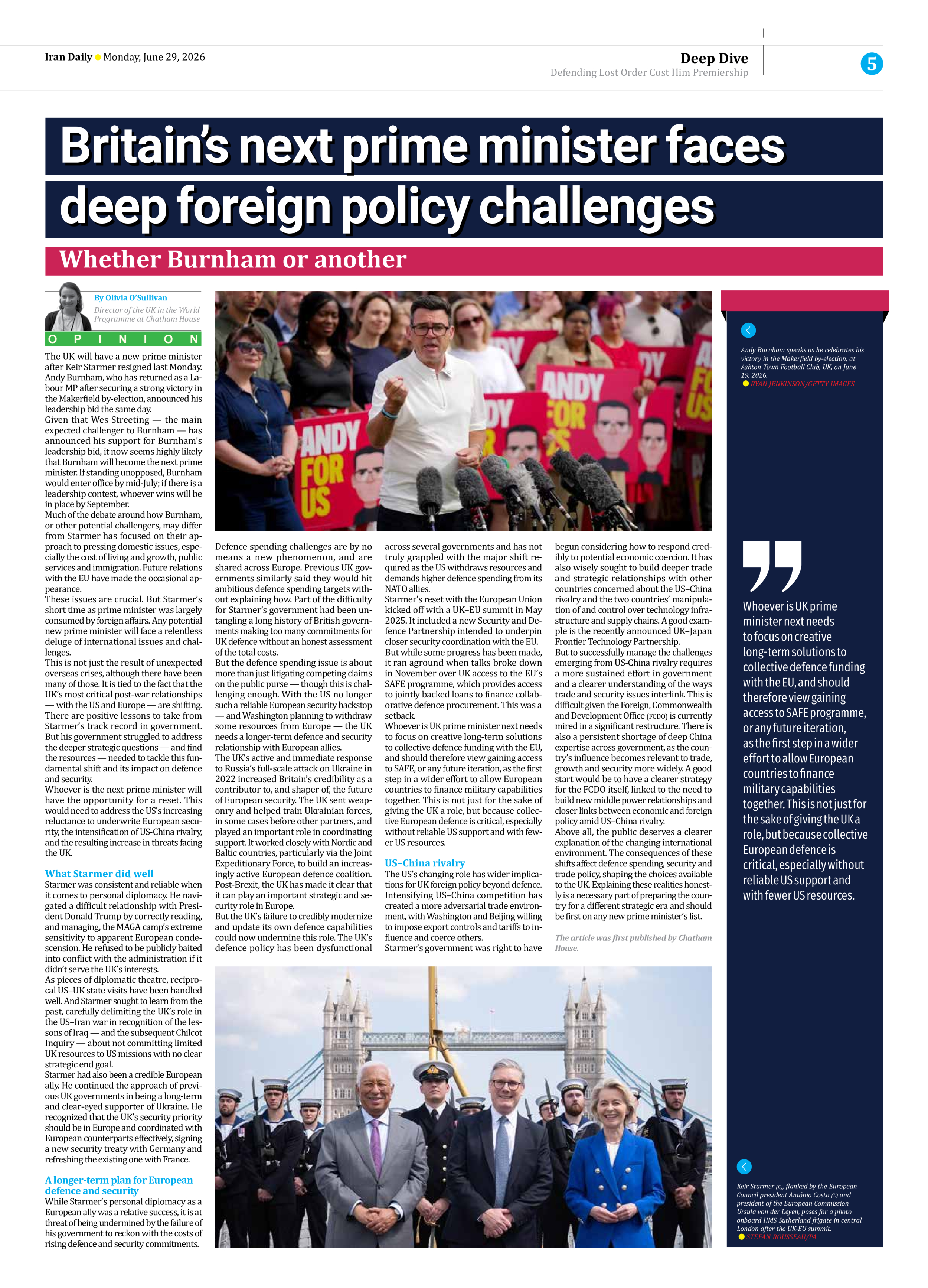
The UK will have a new prime minister after Keir Starmer resigned last Monday. Andy Burnham, who has returned as a Labour MP after securing a strong victory in the Makerfield by-election, announced his leadership bid the same day.
Given that Wes Streeting — the main expected challenger to Burnham — has announced his support for Burnham’s leadership bid, it now seems highly likely that Burnham will become the next prime minister. If standing unopposed, Burnham would enter office by mid-July; if there is a leadership contest, whoever wins will be in place by September.
Much of the debate around how Burnham, or other potential challengers, may differ from Starmer has focused on their approach to pressing domestic issues, especially the cost of living and growth, public services and immigration. Future relations with the EU have made the occasional appearance.
These issues are crucial. But Starmer’s short time as prime minister was largely consumed by foreign affairs. Any potential new prime minister will face a relentless deluge of international issues and challenges.
This is not just the result of unexpected overseas crises, although there have been many of those. It is tied to the fact that the UK’s most critical post-war relationships — with the US and Europe — are shifting.
There are positive lessons to take from Starmer’s track record in government. But his government struggled to address the deeper strategic questions — and find the resources — needed to tackle this fundamental shift and its impact on defence and security.
Whoever is the next prime minister will have the opportunity for a reset. This would need to address the US’s increasing reluctance to underwrite European security, the intensification of US-China rivalry, and the resulting increase in threats facing the UK.
What Starmer did well
Starmer was consistent and reliable when it comes to personal diplomacy. He navigated a difficult relationship with President Donald Trump by correctly reading, and managing, the MAGA camp’s extreme sensitivity to apparent European condescension. He refused to be publicly baited into conflict with the administration if it didn’t serve the UK’s interests.
As pieces of diplomatic theatre, reciprocal US–UK state visits have been handled well. And Starmer sought to learn from the past, carefully delimiting the UK’s role in the US–Iran war in recognition of the lessons of Iraq — and the subsequent Chilcot Inquiry — about not committing limited UK resources to US missions with no clear strategic end goal.
Starmer had also been a credible European ally. He continued the approach of previous UK governments in being a long-term and clear-eyed supporter of Ukraine. He recognized that the UK’s security priority should be in Europe and coordinated with European counterparts effectively, signing a new security treaty with Germany and refreshing the existing one with France.
A longer-term plan for European defence and security
While Starmer’s personal diplomacy as a European ally was a relative success, it is at threat of being undermined by the failure of his government to reckon with the costs of rising defence and security commitments.
Defence spending challenges are by no means a new phenomenon, and are shared across Europe. Previous UK governments similarly said they would hit ambitious defence spending targets without explaining how. Part of the difficulty for Starmer’s government had been untangling a long history of British governments making too many commitments for UK defence without an honest assessment of the total costs.
But the defence spending issue is about more than just litigating competing claims on the public purse — though this is challenging enough. With the US no longer such a reliable European security backstop — and Washington planning to withdraw some resources from Europe — the UK needs a longer-term defence and security relationship with European allies.
The UK’s active and immediate response to Russia’s full-scale attack on Ukraine in 2022 increased Britain’s credibility as a contributor to, and shaper of, the future of European security. The UK sent weaponry and helped train Ukrainian forces, in some cases before other partners, and played an important role in coordinating support. It worked closely with Nordic and Baltic countries, particularly via the Joint Expeditionary Force, to build an increasingly active European defence coalition. Post-Brexit, the UK has made it clear that it can play an important strategic and security role in Europe.
But the UK’s failure to credibly modernize and update its own defence capabilities could now undermine this role. The UK’s defence policy has been dysfunctional across several governments and has not truly grappled with the major shift required as the US withdraws resources and demands higher defence spending from its NATO allies.
Starmer’s reset with the European Union kicked off with a UK–EU summit in May 2025. It included a new Security and Defence Partnership intended to underpin closer security coordination with the EU.
But while some progress has been made, it ran aground when talks broke down in November over UK access to the EU’s SAFE programme, which provides access to jointly backed loans to finance collaborative defence procurement. This was a setback.
Whoever is UK prime minister next needs to focus on creative long-term solutions to collective defence funding with the EU, and should therefore view gaining access to SAFE, or any future iteration, as the first step in a wider effort to allow European countries to finance military capabilities together. This is not just for the sake of giving the UK a role, but because collective European defence is critical, especially without reliable US support and with fewer US resources.
US–China rivalry
The US’s changing role has wider implications for UK foreign policy beyond defence. Intensifying US–China competition has created a more adversarial trade environment, with Washington and Beijing willing to impose export controls and tariffs to influence and coerce others.
Starmer’s government was right to have begun considering how to respond credibly to potential economic coercion. It has also wisely sought to build deeper trade and strategic relationships with other countries concerned about the US–China rivalry and the two countries’ manipulation of and control over technology infrastructure and supply chains. A good example is the recently announced UK–Japan Frontier Technology Partnership.
But to successfully manage the challenges emerging from US-China rivalry requires a more sustained effort in government and a clearer understanding of the ways trade and security issues interlink. This is difficult given the Foreign, Commonwealth and Development Office (FCDO) is currently mired in a significant restructure. There is also a persistent shortage of deep China expertise across government, as the country’s influence becomes relevant to trade, growth and security more widely. A good start would be to have a clearer strategy for the FCDO itself, linked to the need to build new middle power relationships and closer links between economic and foreign policy amid US–China rivalry.
Above all, the public deserves a clearer explanation of the changing international environment. The consequences of these shifts affect defence spending, security and trade policy, shaping the choices available to the UK. Explaining these realities honestly is a necessary part of preparing the country for a different strategic era and should be first on any new prime minister’s list.
The article was first published by Chatham House.