





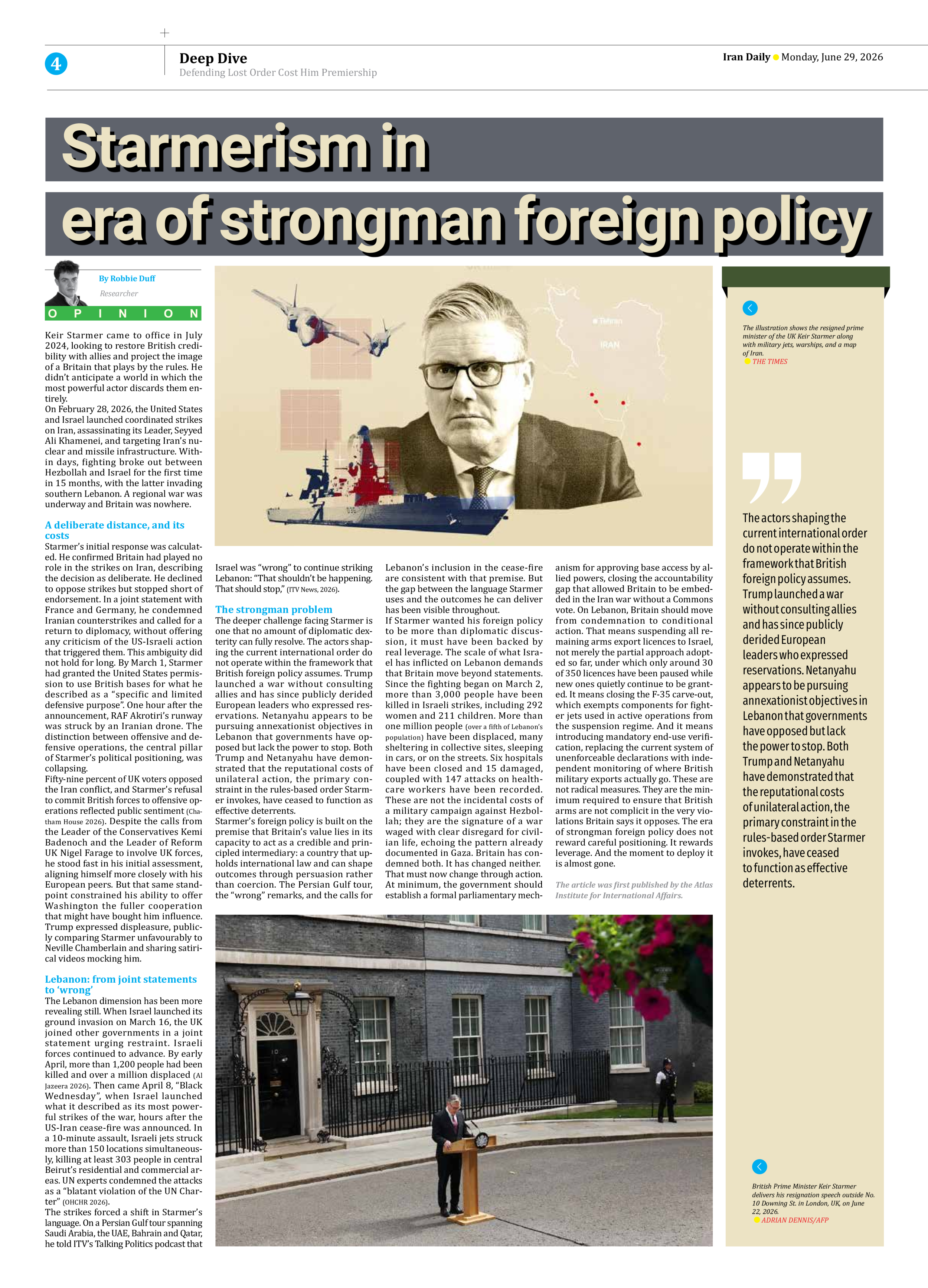


Starmerism in era of strongman foreign policy
By Robbie Duff
Researcher
Keir Starmer came to office in July 2024, looking to restore British credibility with allies and project the image of a Britain that plays by the rules. He didn’t anticipate a world in which the most powerful actor discards them entirely.
On February 28, 2026, the United States and Israel launched coordinated strikes on Iran, assassinating its Leader, Seyyed Ali Khamenei, and targeting Iran’s nuclear and missile infrastructure. Within days, fighting broke out between Hezbollah and Israel for the first time in 15 months, with the latter invading southern Lebanon. A regional war was underway and Britain was nowhere.
A deliberate distance, and its costs
Starmer’s initial response was calculated. He confirmed Britain had played no role in the strikes on Iran, describing the decision as deliberate. He declined to oppose strikes but stopped short of endorsement. In a joint statement with France and Germany, he condemned Iranian counterstrikes and called for a return to diplomacy, without offering any criticism of the US-Israeli action that triggered them. This ambiguity did not hold for long. By March 1, Starmer had granted the United States permission to use British bases for what he described as a “specific and limited defensive purpose”. One hour after the announcement, RAF Akrotiri’s runway was struck by an Iranian drone. The distinction between offensive and defensive operations, the central pillar of Starmer’s political positioning, was collapsing.
Fifty-nine percent of UK voters opposed the Iran conflict, and Starmer’s refusal to commit British forces to offensive operations reflected public sentiment (Chatham House 2026). Despite the calls from the Leader of the Conservatives Kemi Badenoch and the Leader of Reform UK Nigel Farage to involve UK forces, he stood fast in his initial assessment, aligning himself more closely with his European peers. But that same standpoint constrained his ability to offer Washington the fuller cooperation that might have bought him influence. Trump expressed displeasure, publicly comparing Starmer unfavourably to Neville Chamberlain and sharing satirical videos mocking him.
Lebanon: from joint statements to ‘wrong’
The Lebanon dimension has been more revealing still. When Israel launched its ground invasion on March 16, the UK joined other governments in a joint statement urging restraint. Israeli forces continued to advance. By early April, more than 1,200 people had been killed and over a million displaced (Al Jazeera 2026). Then came April 8, “Black Wednesday”, when Israel launched what it described as its most powerful strikes of the war, hours after the US-Iran cease-fire was announced. In a 10-minute assault, Israeli jets struck more than 150 locations simultaneously, killing at least 303 people in central Beirut’s residential and commercial areas. UN experts condemned the attacks as a “blatant violation of the UN Charter” (OHCHR 2026).
The strikes forced a shift in Starmer’s language. On a Persian Gulf tour spanning Saudi Arabia, the UAE, Bahrain and Qatar, he told ITV’s Talking Politics podcast that Israel was “wrong” to continue striking Lebanon: “That shouldn’t be happening. That should stop,” (ITV News, 2026).
The strongman problem
The deeper challenge facing Starmer is one that no amount of diplomatic dexterity can fully resolve. The actors shaping the current international order do not operate within the framework that British foreign policy assumes. Trump launched a war without consulting allies and has since publicly derided European leaders who expressed reservations. Netanyahu appears to be pursuing annexationist objectives in Lebanon that governments have opposed but lack the power to stop. Both Trump and Netanyahu have demonstrated that the reputational costs of unilateral action, the primary constraint in the rules-based order Starmer invokes, have ceased to function as effective deterrents.
Starmer’s foreign policy is built on the premise that Britain’s value lies in its capacity to act as a credible and principled intermediary: a country that upholds international law and can shape outcomes through persuasion rather than coercion. The Persian Gulf tour, the “wrong” remarks, and the calls for Lebanon’s inclusion in the cease-fire are consistent with that premise. But the gap between the language Starmer uses and the outcomes he can deliver has been visible throughout.
If Starmer wanted his foreign policy to be more than diplomatic discussion, it must have been backed by real leverage. The scale of what Israel has inflicted on Lebanon demands that Britain move beyond statements. Since the fighting began on March 2, more than 3,000 people have been killed in Israeli strikes, including 292 women and 211 children. More than one million people (over a fifth of Lebanon’s population) have been displaced, many sheltering in collective sites, sleeping in cars, or on the streets. Six hospitals have been closed and 15 damaged, coupled with 147 attacks on healthcare workers have been recorded. These are not the incidental costs of a military campaign against Hezbollah; they are the signature of a war waged with clear disregard for civilian life, echoing the pattern already documented in Gaza. Britain has condemned both. It has changed neither.
That must now change through action. At minimum, the government should establish a formal parliamentary mechanism for approving base access by allied powers, closing the accountability gap that allowed Britain to be embedded in the Iran war without a Commons vote. On Lebanon, Britain should move from condemnation to conditional action. That means suspending all remaining arms export licences to Israel, not merely the partial approach adopted so far, under which only around 30 of 350 licences have been paused while new ones quietly continue to be granted. It means closing the F-35 carve-out, which exempts components for fighter jets used in active operations from the suspension regime. And it means introducing mandatory end-use verification, replacing the current system of unenforceable declarations with independent monitoring of where British military exports actually go. These are not radical measures. They are the minimum required to ensure that British arms are not complicit in the very violations Britain says it opposes. The era of strongman foreign policy does not reward careful positioning. It rewards leverage. And the moment to deploy it is almost gone.
The article was first published by the Atlas Institute for International Affairs.