







In era of water scarcity
Industrial camel farming key to red-meat self-sufficiency
Red meat remains one of the essential and highly consumed sources of protein in Iranian households, which largely comes from lamb, beef, and veal. Still, consecutive years of droughts, shrinking water and forage resources, and economic hardships have taken a toll on domestic production — so much so that nearly 10 percent of the country’s demand is met through imports. Yet, despite these headwinds, 90 percent is still covered by domestic supply.
The incumbent Iranian government has set its sights on achieving self-sufficiency in red meat production, drawing up a comprehensive plan to cut down on costly imports and wean the market off dependency on foreign supply in the coming years.
To pull off this goal, the country must tap into every available capacity — from boosting the production of both light and heavy livestock to expanding the red meat industry at large. With precise planning and well-targeted support, Iran could make headway in reducing reliance on imports and shoring up domestic production. In this context, developing camel farming could step in as a crucial player.
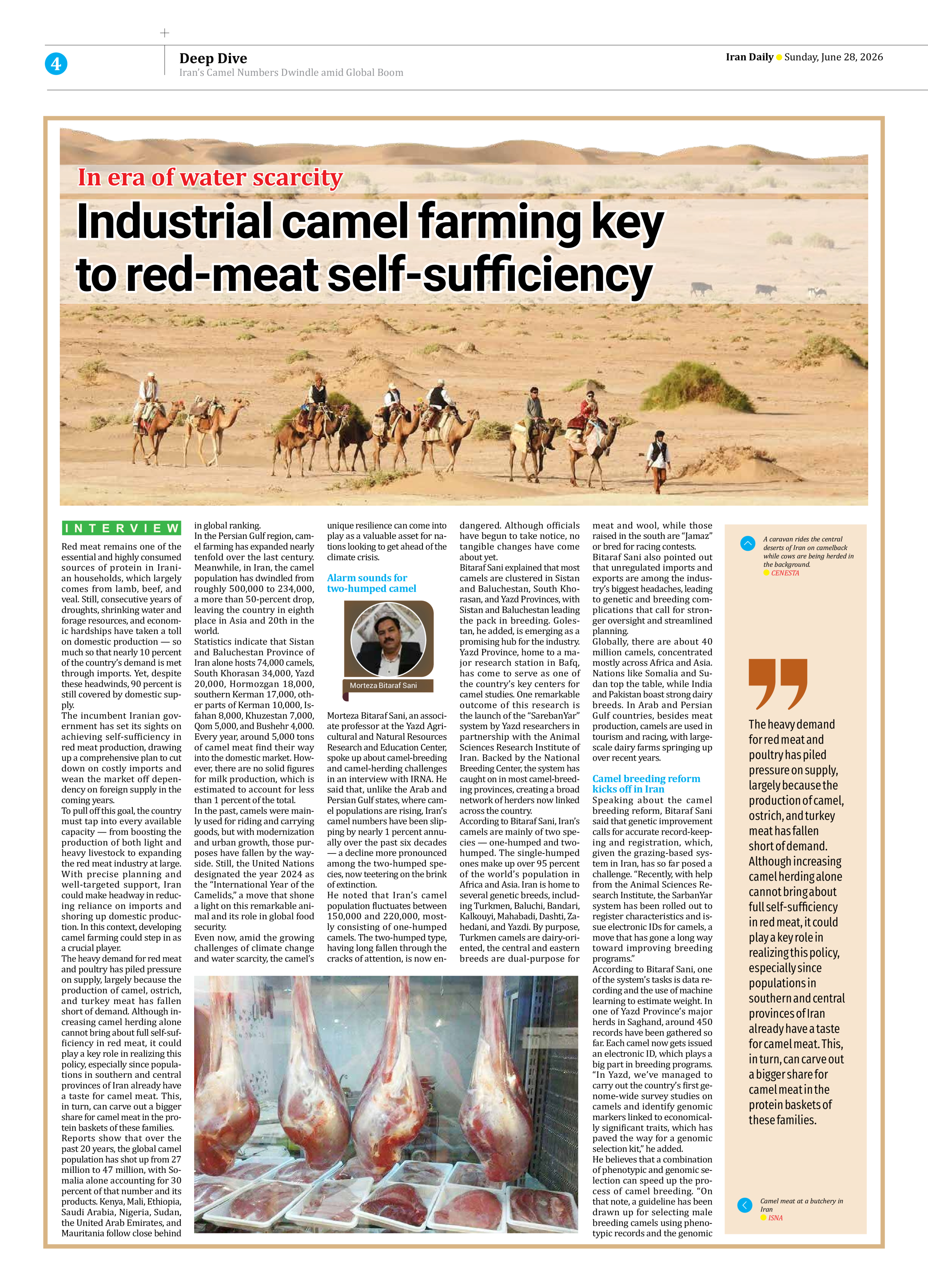
The heavy demand for red meat and poultry has piled pressure on supply, largely because the production of camel, ostrich, and turkey meat has fallen short of demand. Although increasing camel herding alone cannot bring about full self-sufficiency in red meat, it could play a key role in realizing this policy, especially since populations in southern and central provinces of Iran already have a taste for camel meat. This, in turn, can carve out a bigger share for camel meat in the protein baskets of these families.
Reports show that over the past 20 years, the global camel population has shot up from 27 million to 47 million, with Somalia alone accounting for 30 percent of that number and its products. Kenya, Mali, Ethiopia, Saudi Arabia, Nigeria, Sudan, the United Arab Emirates, and Mauritania follow close behind in global ranking.
In the Persian Gulf region, camel farming has expanded nearly tenfold over the last century. Meanwhile, in Iran, the camel population has dwindled from roughly 500,000 to 234,000, a more than 50-percent drop, leaving the country in eighth place in Asia and 20th in the world.
Statistics indicate that Sistan and Baluchestan Province of Iran alone hosts 74,000 camels, South Khorasan 34,000, Yazd 20,000, Hormozgan 18,000, southern Kerman 17,000, other parts of Kerman 10,000, Isfahan 8,000, Khuzestan 7,000, Qom 5,000, and Bushehr 4,000. Every year, around 5,000 tons of camel meat find their way into the domestic market. However, there are no solid figures for milk production, which is estimated to account for less than 1 percent of the total.
In the past, camels were mainly used for riding and carrying goods, but with modernization and urban growth, those purposes have fallen by the wayside. Still, the United Nations designated the year 2024 as the “International Year of the Camelids,” a move that shone a light on this remarkable animal and its role in global food security.
Even now, amid the growing challenges of climate change and water scarcity, the camel’s unique resilience can come into play as a valuable asset for nations looking to get ahead of the climate crisis.
Alarm sounds for
two-humped camel
Morteza Bitaraf Sani, an associate professor at the Yazd Agricultural and Natural Resources Research and Education Center, spoke up about camel-breeding and camel-herding challenges in an interview with IRNA. He said that, unlike the Arab and Persian Gulf states, where camel populations are rising, Iran’s camel numbers have been slipping by nearly 1 percent annually over the past six decades — a decline more pronounced among the two-humped species, now teetering on the brink of extinction.
He noted that Iran’s camel population fluctuates between 150,000 and 220,000, mostly consisting of one-humped camels. The two-humped type, having long fallen through the cracks of attention, is now endangered. Although officials have begun to take notice, no tangible changes have come about yet.
Bitaraf Sani explained that most camels are clustered in Sistan and Baluchestan, South Khorasan, and Yazd Provinces, with Sistan and Baluchestan leading the pack in breeding. Golestan, he added, is emerging as a promising hub for the industry.
Yazd Province, home to a major research station in Bafq, has come to serve as one of the country’s key centers for camel studies. One remarkable outcome of this research is the launch of the “SarebanYar” system by Yazd researchers in partnership with the Animal Sciences Research Institute of Iran. Backed by the National Breeding Center, the system has caught on in most camel-breeding provinces, creating a broad network of herders now linked across the country.
According to Bitaraf Sani, Iran’s camels are mainly of two species — one-humped and two-humped. The single-humped ones make up over 95 percent of the world’s population in Africa and Asia. Iran is home to several genetic breeds, including Turkmen, Baluchi, Bandari, Kalkouyi, Mahabadi, Dashti, Zahedani, and Yazdi. By purpose, Turkmen camels are dairy-oriented, the central and eastern breeds are dual-purpose for meat and wool, while those raised in the south are “Jamaz” or bred for racing contests.
Bitaraf Sani also pointed out that unregulated imports and exports are among the industry’s biggest headaches, leading to genetic and breeding complications that call for stronger oversight and streamlined planning.
Globally, there are about 40 million camels, concentrated mostly across Africa and Asia. Nations like Somalia and Sudan top the table, while India and Pakistan boast strong dairy breeds. In Arab and Persian Gulf countries, besides meat production, camels are used in tourism and racing, with large-scale dairy farms springing up over recent years.
Camel breeding reform kicks off in Iran
Speaking about the camel breeding reform, Bitaraf Sani said that genetic improvement calls for accurate record-keeping and registration, which, given the grazing-based system in Iran, has so far posed a challenge. “Recently, with help from the Animal Sciences Research Institute, the SarbanYar system has been rolled out to register characteristics and issue electronic IDs for camels, a move that has gone a long way toward improving breeding programs.”
According to Bitaraf Sani, one of the system’s tasks is data recording and the use of machine learning to estimate weight. In one of Yazd Province’s major herds in Saghand, around 450 records have been gathered so far. Each camel now gets issued an electronic ID, which plays a big part in breeding programs. “In Yazd, we’ve managed to carry out the country’s first genome-wide survey studies on camels and identify genomic markers linked to economically significant traits, which has paved the way for a genomic selection kit,” he added.
He believes that a combination of phenotypic and genomic selection can speed up the process of camel breeding. “On that note, a guideline has been drawn up for selecting male breeding camels using phenotypic records and the genomic kit — an achievement that was singled out for honor three years ago during Research Week at the Ministry of Agriculture,” he maintained.
He emphasized that to keep this momentum going, the government must, under Article 3 of the National Livestock System, step in to back up and make use of such initiatives supporting genetic conservation.
The associate professor at the Yazd Agricultural and Natural Resources Research and Education Center added that camel meat, valued for its similarity to red meat but with lower cholesterol, has earned a special place among consumers, particularly in desert regions. Given Iran’s arid climate and the camel’s outstanding ability to cope with drought and water scarcity, expanding camel meat production could act as a sustainable and cost-effective solution to meet the country’s protein needs and cut back on red meat imports.
He said the main strategy in camel farming now is to maintain current herds and broaden dairy camel breeding. Since camel meat still barely figures in most people’s diets, the focus has long fallen by the wayside, though dairy production is in far better shape.
Bitaraf Sani stated that Iran’s camels make up roughly 2 percent of the global livestock population, compared with 20 to 25 percent in neighboring Arab countries. Ultimately, given Iran’s desert potential for breeding and free-range pasture capacity, along with the reduced dependency on feed inputs, camel rearing through hand-feeding can play a leading role in expanding livestock production.
He continued that from a quantitative point of view, the camel development strategy must zero in on pasture management. “Conducting rangeland audits, identifying unclaimed pastures, and promoting ecologically sustainable camel breeding based on grazing capacity and supplementary feeding could serve as a solid foundation.” On top of that, he said, before industrial farms and dairy or protein production are developed, marketing, branding, packaging, and processing should be seriously pushed forward “through a non-governmental organization”.
He added that, with growing attention from authorities and untapped potential across the country, scaling up camel meat production could hold the key to self-sufficiency and long-term growth in the livestock sector.
The faculty member believes that, considering desert ecology and advances in breeding science, the development of camel farming could play a major part in ensuring national food security and animal protein supply. “However, this requires continuous government support, technical infrastructure, and attention to cultural and market challenges in Iran,” he concluded.
20 percent of Iran’s deserts ready for expansion
Previously, Nader Asadzadeh, deputy director for Research, Technology, and Findings Dissemination at the Animal Sciences Research Institute of Iran, told IRNA that more than 20 percent of Iran’s landmass is desert, unsuitable for any species other than camels — making them the natural choice. As global desertification gathers pace due to climate change, camel breeding has come under the spotlight worldwide. He noted that most research now comes out of the US and Europe, emphasizing camel applications and importance, while in Iran, the issue has been left on the back burner.
He attributed the decline of camel farming in Iran to growing urbanization and shifts in the animal’s traditional function, despite camels being multi-purpose livestock that lend themselves to the production of food, medicine, and hygiene products using their milk, meat, wool, and hide.
Asadzadeh noted that Iran’s one-humped native camels — Turkmen, Baluchi, Zahedi, Kalkouyi, and Mahabadi breeds — are suited to both meat and milk production, while the two-humped species are mainly found in the Caucasus and Azerbaijan.
He went on to say that the Animal Sciences Research Institute has been following up on programs to preserve and expand camel breeding in Iran in recent years. “Ecological camel development has been worked into provincial development plans for suitable regions such as Sistan and Baluchestan, Khorasan, and Yazd. These projects are being carried out under the execution wing of the Executive Headquarters of Imam’s Order and are receiving backing from national authorities.”
According to Asadzadeh, strengthening scientific and research infrastructure, supporting camel breeders, and pursuing genetic improvement through new technologies stand out as crucial strategies that can help stabilize the red meat market and bolster food security.
He pointed out, “Extensive work on camel nutrition, breeding management, and genetic enhancement has been underway in Yazd, and genomic studies have taken off, focusing on breeds with higher milk and meat yields. Current data on camel population and production is being recorded in several provinces, including Ardabil.”
Not long ago, the FAO sounded the alarm over camel extinction in Iran — a stark warning for camel-rich provinces. Of the nation’s camels, 99 percent of the one-humped breed belong to hot and arid zones, while the two-humped type thrives in colder climates. There are now only 300 to 400 two-humped camels left in Ardabil Province.
National registration of indigenous breeds by 2027
The National Program for the Protection and Registration of Genetic Livestock Resources, led by the Animal Sciences Research Institute of Iran, revolves around the registration and conservation of native breeds, the sustainable use of genetic reserves, and the improvement of breeding standards. The program kicks into gear for 10 at-risk livestock and poultry breeds, including camels.
Its main focus areas include preserving gene pools, enhancing economically valuable and reproductive traits, improving livestock longevity, developing new genetic combinations, calculating economic coefficients, defining selection goals and indexes, carrying out group breeding among small livestock, and conducting Omics-based analyses of key economic traits. AI-driven Omics analytics are set to unify current applications and map out future directions. Technical guidelines and gene bank catalogs will be rolled out, and national IDs for native breeds are expected to be drawn up by 2027.
Given the importance of protecting Iran’s camel population, two years ago, Agriculture Minister Gholamreza Nouri Qezeljeh put forward a proposal at the first International Camel Congress to register Iranian camel farming in the FAO’s Global Agricultural Heritage Systems (GIAHS).
The interview first appeared in Persian on IRNA.