







Consequences of great powers competing to militarize AI
By Javad Mohammadi
Expert on artificial intelligence
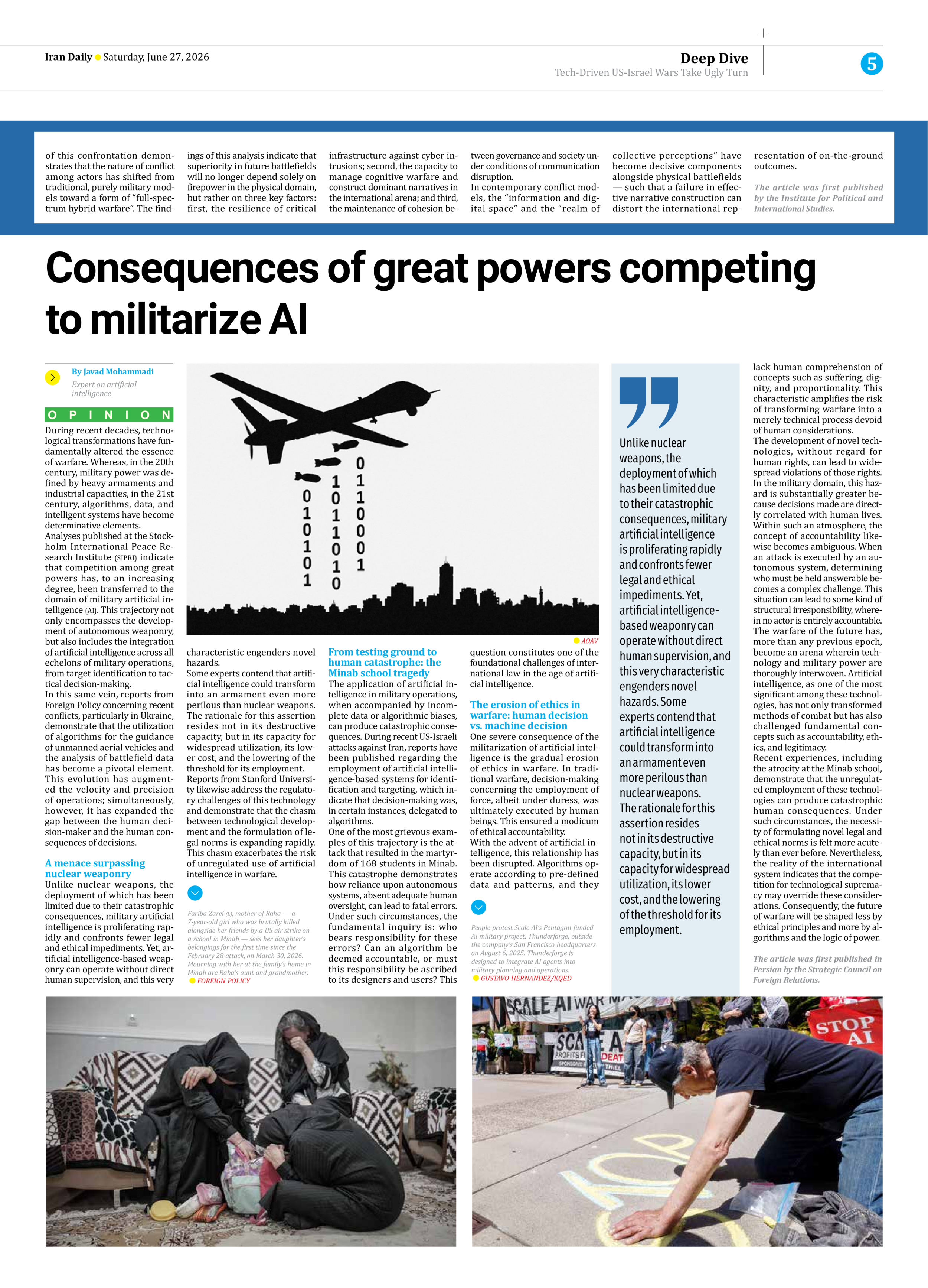
During recent decades, technological transformations have fundamentally altered the essence of warfare. Whereas, in the 20th century, military power was defined by heavy armaments and industrial capacities, in the 21st century, algorithms, data, and intelligent systems have become determinative elements.
Analyses published at the Stockholm International Peace Research Institute (SIPRI) indicate that competition among great powers has, to an increasing degree, been transferred to the domain of military artificial intelligence (AI). This trajectory not only encompasses the development of autonomous weaponry, but also includes the integration of artificial intelligence across all echelons of military operations, from target identification to tactical decision-making.
In this same vein, reports from Foreign Policy concerning recent conflicts, particularly in Ukraine, demonstrate that the utilization of algorithms for the guidance of unmanned aerial vehicles and the analysis of battlefield data has become a pivotal element. This evolution has augmented the velocity and precision of operations; simultaneously, however, it has expanded the gap between the human decision-maker and the human consequences of decisions.
A menace surpassing nuclear weaponry
Unlike nuclear weapons, the deployment of which has been limited due to their catastrophic consequences, military artificial intelligence is proliferating rapidly and confronts fewer legal and ethical impediments. Yet, artificial intelligence-based weaponry can operate without direct human supervision, and this very characteristic engenders novel hazards.
Some experts contend that artificial intelligence could transform into an armament even more perilous than nuclear weapons. The rationale for this assertion resides not in its destructive capacity, but in its capacity for widespread utilization, its lower cost, and the lowering of the threshold for its employment.
Reports from Stanford University likewise address the regulatory challenges of this technology and demonstrate that the chasm between technological development and the formulation of legal norms is expanding rapidly. This chasm exacerbates the risk of unregulated use of artificial intelligence in warfare.
From testing ground to human catastrophe: the Minab school tragedy
The application of artificial intelligence in military operations, when accompanied by incomplete data or algorithmic biases, can produce catastrophic consequences. During recent US-Israeli attacks against Iran, reports have been published regarding the employment of artificial intelligence-based systems for identification and targeting, which indicate that decision-making was, in certain instances, delegated to algorithms.
One of the most grievous examples of this trajectory is the attack that resulted in the martyrdom of 168 students in Minab. This catastrophe demonstrates how reliance upon autonomous systems, absent adequate human oversight, can lead to fatal errors.
Under such circumstances, the fundamental inquiry is: who bears responsibility for these errors? Can an algorithm be deemed accountable, or must this responsibility be ascribed to its designers and users? This question constitutes one of the foundational challenges of international law in the age of artificial intelligence.
The erosion of ethics in warfare: human decision vs. machine decision
One severe consequence of the militarization of artificial intelligence is the gradual erosion of ethics in warfare. In traditional warfare, decision-making concerning the employment of force, albeit under duress, was ultimately executed by human beings. This ensured a modicum of ethical accountability.
With the advent of artificial intelligence, this relationship has been disrupted. Algorithms operate according to pre-defined data and patterns, and they lack human comprehension of concepts such as suffering, dignity, and proportionality. This characteristic amplifies the risk of transforming warfare into a merely technical process devoid of human considerations.
The development of novel technologies, without regard for human rights, can lead to widespread violations of those rights. In the military domain, this hazard is substantially greater because decisions made are directly correlated with human lives. Within such an atmosphere, the concept of accountability likewise becomes ambiguous. When an attack is executed by an autonomous system, determining who must be held answerable becomes a complex challenge. This situation can lead to some kind of structural irresponsibility, wherein no actor is entirely accountable.
The warfare of the future has, more than any previous epoch, become an arena wherein technology and military power are thoroughly interwoven. Artificial intelligence, as one of the most significant among these technologies, has not only transformed methods of combat but has also challenged fundamental concepts such as accountability, ethics, and legitimacy.
Recent experiences, including the atrocity at the Minab school, demonstrate that the unregulated employment of these technologies can produce catastrophic human consequences. Under such circumstances, the necessity of formulating novel legal and ethical norms is felt more acutely than ever before. Nevertheless, the reality of the international system indicates that the competition for technological supremacy may override these considerations. Consequently, the future of warfare will be shaped less by ethical principles and more by algorithms and the logic of power.
The article was first published in Persian by the Strategic Council on Foreign Relations.