





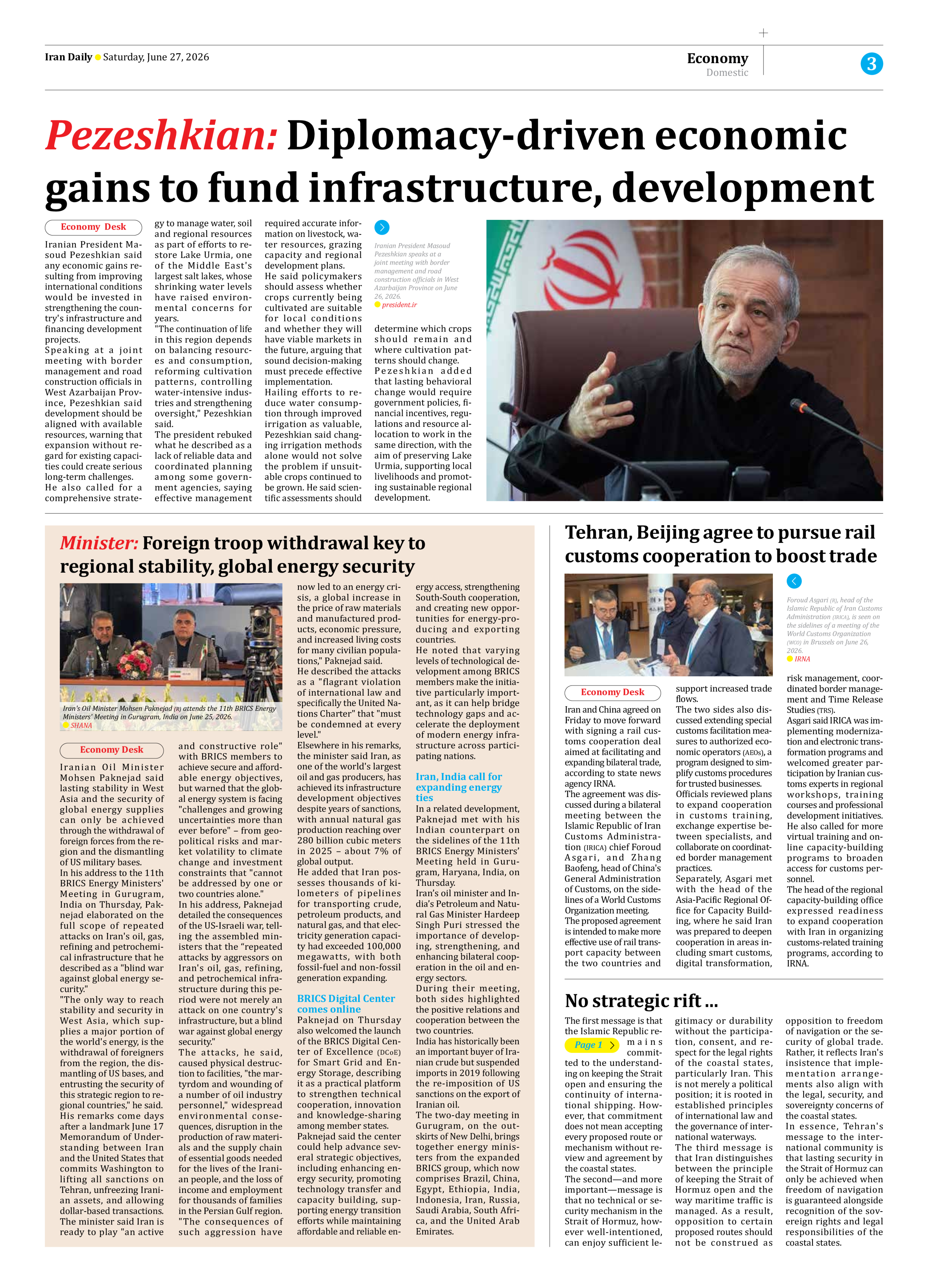


Minister: Foreign troop withdrawal key to regional stability, global energy security
Iranian Oil Minister Mohsen Paknejad said lasting stability in West Asia and the security of global energy supplies can only be achieved through the withdrawal of foreign forces from the region and the dismantling of US military bases.
In his address to the 11th BRICS Energy Ministers' Meeting in Gurugram, India on Thursday, Paknejad elaborated on the full scope of repeated attacks on Iran's oil, gas, refining and petrochemical infrastructure that he described as a "blind war against global energy security."
"The only way to reach stability and security in West Asia, which supplies a major portion of the world's energy, is the withdrawal of foreigners from the region, the dismantling of US bases, and entrusting the security of this strategic region to regional countries," he said.
His remarks come days after a landmark June 17 Memorandum of Understanding between Iran and the United States that commits Washington to lifting all sanctions on Tehran, unfreezing Iranian assets, and allowing dollar-based transactions.
The minister said Iran is ready to play "an active and constructive role" with BRICS members to achieve secure and affordable energy objectives, but warned that the global energy system is facing "challenges and growing uncertainties more than ever before" – from geopolitical risks and market volatility to climate change and investment constraints that "cannot be addressed by one or two countries alone."
In his address, Paknejad detailed the consequences of the US-Israeli war, telling the assembled ministers that the “repeated attacks by aggressors on Iran's oil, gas, refining, and petrochemical infrastructure during this period were not merely an attack on one country's infrastructure, but a blind war against global energy security."
The attacks, he said, caused physical destruction to facilities, "the martyrdom and wounding of a number of oil industry personnel," widespread environmental consequences, disruption in the production of raw materials and the supply chain of essential goods needed for the lives of the Iranian people, and the loss of income and employment for thousands of families in the Persian Gulf region.
"The consequences of such aggression have now led to an energy crisis, a global increase in the price of raw materials and manufactured products, economic pressure, and increased living costs for many civilian populations," Paknejad said.
He described the attacks as a "flagrant violation of international law and specifically the United Nations Charter" that "must be condemned at every level."
Elsewhere in his remarks, the minister said Iran, as one of the world's largest oil and gas producers, has achieved its infrastructure development objectives despite years of sanctions, with annual natural gas production reaching over 280 billion cubic meters in 2025 – about 7% of global output.
He added that Iran possesses thousands of kilometers of pipelines for transporting crude, petroleum products, and natural gas, and that electricity generation capacity had exceeded 100,000 megawatts, with both fossil-fuel and non-fossil generation expanding.
BRICS Digital Center comes online
Paknejad on Thursday also welcomed the launch of the BRICS Digital Center of Excellence (DCoE) for Smart Grid and Energy Storage, describing it as a practical platform to strengthen technical cooperation, innovation and knowledge-sharing among member states.
Paknejad said the center could help advance several strategic objectives, including enhancing energy security, promoting technology transfer and capacity building, supporting energy transition efforts while maintaining affordable and reliable energy access, strengthening South-South cooperation, and creating new opportunities for energy-producing and exporting countries.
He noted that varying levels of technological development among BRICS members make the initiative particularly important, as it can help bridge technology gaps and accelerate the deployment of modern energy infrastructure across participating nations.
Iran, India call for expanding energy ties
In a related development, Paknejad met with his Indian counterpart on the sidelines of the 11th BRICS Energy Ministers’ Meeting held in Gurugram, Haryana, India, on Thursday.
Iran’s oil minister and India’s Petroleum and Natural Gas Minister Hardeep Singh Puri stressed the importance of developing, strengthening, and enhancing bilateral cooperation in the oil and energy sectors.
During their meeting, both sides highlighted the positive relations and cooperation between the two countries.
India has historically been an important buyer of Iranian crude but suspended imports in 2019 following the re-imposition of US sanctions on the export of Iranian oil.
The two-day meeting in Gurugram, on the outskirts of New Delhi, brings together energy ministers from the expanded BRICS group, which now comprises Brazil, China, Egypt, Ethiopia, India, Indonesia, Iran, Russia, Saudi Arabia, South Africa, and the United Arab Emirates.