







Copy in clipboard...
Iran reasserts its right to control shipping in Strait of Hormuz
Deputy FM warns vessels against using parallel routes
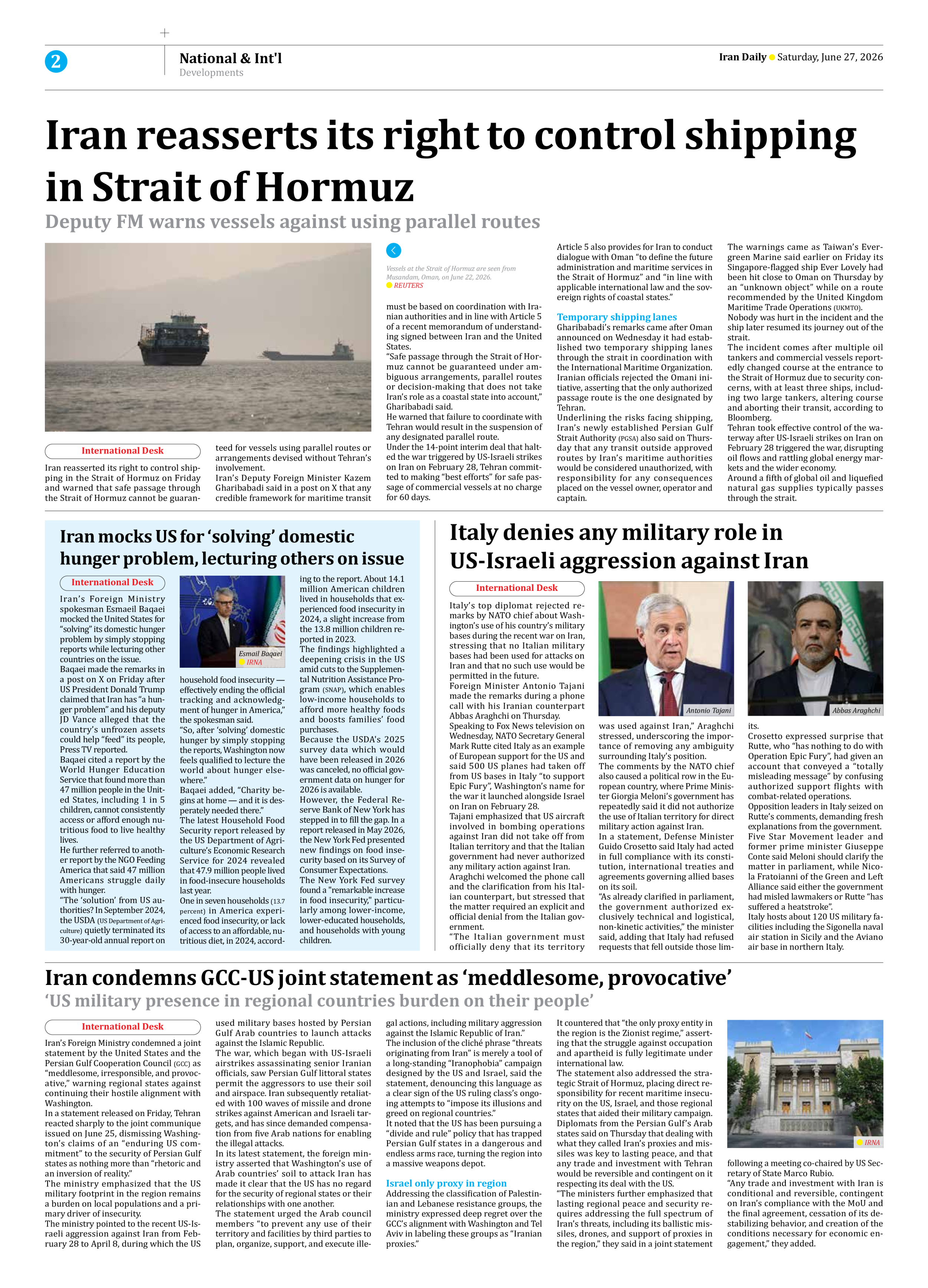
Iran reasserted its right to control shipping in the Strait of Hormuz on Friday and warned that safe passage through the Strait of Hormuz cannot be guaranteed for vessels using parallel routes or arrangements devised without Tehran’s involvement.
Iran’s Deputy Foreign Minister Kazem Gharibabadi said in a post on X that any credible framework for maritime transit must be based on coordination with Iranian authorities and in line with Article 5 of a recent memorandum of understanding signed between Iran and the United States.
“Safe passage through the Strait of Hormuz cannot be guaranteed under ambiguous arrangements, parallel routes or decision-making that does not take Iran’s role as a coastal state into account,” Gharibabadi said.
He warned that failure to coordinate with Tehran would result in the suspension of any designated parallel route.
Under the 14-point interim deal that halted the war triggered by US-Israeli strikes on Iran on February 28, Tehran committed to making “best efforts” for safe passage of commercial vessels at no charge for 60 days.
Article 5 also provides for Iran to conduct dialogue with Oman “to define the future administration and maritime services in the Strait of Hormuz” and “in line with applicable international law and the sovereign rights of coastal states.”
Temporary shipping lanes
Gharibabadi’s remarks came after Oman announced on Wednesday it had established two temporary shipping lanes through the strait in coordination with the International Maritime Organization.
Iranian officials rejected the Omani initiative, asserting that the only authorized passage route is the one designated by Tehran.
Underlining the risks facing shipping, Iran’s newly established Persian Gulf Strait Authority (PGSA) also said on Thursday that any transit outside approved routes by Iran’s maritime authorities would be considered unauthorized, with responsibility for any consequences placed on the vessel owner, operator and captain.
The warnings came as Taiwan’s Evergreen Marine said earlier on Friday its Singapore-flagged ship Ever Lovely had been hit close to Oman on Thursday by an “unknown object” while on a route recommended by the United Kingdom Maritime Trade Operations (UKMTO).
Nobody was hurt in the incident and the ship later resumed its journey out of the strait.
The incident comes after multiple oil tankers and commercial vessels reportedly changed course at the entrance to the Strait of Hormuz due to security concerns, with at least three ships, including two large tankers, altering course and aborting their transit, according to Bloomberg.
Tehran took effective control of the waterway after US-Israeli strikes on Iran on February 28 triggered the war, disrupting oil flows and rattling global energy markets and the wider economy.
Around a fifth of global oil and liquefied natural gas supplies typically passes through the strait.