







From oud to ‘taroud’
An Iranian instrument maker on innovation, tradition and survival
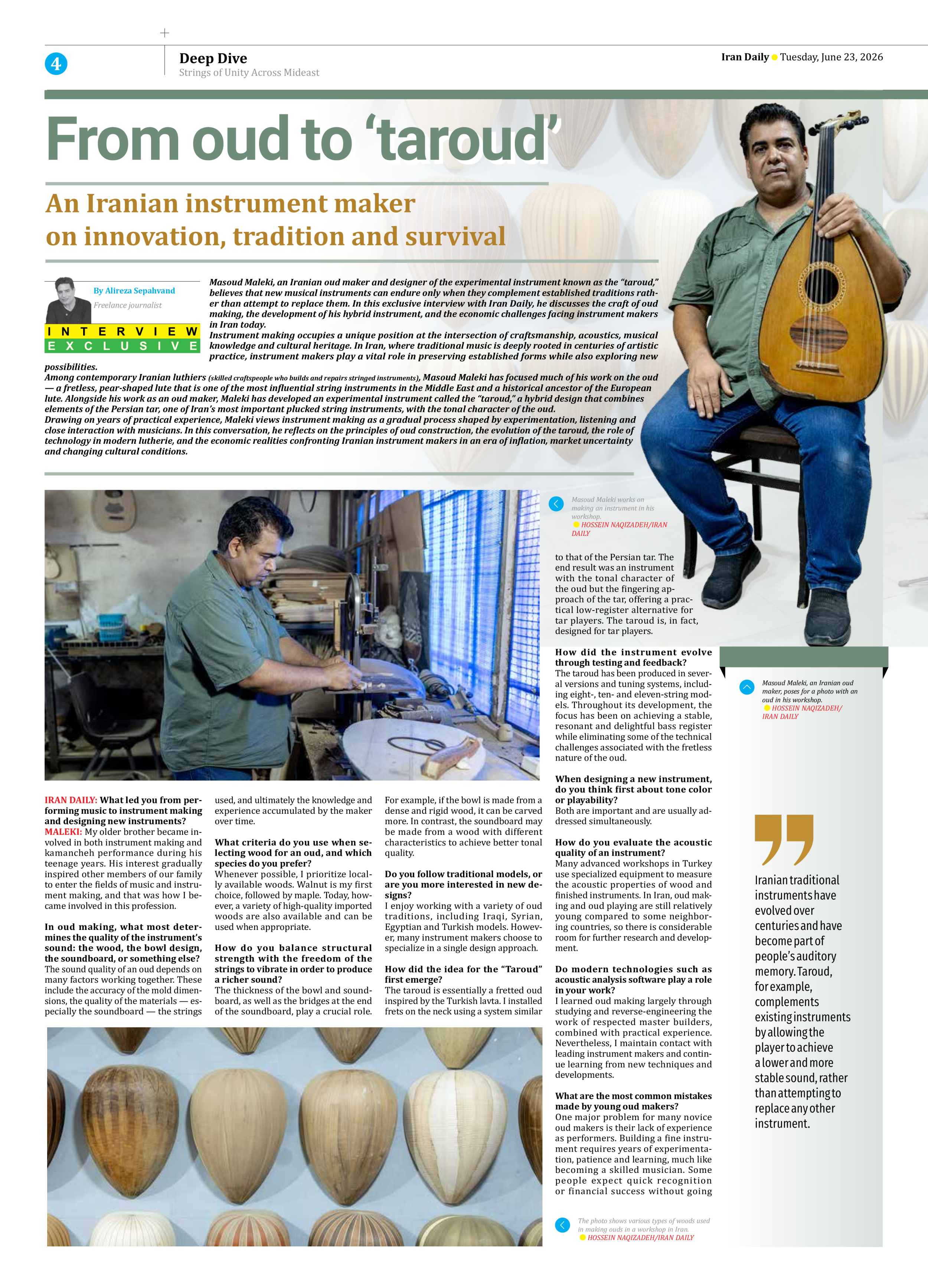
Masoud Maleki, an Iranian oud maker and designer of the experimental instrument known as the “taroud,” believes that new musical instruments can endure only when they complement established traditions rather than attempt to replace them. In this exclusive interview with Iran Daily, he discusses the craft of oud making, the development of his hybrid instrument, and the economic challenges facing instrument makers in Iran today. Instrument making occupies a unique position at the intersection of craftsmanship, acoustics, musical knowledge and cultural heritage. In Iran, where traditional music is deeply rooted in centuries of artistic practice, instrument makers play a vital role in preserving established forms while also exploring new possibilities. Among contemporary Iranian luthiers (skilled craftspeople who builds and repairs stringed instruments), Masoud Maleki has focused much of his work on the oud — a fretless, pear-shaped lute that is one of the most influential string instruments in the Middle East and a historical ancestor of the European lute. Alongside his work as an oud maker, Maleki has developed an experimental instrument called the “taroud,” a hybrid design that combines elements of the Persian tar, one of Iran’s most important plucked string instruments, with the tonal character of the oud. Drawing on years of practical experience, Maleki views instrument making as a gradual process shaped by experimentation, listening and close interaction with musicians. In this conversation, he reflects on the principles of oud construction, the evolution of the taroud, the role of technology in modern lutherie, and the economic realities confronting Iranian instrument makers in an era of inflation, market uncertainty and changing cultural conditions.
By Alireza Sepahvand
Freelance journalist
IRAN DAILY: What led you from performing music to instrument making and designing new instruments?
MALEKI: My older brother became involved in both instrument making and kamancheh performance during his teenage years. His interest gradually inspired other members of our family to enter the fields of music and instrument making, and that was how I became involved in this profession.
In oud making, what most determines the quality of the instrument’s sound: the wood, the bowl design, the soundboard, or something else?
The sound quality of an oud depends on many factors working together. These include the accuracy of the mold dimensions, the quality of the materials — especially the soundboard — the strings used, and ultimately the knowledge and experience accumulated by the maker over time.
What criteria do you use when selecting wood for an oud, and which species do you prefer?
Whenever possible, I prioritize locally available woods. Walnut is my first choice, followed by maple. Today, however, a variety of high-quality imported woods are also available and can be used when appropriate.
How do you balance structural strength with the freedom of the strings to vibrate in order to produce a richer sound?
The thickness of the bowl and soundboard, as well as the bridges at the end of the soundboard, play a crucial role. For example, if the bowl is made from a dense and rigid wood, it can be carved more. In contrast, the soundboard may be made from a wood with different characteristics to achieve better tonal quality.
Do you follow traditional models, or are you more interested in new designs?
I enjoy working with a variety of oud traditions, including Iraqi, Syrian, Egyptian and Turkish models. However, many instrument makers choose to specialize in a single design approach.
How did the idea for the “Taroud” first emerge?
The taroud is essentially a fretted oud inspired by the Turkish lavta. I installed frets on the neck using a system similar to that of the Persian tar. The end result was an instrument with the tonal character of the oud but the fingering approach of the tar, offering a practical low-register alternative for tar players. The taroud is, in fact, designed for tar players.
How did the instrument evolve through testing and feedback?
The taroud has been produced in several versions and tuning systems, including eight-, ten- and eleven-string models. Throughout its development, the focus has been on achieving a stable, resonant and delightful bass register while eliminating some of the technical challenges associated with the fretless nature of the oud.
When designing a new instrument, do you think first about tone color or playability?
Both are important and are usually addressed simultaneously.
How do you evaluate the acoustic quality of an instrument?
Many advanced workshops in Turkey use specialized equipment to measure the acoustic properties of wood and finished instruments. In Iran, oud making and oud playing are still relatively young compared to some neighboring countries, so there is considerable room for further research and development.
Do modern technologies such as acoustic analysis software play a role in your work?
I learned oud making largely through studying and reverse-engineering the work of respected master builders, combined with practical experience. Nevertheless, I maintain contact with leading instrument makers and continue learning from new techniques and developments.
What are the most common mistakes made by young oud makers?
One major problem for many novice oud makers is their lack of experience as performers. Building a fine instrument requires years of experimentation, patience and learning, much like becoming a skilled musician. Some people expect quick recognition or financial success without going through that process.
Why do some newly invented instruments survive while others disappear?
Iranian traditional instruments have evolved over centuries and have become part of people’s auditory memory. Taroud, for example, complements existing instruments by allowing the player to achieve a lower and more stable sound, rather than attempting to replace any other instrument.
How did you combine the characteristics of the tar and the oud in the taroud?
One challenge of the oud is its large body and fretless fingerboard, which can make playing more demanding. In the taroud, the body is smaller and the neck is longer. The addition of frets simplifies performance, while the instrument also avoids issues associated with the animal-skin soundboard used in the traditional Persian tar.
Do you have plans to document your knowledge through books, blueprints or educational programs?
More or less, I continue to study wood structures, tonal characteristics and more precise tools and techniques. However, instrument making is a vast field, and there is always more to learn.
If you could design an entirely new instrument today, what gap in Iranian instruments would you try to address?
Just as the synthetic-frame daf was able to resolve some of the issues of the leather-headed daf, in my opinion, the use of skin (membrane) on important Iranian instruments such as the tar and kamancheh still poses certain challenges, and it would be good to think of a solution for it.
What is the biggest financial challenge facing instrument makers in Iran today?
Market instability, rapid inflation and uncertainty surrounding the broader music environment make professional instrument making increasingly difficult.
Can instrument making alone provide a sustainable livelihood?
Some makers who are able to sell high-end or export-quality instruments can earn a comfortable living. However, many people working in the arts continue to face significant financial pressures.
How have rising material costs affected the industry?
The dramatic increase in the price of wood, tools and other materials has placed enormous pressure on instrument makers. Combined with a sluggish market, these rising costs have significantly affected production and sales.
How do you assess the current market for handmade Iranian instruments?
Most of my work is focused on the domestic market. However, the Persian Gulf region was once a very favorable destination for Iranian-made ouds. Recent regional developments have weakened that market, and its future remains uncertain.
What measures could improve the situation for Iranian instrument makers?
Professional exhibitions in Iran and abroad, insurance support, improved international communication and stronger infrastructure would all contribute to a healthier environment for instrument makers.
Have you ever had to sell an instrument for less than its true value despite months of work?
Yes. During periods of economic hardship and market stagnation, I have sometimes had no choice but to sell special instruments below their actual value. It is a difficult reality for any craftsman, but it is one of the challenges of working in today’s market.